



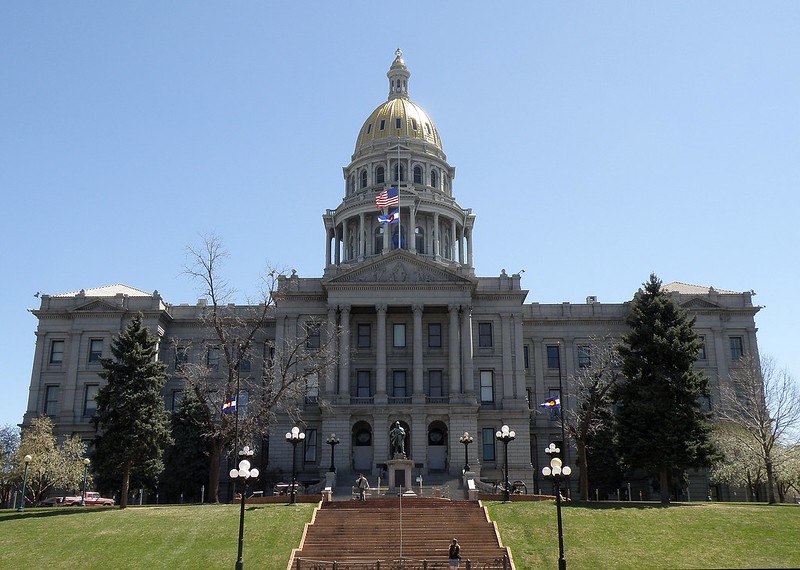
Looking ahead to the impact of an 8th Congressional district in Colorado.
It’s no secret that Colorado’s seen an influx of people over the past 10 years. Indeed, according to the most recent U.S. Census, Colorado gained 744,518 new residents between 2010 and 2020. That’s an increase of 14.8 percent.
And while that increase has brought about challenges — namely, an increase in crime and sky-high housing prices — it’s also paved the way for Colorado to gain more political clout. That’s right, because of Colorado’s booming population, Colorado gained a seat in the U.S. House of Representatives, and is getting an 8th Congressional district. Here’s why the new district could shake things up politically.
Colorado’s New 8th Congressional District
There are 435 seats in the House of Representatives, 100 Senators, and 538 electoral votes. And while every state is guaranteed two senators, a state’s population determines how many Representatives and electoral votes it’ll have. Consequently, when enough people move from one state to another, political power shifts. That’s exactly what’s happening in Colorado.
Before the 2020 Census, Colorado had seven Congressional districts and nine electoral votes, which equaled seven Representatives in the U.S. House. But, thanks to a significant increase in population, Colorado will gain an 8th Congressional district, which means one more seat in the House of Representatives.
The population increase also means Colorado gets one more electoral vote. That brings the total number of U.S. Representatives to eight, and electoral votes to 10, starting in 2022.
But that’s not all.
Each state has boundaries that make up Congressional districts, but those boundaries are further divided to mark boundaries for Colorado’s House of Representatives and State Senate. There are 65 state House districts and 35 state Senate districts in Colorado, and each one of these districts gets to elect one legislator to represent them at the Colorado General Assembly.
Colorado’s increasing population and subsequent new 8th district won’t add to the total number of Colorado state legislators. Instead, Colorado’s Independent Redistricting Commission will redraw the state’s district lines, which could impact how districts swing.
New Boundaries are Coming
Thanks to the passage of Amendment Y and Z, Colorado state legislators don’t draw boundary lines. Instead, an independent commission made up of four Democrats, four Republicans, and four Independents draw them. This is beneficial to Coloradoans because it helps prevent gerrymandering, which is where legislators draw lines to benefit themselves politically. Moreover, the commission is legally required to draw the lines so that the population is split evenly — the size of the area is not a factor.
Ideally, this means the commission won’t cherry-pick high population Democrat areas and pair them with low-population Republican areas to benefit Democrats, nor pair high-population Republican areas with low population Democrat areas to help Republicans. Instead, the commission members must agree on how they want to split the population into all the districts evenly.
More importantly, this is something the commission is currently doing and has released preliminary maps for the new boundaries as part of the process.
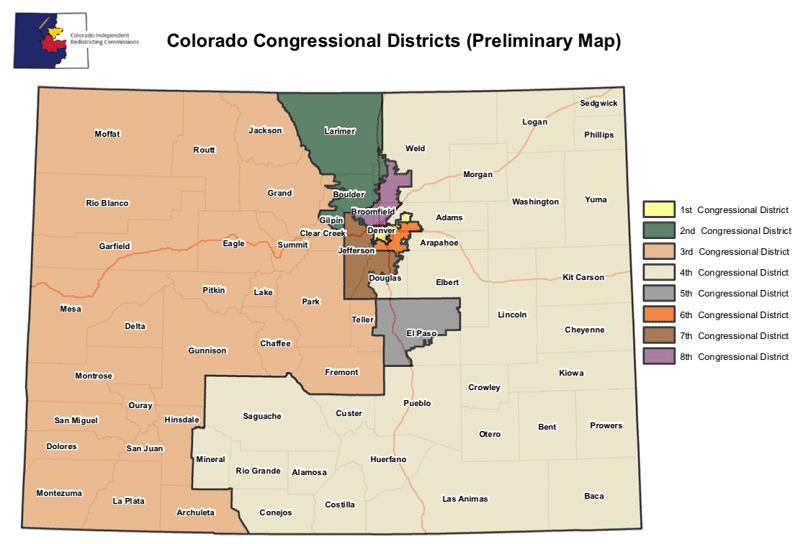

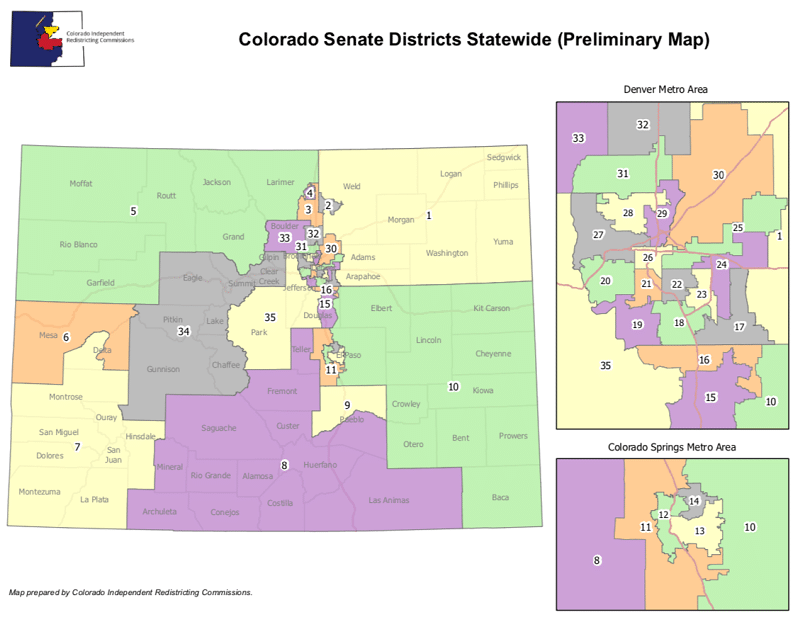
So far, neither Republicans nor Democrats are entirely pleased with the way the commission divided the boundaries. Colorado Democratic Party Chairwoman Morgan Carroll said she thought the map advantaged Republicans. In contrast, Adam Kincaid, executive director of the National Republican Redistricting Trust, said he felt the “left” was manipulating the boundaries. That’s a good sign that the division is fair.
An Equal Divide?
We won’t know what the final boundaries will look like until after Aug. 2021. And even then, the plans must be approved by the Colorado Supreme Court by the middle of December. One thing is certain; however, the new boundaries will have a political impact, one way or another.
Will the new boundaries favor Republicans? Will they favor Democrats? Or will it be an even split? Will Colorado’s new 8th district send a Republican or Democrat to Congress? These are all questions The Maverick Observer is following and will answer after the 2022 elections.
In the meantime, if you’d like to have your opinion heard when it comes to the new boundaries, the Redistricting Commission is holding meetings specifically for the public to come and give input on where they think the boundaries should be. If you’d like to attend a meeting, click on this link to go to the Commission’s calendar. There you’ll find dates, times, and locations for all the meetings between now and Aug. 28.







[…] due to recently redrawn state legislative boundaries, Williams is facing a primary election on June 28, 2022, to represent Colorado’s 5th […]