



As road-sharing bike accidents increase around the country, is Colorado Springs escaping the trend or following it?
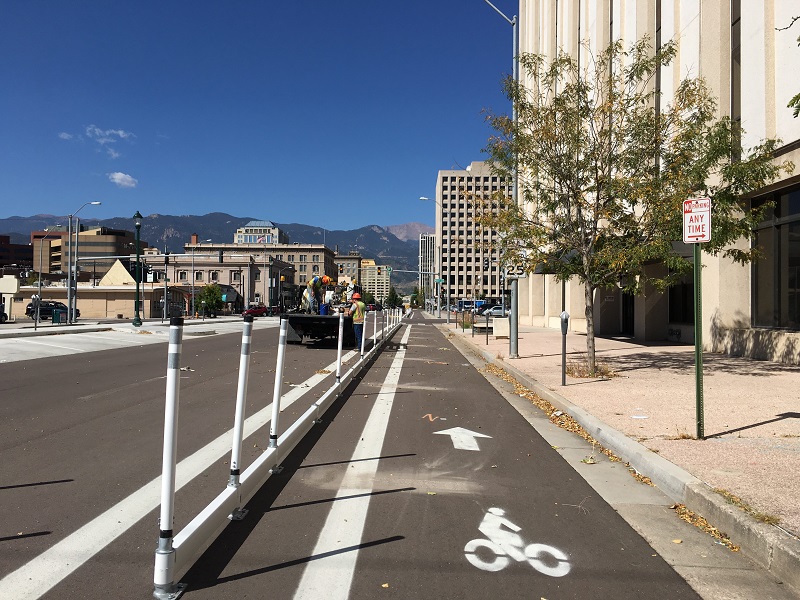
2019 Cyclists Injured or Killed
“I went underneath the pickup truck and was dragged until the driver realized there was somebody underneath,” recalls the Colorado Springs cyclist, who declines to be named due to an ongoing court case. He was just one of 98 cyclists injured or killed in a motor-vehicle vs. bicycle accident in Colorado Springs last year, at a time when the U.S. is seeing a national rise in casualties associated with increases in “road-sharing.”
Last November, the National Transportation Safety Board (NTSB) released its first safety report on bicycle use in 47 years, citing the need to address “the recent rise in fatal bicycle crashes involving motor vehicles.” While overall total traffic fatalities fell in the U.S. by 11% between 2007 and 2018, the NTSB reported that cyclist fatalities increased over that same period by 22%, nearly doubling as a percentage of traffic fatalities.
Put simply: unlike driving accidents, fatal bicycling accidents are on the rise.
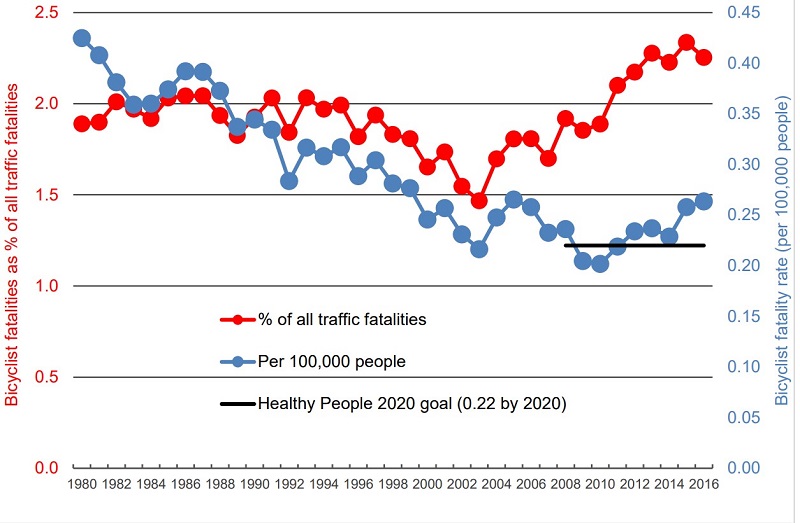
(Above: trends of bicyclist fatality rates and bicyclist fatalities as a percentage of all traffic fatalities from 1980 through 2016, using FARS and US Census Bureau data, courtesy of the NTSB)
Americans Bicycle the Fewest Miles Annually
The NTSB report compared data on bicycling in the US to 13 other modern nations, showing that of all of them, America bicycles the fewest miles annually—almost half as many as the next-lowest, the United Kingdom. But despite a relatively low number of cyclists, American bicycling casualties rank second on the same list, with 79 deaths per billion miles bicycled. That may not sound like many, but it’s nearly twice as many casualties as the next highest, the UK, which has only 45 fatalities per billion miles bicycles.

(Above: Yearly bicyclist fatalities per billion miles bicycles among 14 countries, from 2011 through 2015, courtesy of the NTSB)
“Let’s just say that even a mild bicycle-car accident is a life-changing experience,” says Denis Voitenko. He’s the co-founder of Velosurance, which he says is the largest and longest-surviving bike insurance company in the country. The company’s offices are based in Colorado Springs.
Bicycling on Urban Trails vs. Bike Lanes
A committed bicyclist himself, Denis stays off roads as much as possible, resorting to Colorado Springs’ urban trails. “If I have to ride on the road,” he says, “it’s maybe for a mile.”
Dave Williams, Denis’s co-founder, is also an avid cyclist. But he avoids road-sharing entirely, choosing mountain biking over using Colorado Springs’ growing number of bike lanes on roadways.
Colorado Springs’ appearance on the cycling scene is relatively recent. This sprawling mountain city could hardly be called “population dense,” but in 2016 the city began developing a bike plan that called for implementation of infrastructure changes to make the city “bike friendly.”
Increasing Bicycling Popularity and Bike Accidents
One goal is just to make biking more popular. Though the most recent data on the topic, a 2017 census, shows fewer than one percent of Colorado Springs commuters riding their bikes to work, Colorado Springs Bike Master Plan (2018) names as one of its goals that, “by 2030, 10 percent of trips downtown are made by bike.”
According to Colorado Springs’ Bike Master Plan (updated two years ago in the spring of 2018), the Colorado Springs “Vision Network” plan included 379 miles of bike paths, trails and lanes. The city last year hired its first full-time biking planner, Kate Brady, reinforcing its commitment to the trend. But as it tries to make cycling more popular, and bolster its biking infrastructure, is Colorado Springs doing everything it can to protect cyclists?
“I’m not against bicycle lanes,” says Rick Villa. He has followed the issue in Colorado Springs for years. But when Villa looks at bike lanes on arteries, like the one on Cascade Avenue, north of Colorado Springs’ downtown, he wonders: should this unprotected-bike lane be placed one block over, on a less crowded side street?
The short answer is that a popular urban trail meets the road on North Cascade, just a few blocks north of the bike lane. The need for a bike lane that connects to that trail is obvious.
But as it stands, the bike lane doesn’t connect directly to the trail, and last year three cyclist accidents—one of them fatal—occurred between the urban trail and the North Cascade bike lane.
One way to physically protect cyclists is a protected bike lane. In Berlin, protecting a bike lane means raising it up onto a curb, making it level with the sidewalk. New York City is placing car parking between bike lanes and traffic, as well as using raised curbs to divide traffic from bike lanes.
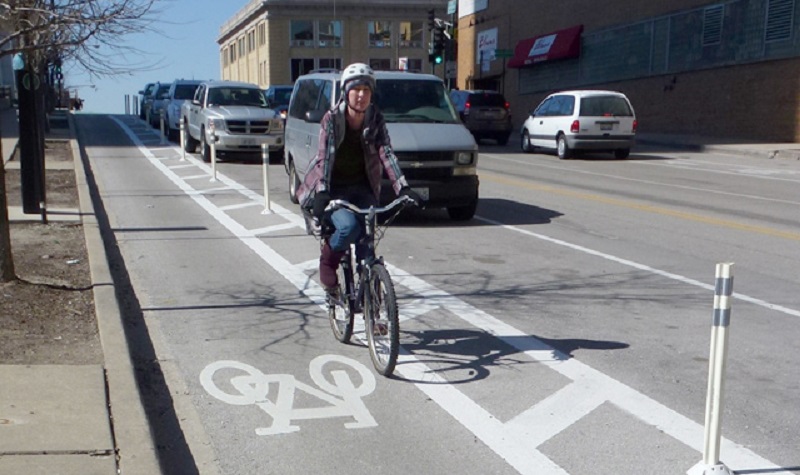
(above: an example one-way protected bike lane, separated from the street by parking, courtesy of NACTO)
Of course, raising a lane to the level of the sidewalk, using parking to protect bike lanes, or placing raised curbs between bike lanes and traffic are all expensive modifications – ones frequently resisted by drivers, who see lane narrowing as encroaching on important vehicular territory.
Average Citizens aren’t Clamoring for Bike Lanes
“Average citizens aren’t clamoring for bike lanes,” says Rebecca Marshall of SpringsTaxpayers.com, a nonprofit that aims to educate Colorado Springs and El Paso County taxpayers “on local issues that impact them financially.” Marshall earned her chops as a local government watchdog when she helped organize opposition to a massive 2016 lane modification near her home on Research Parkway. Marshall believes local taxpayers are most interested in seeing potholes filled and traffic congestion reduced. And narrowing traffic lanes to add or protect lanes for bike commuters, she points out, serves neither of those purposes.
Around the country, cities are looking at other safety solutions for cyclists that do not include physical barriers. One such solution is “road dieting.” This term can refer to narrowing streets, removing traffic lanes, adding obstacles like speed humps or roundabouts to slow (or “calm”) traffic, or any combination of those methods.
When road diets were implemented on a busy street in Los Angeles three years ago, traffic planners predicted that forcing commuters to drive slower would lessen the impact and number of accidents. But according to John Russo, co-founder of KeepLAMoving, an organization that tracks road modifications and traffic statistics, traffic accidents went “through the roof,” endangering cyclists and drivers more than before the diet.
Traffic-Calming
“Traffic-calming” can create real problems on occasions when drivers must hurry. During the 2018 Camp Fire that ravaged California, citizens of Paradise were unable to evacuate the burning city and escape the flames, some dying inside their cars as they tried to flee. Many factors contributed to disaster—but one still talked about is the fact that Skyway, a main evacuation route, had been reduced from four lanes to two— in order to “calm” traffic.
The city’s 2018 Bike Master Plan included a “vision network” of 379 miles of bike paths, trails and lanes. But it’s unclear where protected lanes fit in, if they do. Fast forward two years to 2020, and on Colorado Springs’ Interactive City Bicycling map, no protected bike lanes are marked. A quick trip downtown shows that part of Pikes Peak avenue is a protected bike lane, but without driving or riding around all the streets in Colorado Springs, it’s difficult to know where any others are.
The Maverick Observer reached out to the city’s full-time bike planner, Kate Brady, for comment, but she, through a representative, declined to be interviewed.
Road-Sharing vs. Cyclist Safety
As debates surrounding road-sharing and cyclist safety continue around the US, against the backdrop of rising cyclist deaths, and while we in the Springs sort through our own multi-modal future, serious cyclists see little choice but to use existing trails and lanes while trying to stay vigilant and safe.
Whether that means riding on urban trails, using side streets, or taking up mountain-biking to avoid traffic altogether, cyclists like Denis Voitenko continue to ride. Voitenko doesn’t see himself stopping his frequent bike commutes any time soon, “unless I get hit by a car,” he quips.







[…] Maverick Observer is doing a two-part series on bike lanes. This video is the first part of our series. Reporter Anna Brown digs into the statistics […]