


Publisher’s Thoughts:
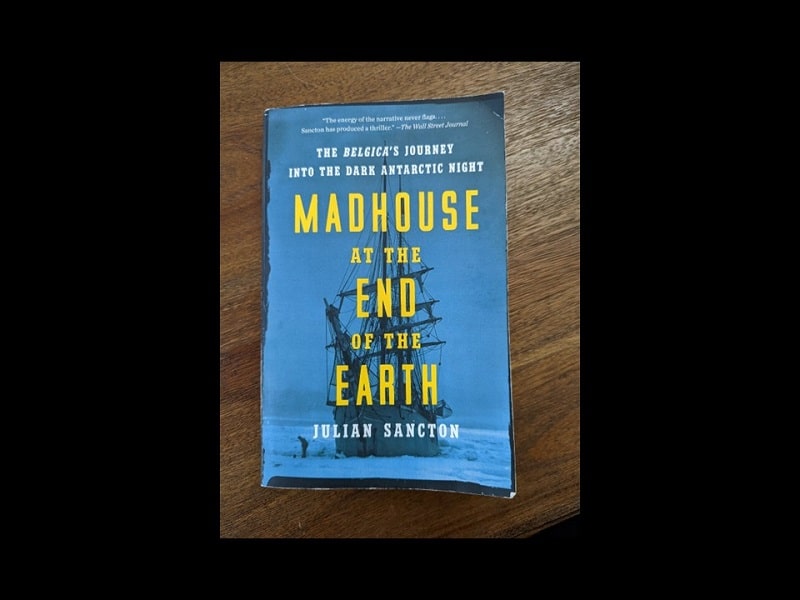
In August 1897, the young Belgian commandant Adrien de Gerlache set sail for a three-year expedition aboard the good ship Belgica with dreams of glory. His destination was the uncharted end of the earth: the icy continent of Antarctica.
But de Gerlache’s plans to be first to the magnetic South Pole would swiftly go awry. After a series of costly setbacks, the commandant faced two bad options: turn back in defeat and spare his men the devastating Antarctic winter, or recklessly chase fame by sailing deeper into the freezing waters. De Gerlache sailed on, and soon the Belgica was stuck fast in the icy hold of the Bellingshausen Sea. When the sun set on the magnificent polar landscape one last time, the ship’s occupants were condemned to months of endless night. In the darkness, plagued by a mysterious illness and besieged by monotony, they descended into madness.
In Madhouse at the End of the Earth, Julian Sancton unfolds an epic story of adventure and horror for the ages. As the Belgica’s men teetered on the brink, de Gerlache relied increasingly on two young officers whose friendship had blossomed in captivity: the expedition’s lone American, Dr. Frederick Cook—half genius, half con man—whose later infamy would overshadow his brilliance on the Belgica; and the ship’s first mate, soon-to-be legendary Roald Amundsen, even in his youth the storybook picture of a sailor. Together, they would plan a last-ditch, nearly certain-to-fail escape from the ice—one that would either etch their names in history or doom them to a terrible fate at the ocean’s bottom.
Drawing on the diaries and journals of the Belgica’s crew and with exclusive access to the ship’s logbook, Sancton brings novelistic flair to a story of human extremes, one so remarkable that even today NASA studies it for research on isolation for future missions to Mars. Equal parts maritime thriller and gothic horror, Madhouse at the End of the Earth is an unforgettable journey into the deep.
Staff Thoughts:
I possess an unusual fascination with polar exploration; those gritty tales of survival and resilience are among the worst that nature can throw at humanity. And yet somehow, I had never heard of the Belgica’s journey. I was intrigued the moment I picked up Julian Sancton’s Madhouse at the End of the Earth.
This nonfiction book reads almost like an adventure novel. The narrative is exciting and fast-paced, and it does not feel like you are reading nonfiction. Sancton packs a lot of information into the story, including discussions of scientific technologies, navigation techniques of the late 19th century, the psychological toll of confinement and monotony, early photography, weather patterns of the Antarctic, polar survival, and more. Even the reasoning (and planning) behind the expedition makes for an interesting read, tied in with the creation of Belgium as a country, political pressure, a family’s high expectations, and the challenges of hiring for an oceanic polar expedition in a country with essentially no navy.
The Belgica expedition was unique in many ways, one of which being that this was one of the most- and best-cataloged of the 19th-century polar expeditions since nearly every crew member kept a journal. However, Sancton specifically focuses on three members of the crew, telling parts of the tale through their experiences related in their journals: the wistful and pressured Belgian commandant Adrien de Gerlache, the first mate Roald Amundsen (of later polar exploration fame, onboard to gain experience in polar conditions to prepare for his own future expeditions), and a charismatic American doctor, Frederick Cook, with a fondness for self-promotion and exaggeration, but who was also essential to keeping the crew alive. Sancton paints detailed pictures of all these men, weaving in their backstories and bringing them to life within the pages. (The sometimes-haunting photographs from the expedition also do the same). These strong personalities were all driven by their own goals, hopes, hubris, and pressures; the friendship, conflict, and even genius that arose from their being thrown together on a perilous expedition make for a book that is hard to put down.
Sancton tells the story well overall, though at times it does feel it switches between topics and focus a bit too often, occasionally losing the thread of the narrative. However, much ground is covered in telling this tale, and Sancton finds ways to tie it all together, especially when discussing the influence of the Belgica’s expedition on future exploration – even right down to how it has impacted modern preparations for space travel. This book was enjoyable, informative, and, at times, thrilling. History, exploration, and maritime enthusiasts would all do well to give Madhouse at the End of the Earth a read.