

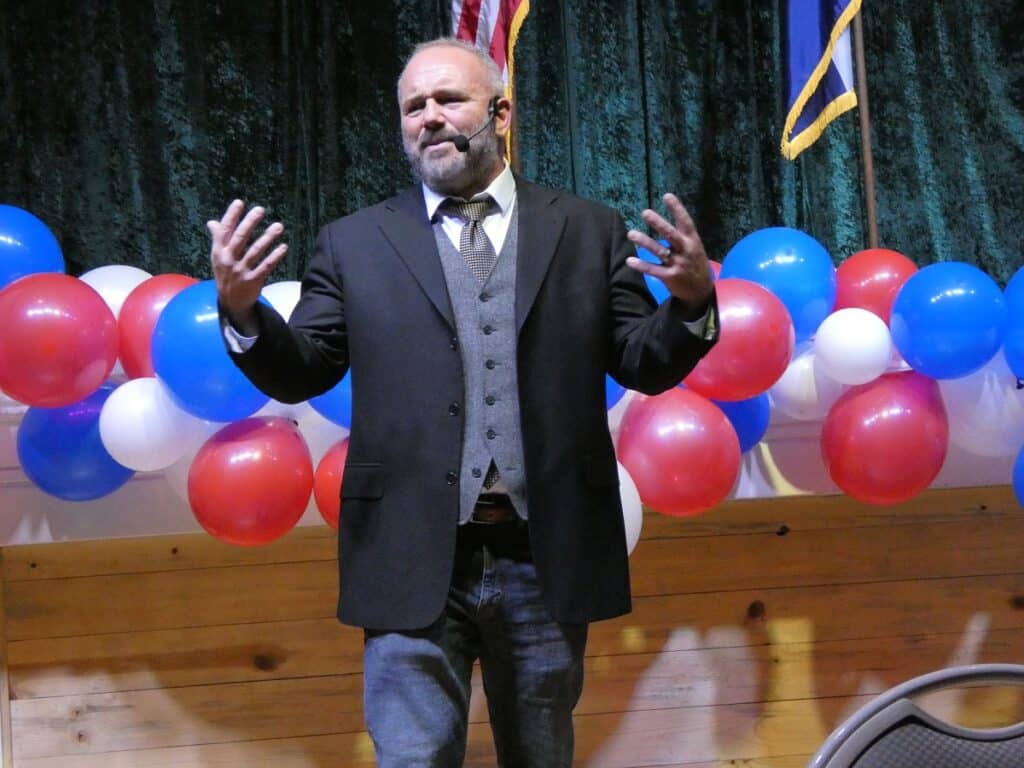
Krannawitter returns to talk about slavery and the founding of the Nation.
Woodland Park’s Merit Academy held its second lecture in a series on Nov. 5. The series put on by the charter school is a move to share what is taught in the school’s classes with parents and the community at large.
Merit Academy’s Road to Becoming a Charter School
Merit Academy was the first charter school to be accepted into the Woodland Park RE-2 School District after a lengthy battle between the school and district officials. The school first applied to be a charter in 2020, but the school board at the time denied its application.
The school’s steering committee continued its battle to find a way that the school could still open its doors for its first year in the fall of 2021. The school ended up getting approved as a contract school through the ER BOCES based out of Colorado Springs.
The school launched in Woodland Park in 2021 by holding classes in a local church at first and then renting a commercial property. But then during the November 2021 election, four new school board members who campaigned as being the “conservative choice” launched a mass effort to speed up the process to charter Merit Academy into the district.
The efforts by the new school board saw opposition from some community members that ended in a lawsuit and a recall effort being launched. However, the recall petition did not get enough signatures and a district judge recently filed a summary judgment ending the lawsuit.
In the end, the Merit Academy was charted into the Woodland Park School District and starting in the fall of 2022, the school moved out of its leased commercial building and now shares a portion of the Woodland Park Middle School. The Merit Academy held their first lecture series with Krannawitter last May, which focused on breaking down and explaining the Declaration of Independence.
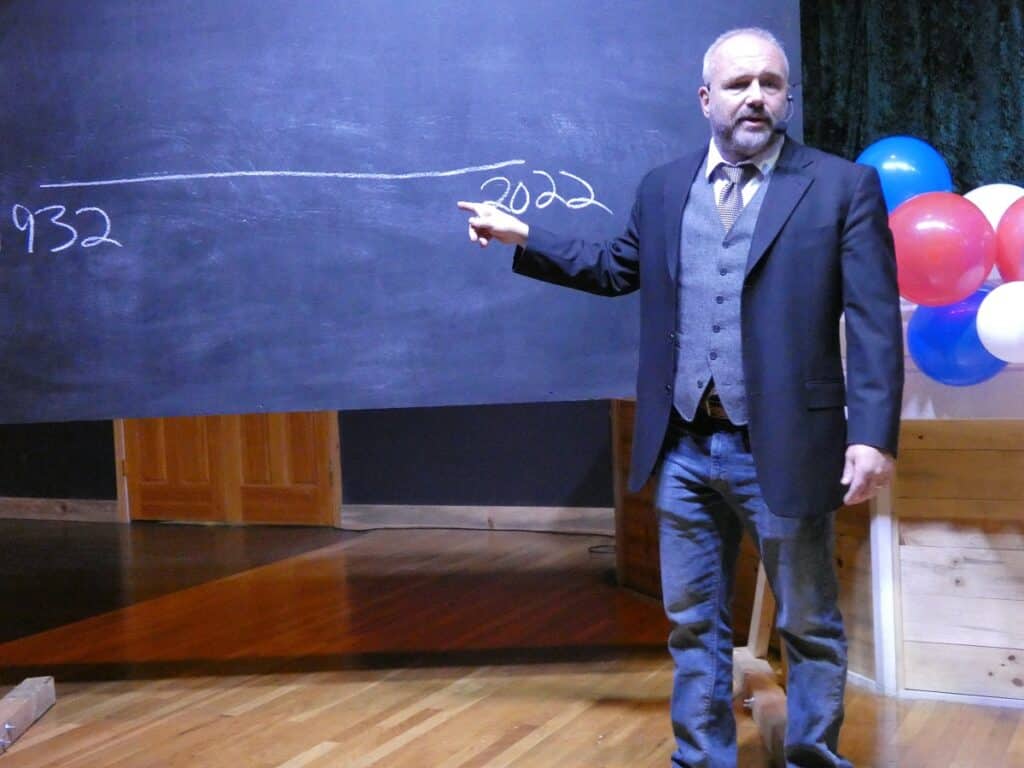
Krannawitter Explains the Problem of Slavery in the American Founding
During the second lecture, Krannawitter started where he left off during his first talk explaining what happened directly after America was founded. The lecture explained how America’s Founding Fathers knew slavery undermined the clause in the Declaration of Independence that every man was created equal.
He went on to explain how the founding of the nation was the start of the biggest anti-slavery movement in human history. To go along with his lecture, Krannawitter provided a handout with several quotes from the nation’s Founding Fathers that speak against slavery dated between when the country was founded and the start of the Civil War.
“There is not a man living who wishes more than I do, to see a plan adopted for the abolition of slavery,” George Washington wrote in a letter in 1786.
“Slavery is … an atrocious debasement of human nature,” Benjamin Franklin said in “An Address to the Public from the Pennsylvania Society for Promoting the Abolition of Slavery” in 1789.
Krannawitter explained that the founding of America had one big problem because all of its citizens were not free and self-governing. He explained that some people discredit the Constitution because it was drafted during a time when many Americans owned slaves.
“Our Constitution has suffered a very serious moral critique that the Constitution is a racist document,” the lecturer explained. “The Constitution was written by slave owners and therefore we today are morally superior to the founders and the Constitution. Why should we obey and be limited by their immoral Constitution? I’m suggesting to you that what our Constitution really needs right now is a moral defense. It needs Americans who actually think the Constitution is good.”
Krannawitter said that part of the purpose of the second lecture of the series was to try to morally justify the Constitution by helping listeners understand the question of slavery.
“I am going to propose a thesis tonight that the American founding, which includes the Constitution, was not only not an embarrassing, shameful chapter in human history,” Krannawitter stated. “I am going to argue just the opposite that the American founding ignited the greatest anti-slavery movement in all of human history. Hands down, no group of people anywhere else in the world ever came close. And it is something America should be proud of.”
The First Step to the Anti-Slavery Movement
The lecturer said that the quotes he provided to the audience prove that many of the Founding Fathers saw slavery as a problem once the country was founded and that was the first step to the anti-slavery movement.
“Simply recognizing slavery as a problem, that in itself is a huge step forward in the moral awakening of human consciousness,” Krannawitter explained. “To recognize that it’s a problem to be solved is huge because most people throughout history did not view slavery as a problem to be solved. They viewed it as something traditional, ancestral, and a customary way of life that should be preserved.”
He then talked about the 1619 Project, which was published by the New York Times, and how their argument was that America is inseparable from slavery. He went on to explain that the 1619 Project was wrong when they said that the words of the Declaration of Independence were not true because slaves weren’t free by describing that the words, “All men are created” were right because that is what made slavery wrong.
He said that Americans were some of the first people to notice that slavery was wrong because all people have unalienable human rights. “The practice of slavery is really old,” Krannawitter said. “Slavery exists in all 6,000 years of written history. There is also strong evidence that suggests that slavery existed before written history or in prehistorical times. Some scholars have argued that the practice of slavery likely stretches all the way back to when human beings first started to domesticate animals. The first time that human beings got the idea in their heads that, ‘Hey I can make that horse or mule do some work for me,’ it was a short step to thinking if I can get a horse to do work for me then why can’t I make another human being to work for me.”
The rest of the lecture detailed other steps that were taken to get rid of slavery once it was seen as a problem after the country was founded. He detailed many things that happened before the Civil War occurred to get to the point where slavery would be abolished.
Krannawitter talked about the first steps taken to end the slave trade in the country. And then, he talked about how before the Civil War the country had ended the slave trade coming into the U.S. and made slavery illegal in the Northwest Territory in 1787 before some states started banning slavery in the 1800s.
The lecturer explained how there were many steps to end slavery before the Civil War started, which eventually led to the freeing of slaves. He said that he plans to talk about the Civil War and the Emancipation Proclamation during the third lecture of his series.
During the first lecture, Merit Academy officials said that they would try to put on a lecture every semester. The next of the series will most likely take place sometime this spring.