


State legislatures across the country are trying to address the complex and controversial issue of how to balance transgender athletes and athletics. In April, House Concurrent Resolution 1004 “Fundamental Rights for Parents,” a resolution to amend the Colorado Constitution was introduced in the Colorado House of Representatives.
The concurrent resolution would have established a parent’s bill of rights that sets forth specific parental rights related to directing the upbringing, education, and health care of a minor child.
The resolution failed in the House State, Civic, Military, and Veterans Affairs Committee with a vote of 3-8.
One Colorado, a Denver organization that advocates for LGBTQIA+ equality, opposed HCR23-1004 opposed the resolution.
“This resolution is an overstep that will restrict the rights of young people and suppress information,” said One Colorado Executive Director Nadine Bridges. “Our country is facing a mental health crisis and young people, especially LGBTQ+ young people, need support and access to resources more than ever. HCR23-1004 would have caused irreparable harm by amending the Colorado Constitution to favor censorship and invasion of privacy over basic rights. It’s dangerous to try to use Colorado’s Constitution to control what students can and cannot read, what they can and cannot learn, and most troublingly, who they can and cannot be.”
HCR23-1004 was a legislatively referred constitutional amendment, meaning it would have amended the state constitution. To become law, the resolution first needed to pass the House and Senate, and then be approved by voters in the 2024 General Election.
Transgender Identification
Transgender is a term used to describe people whose gender or sense of personal identity does not match the sex they were born with. In other words, a transgender person may have been born as a male but identifies as a female or vice versa.
“Transgender people are part of the LGBTQ+ community. According to the Williams Institute, 1.4 million adults identify as transgender in the United States. About 0.5 percent of adults 18-24 identify as transgender, and 0.3 percent of adults 65 and older identify as transgender.”
According to worldpopulationreview.com, there are 27,000 people living in Colorado that identify as transgender. The issue of transgender athletics has also garnered attention at the federal level.
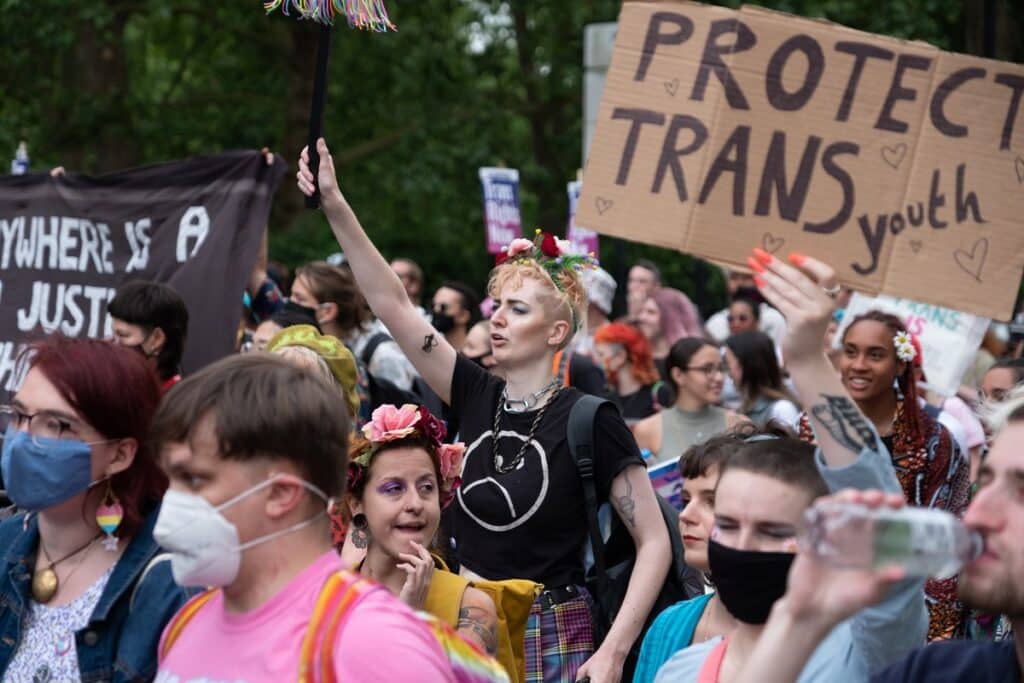
The Impact on Athletes and Athletics
The Department of Education’s proposed Title IX athletics rule that could strip federal funding from schools that don’t allow athletes to compete based on their gender identity received more than 156,000 statements during the 30-day public comment period.
The proposed rule, which entered the public comment period, places restrictions on the ability of schools to require student-athletes to compete based on their biological sex. If schools defy the rule, they could lose federal funds, even as several states have passed laws requiring student-athletes to compete based on their biological sex.
The department has said it aims for a middle ground that allows for inclusion and fair competition. Schools should consider, for example, the grade level or education level to make a final determination. It expects high school and college sports to be more limiting of transgender students’ participation than elementary schools. “Every student should be able to have the full experience of attending school in America, including participating in athletics, free from discrimination; Education Secretary Miguel Cardona said in a statement in April that included details of the proposal.
One Colorado said in a statement it was supportive of the new proposal.
“One Colorado commends the Biden administration and Department of Education proposed regulations for a Title IX Athletics rule to protect the right of all students of all ages to participate in any sport in this country. Youth, including trans and intersex youth, deserve the most inclusive and protective rule possible. We will continue to work with our local, statewide, and national partners to ensure that a final rule supports the full inclusion of trans, nonbinary, and intersex students in all aspects of education, including sports.”
Critics of the New Proposal
Nicki Neily, the president of the parent activist group Parents Defending Education, told the Washington Examiner that the sheer number of comments submitted in such a short period of time indicated a wide range of passionate opinions on the proposed regulations.
The Department of Education only opened the comment period for 30 days (rather than the customary 60-90 days), yet the volume that was generated in such a short period of time actually surpassed the total number of comments submitted for Secretary DeVos; Title IX rule in 2018, Neily said. This highlights how strongly Americans feel about the issue of transgender athletic participation — both for and against — and will be closely watching how the federal government decides to adjudicate this fraught issue.
Transgender Athlete Speaks Out
Lia Thomas, a former transgender athlete, demanded that President Joe Biden’s new Title IX proposal include additional safeguards to permit biological male athletes to compete in female sports and called fairness concerns a “guise” in an Instagram video published previously.
Thomas addressed concerns that new proposals to Title IX, which prohibits sex-based discrimination, do not go far enough to ensure that transgender athletes can compete in divisions that match their gender identity, according to the video. “The Department of Education has proposed a new rule for Title IX regarding transgender athletes; this
rule would prohibit blanket bans on transgender kids, especially in grades K through 8,” Thomas said in the video. “However, it would not prohibit discrimination against trans kids in the high school and college levels under the guise of competitive fairness.”
Thomas competed on the University of Pennsylvania women’s swim team during 2021-2022
academic year after previously competing on the men’s team. Thomas won multiple championship titles including a first-place finish at the NCAA Women’s Swimming Championships in the 500-yard freestyle — beating opponents by 1.75 seconds.
Colorado Transgender Legal Standing
Meredith Gleitz, One Colorado Policy Manager, said Colorado is ranked first nationwide for LGBTQ+ laws and policies. “Statewide, we’ve seen significant legal advancements for trans equality, including this year’s Senate Bill 23-188 making Colorado one of the safest places in the US to access or provide gender-affirming care, policies that make Colorado the first state to include gender-affirming care services in its benchmark health insurance plan,” she said. “Laws like ‘“Jude’s Law,’” which ensures trans people can correct their name and gender marker on identity documents, and protections like Senate Bill 20-221 making Colorado the 11th state to protect LGBTQ+ Coloradans from gay and trans panic defenses.”
Gleitz said regardless of this progress, trans-Coloradans are still impacted by the recent onslaught of anti-trans political attacks in Colorado and nationwide, including an attempted anti-trans sports ban this legislative session. “Even more commonly, we’re seeing local efforts to undermine trans justice, such as school districts attempting to restrict pronoun use and inclusive curriculum at schools, and local governments attempting to defy non-discrimination protections,” she said.

Colorado a Safe Haven
Alex Floyd, One Colorado Health Equity Director, said because of Colorado’s legal protections, the state is considered a safe haven for LGBTQ+ Coloradans. “However, we know there are still many barriers trans-Coloradans face,” he said.
“For example: while access to health care continues to be protected in our state, finding a competent, safe provider can be a significant challenge for our community — especially for people living in rural areas. This context forces many individuals to travel long distances for appointments or forgo necessary care. One Colorado works to progress both the legal and lived equality of LGBTQ+ Coloradans.”
For another view on this topic, check out “Is Trans Activism Destroying Women’s Rights?”, by Katie Spence.