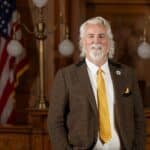


Tony Hoewisch, owner of Ted’s Bicycles in Colorado Springs, knows that the lifestyle of cycling has changed since he began the business in 1976. But with every change in technology, the biking community builds in its interconnectivity and amenities. This helps educate people on what kind of bike is right for them. Hoewisch and his staff try to match the mindset of the customer with the right bike while using his years of experience to point them in the right direction.
Hoewisch remembers a time in the Springs (and the nation for that matter) when cycling in urban areas was not necessarily accepted from a driver’s standpoint. That mentality has changed somewhat./ Back in the mid-1970s/early 80s, there weren’t a lot of bike trails or pathways through most cities, only typical sidewalks. Cyclists had to share the road, but it was not as readily acceptable to share the road at that time.
Hoewisch initially got into bikes because he rode as a kid. “My biggest interest, what got me involved in the industry, was simply the mechanics of the bicycle and the lifestyle. I had family and friends that knew how to take hubs and stuff apart. But it just intrigued me that they could do something like that. Obviously, it was a pretty simple procedure, but in my time and age, I had no idea what it looked like inside the bike. And so I had an interest in learning.”
Hoewisch says he never raced in any organized fashion before he joined the shop. “I was never a huge cyclist per se. But I have commuted a fair amount over the years. I’ve done century rides. I’ve done mountain excursion-type rides.” He got his first three-speed bicycle at 12 years old. Prior to that, in his family, two bicycles were shared between four siblings. But he had a dream of his own bike at that time: a Stingray with high-rise handlebars. Stingray bikes were quite popular at the time. His plan at 12 years old was to turn one of his shared bikes into a Stingray the best that he could. “And to my surprise, at Christmas time, my siblings and my folks went in and bought me a brand-new bike in the Stingray fashion. It wasn’t an actual Stingray, but it was a copy. I was totally excited, obviously. And it’s definitely a great memory.”
Bikes Can Be an Essential Need
The reason Hoewisch brings this memory up, he says, is that it reflects an essential need. “I would ride that bike to different church class sessions that were for the younger adults and for the youth. I was brought up on a farm, and sometimes my folks didn’t always have time to transport me to the classes. And so I would just ride my bike, which was equivalent at that time, to about a five-mile ride. It was pretty cool. It was something I was excited about. I’d carry my books and everything on there, and it was always ready to go.”
When Hoewisch first came to work for original shop owner Ted Wilber in 1976, there were a lot of three-speed bikes in their inventory with most of the frames sporting one and three-eighths tires which were considered road bikes. The term 10-speed, Hoewisch says, at that time, referred to a dropped handlebar, whether it was a five-speed or a 10-speed. The dropped handlebars always identified it as a 10-speed.
The design of bicycles started to change over the years and different categories just began opening. The mountain bike, he explains, originated as a cruiser with gears. Cruisers had wider tires and were a little bit more efficient for road riding. The BMX sector into the mid-80s was more for young riders. It then branched off in several directions, not only for racing but for freestyle use, and then for dirt jumping with tricks. Hoewisch says recumbent bikes also became popular over the years, and now there are e-bikes and hybrids. “There’s a bike for literally every interest and/or need a person would want.”
Finding the Interest of the Customer
Regarding what Ted’s decided to carry in terms of their inventory, Hoewisch doesn’t deny that some of it is simply where the interest of the customer lies, but it’s also reflected in the category of rider that the shop wants to be responsive to. They are not a racer-oriented shop. Hoewisch says they have always been a family-oriented bike shop. “But that doesn’t mean that we don’t sell bikes for racers, or people that tour.” Ted’s Bicycles understands if something has to be special-ordered. “If someone wants a specific type of bike, and it’s within our realm to order it, we will do that.”
Repair is also a large part of their business as well. Hoewisch laughs, saying “We tell people we do everything but weld and paint.” Flats, he explains though, are probably the number one repair they do followed by overall tune-ups. He says there are also folks who just want the latest and greatest accessories like Bluetooth shifting. In addition, there is also an aesthetic angle for many customers in terms of upgrading an old bike to look new while still retaining its original feel.
“There are folks that have a bike that’s 20, 30 years old. Some still ride it every day. Some just ride it on the weekends, and some just want it for nostalgia reasons. And so, they want to get it repainted, decals put on, get it overhauled, new fresh grease, and so forth.” It simply rests, Hoewisch says, in the budget of the customer and where their interests are at. Sometimes bikes are brought in that simply are not in the best shape. Unfortunately, he says, they can be difficult to repair. because in some scenarios, parts are not available anymore because they’re proprietary to a certain design and/or equipment that’s on the bike. Hoewisch says sometimes they need to have special parts machined because they are simply not made anymore.
Every Rider is Different
Every customer is different. Hoewisch recalls a customer years ago who brought in a used bike for him to fix. At that time, this man was in his 50s. He had decided that he wanted to get into cycling. Ted’s fixed the bike up for him, and he rode it for the next few years consistently. The man had health problems which is one of the reasons he got into cycling per his doctor’s recommendation. The man told Hoewisch that the bike they fixed for him was just “the cat’s meow.”.
After a couple of years, the man came in and said he wanted to upgrade. “He wanted to get into something a little lighter, a little more efficient.” Hoewisch put him on a couple of different bikes and the man couldn’t believe the difference, simply because the technology had changed since he first started. Cut to 25 years later (by Hoewisch’s estimate), the man came back in and purchased eight bicycles of various styles from Ted’s over a short period of time for him and his family. He rode those bikes every single day until he retired and then even more once he actually retired. “He also got his daughter, son-in-law, and other members of the family into cycling as well with these bikes, almost at the same degree as his own interest. The man just became an advocate for cycling with other friends and peers. “And he told me time and time again how thankful he was that I guided him in the direction that I did to help him enjoy his cycling experience, and to get his health turned around. His physician just could not believe the difference that it made.”
The beauty of this kind of store has been what Hoewisch enjoys most about his business and this industry. “As I mentioned, I’ve never been a huge cyclist in the term ‘huge’. My interest started more in the mechanical end of things. But I love people, and I love people sharing with each other, whether it’s their family, their friends, or both. It doesn’t matter.” Cycling, he says, has just been such a big part of keeping families together or reuniting families. “And it just warms my heart to see that.”