

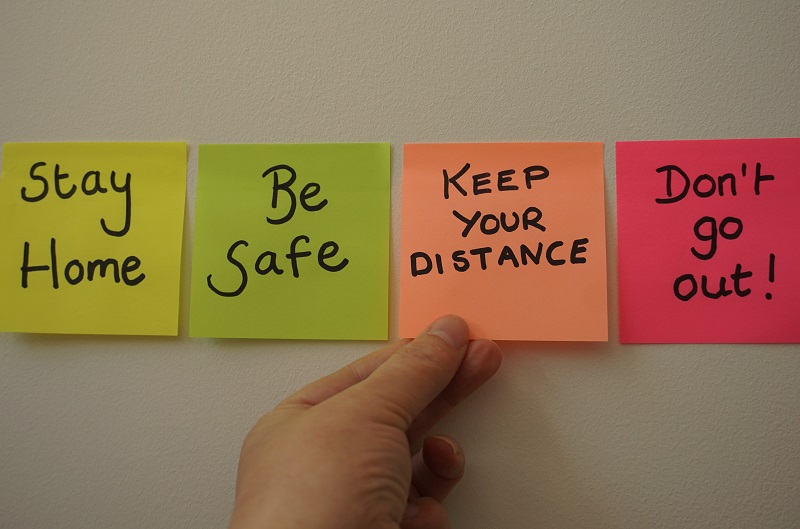
You’re probably ecstatic over the many reopening plans in progress. The SARS-CoV-2 virus and the COVID-19 disease have been unprecedented challenges for the states and local communities with COVID shutdowns and stay-at-home orders.
State’s Reopening Strategy
Colorado Gov. Jared Polis, a Democrat, began the state’s reopening strategy relatively early compared to most of the United States, and, so far, it has been successful. Shops are now reopening, and restaurants are allowing dine-in operations at reduced guest capacities to ensure some degree of social distancing and separation. Open-air establishments, too, have skyrocketed into post-lockdown popularity due to the changing summer weather and many other happy coincidences (liquor stores and weed dispensaries staying open, for starters).
Elsewhere, many state and local communities aren’t so fortunate. When not in my mountain home, my wife and I spent a lot of time in Las Vegas every year. The land of the King is a second home. We have family there, and I’ve had my fair share of escapades along historic Fremont Street that ended with less-than sanitary incidents.
For The Center Square, I reported that Las Vegas was expected to be one of the hardest-hit areas by COVID-19. Casinos, hotels, and virtually every aspect of the front-facing hospitality and entertainment industries are considered “high-risk.” Massive casino-hotel management companies have cut many workers from the payroll. They are struggling to resume business as usual amid a new reality that necessitates creative changes.
For hotels, this includes limiting the number of guests at one time, the regulation of acceptable behaviors on casino floors, and the restriction of movement from individuals who aren’t staying at the hotel. It’s safe to say that even for a few short months, the COVID shutdowns of business in the entertainment capital of the world will have long-term consequences. Luckily, the Las Vegas strip is now in the reopening process and is starting to see guests return. I’ll be one of those guests, with my wife, who supports casino workers through patronage later this summer.
COVID Shutdowns or Stay-at-home Orders Constitutional?
The question to ask, though, is: Are COVID-19 shutdowns and stay-at-home orders at all constitutional? To ask if one such order is legal, you must ask whether someone’s rights are being infringed upon, why they are, and whether this infringement of liberty is justified.
Walter Olson, a senior fellow for the Cato Institute in Washington, D.C., believes that there is no one affirming whether the COVID-19 stay-at-home orders are constitutional.
We were unable to reach Olson directly, but a Cato Institute spokesperson provided us with his latest musings on the topic. Olson, an attorney, specializing in tort reform, finds that the black and white arguments whether something is unconstitutional versus constitutional are entirely lacking in nuance. He refers to instances of case law that show collective confirmation that governments have the exclusive right to protect the health and wellbeing of people living under their purview during extreme and exigent circumstances.
“American constitutional law, like the colonial law that preceded it, recognized states’ and cities’ police power during true emergencies to intercept the sorts of otherwise harmless movements and actions that can turn well-meaning individuals into vectors of physical harm to others,” Olson notes in his writing. “It can be tempting to spin tales of constitutional law as we might like it to have been, and pass that off as the actual state of the law.”
Olson refers to “harmless movements and actions” as a measure of what isn’t necessarily constitutional. While the COVID-19 stay-at-home orders are justified to protect life and safety, the concerns over rising power could come from the actions of public health regulators on certain personal behaviors deemed medically risky or a direct affront to human health. A noteworthy example of this is the controversy over the lung injury epidemic tied to illicit vaping that ravaged across the U.S. in late 2019 and earlier this year.
CDC Pandemic Response Team
The Centers for Disease Control and Prevention mobilized their pandemic response team to understand how people were getting injured from vaping. With roughly 2,000 cases and a few deaths, the findings of a crucial scientific investigation into the phenomenon proved that the vast majority of people who were sick from vaping consumed adulterated or illicit products. Now, vaping and regulation of the product category is an issue that will impact U.S. voters as we move ever closer to the general election in November.
This all corresponds to the constitutionality argument because it shows how perceived risks can dictate aggressive policy responses. Olson further notes that seemingly severe crises like vaping are harmless compared to a global pandemic that has infected millions of people. Governments, especially in the U.S., are poised to employ public health strategies that substantially limit things like free movement and a person’s ability to work or run their businesses.
Police Powers or Stay-at-home Orders?
The power that we’ve referred to relates to state police powers. Under the 10th amendment of the U.S. Constitution, police powers divulge to governments the fundamental right to make necessary laws to govern and maintain order at the state and local levels. These powers are granted to the states because the 10th amendment grants state the rights and powers not delegated by the federal government.
States are then allowed the authority to establish and enforce laws protecting the welfare, safety, and health of their local public. A federal judge in Illinois ruled in favor of the administration of Gov. J.B. Pritzker, confirming that the state’s stay-at-home order was constitutional amid challenges from worship leaders and small business owners in several small and suburban communities across Chicagoland and rural up-state Illinois.
This isn’t to say that stay-at-home orders aren’t harming businesses and workers. One of the most important aspects of a constitutionality debate involves the implications of policymaking when ordered more than the actual need.
If we return to the vaping example, we can see a situation that provides this context. A controversy and an ongoing debate over the essential status of a vaping-based business or manufacturer has reared its head in Colorado and dozens of other states. Denver Mayor Michael B. Hancock made national headlines when he exempted liquor stores and recreational and medical marijuana dispensaries from closure orders. He deemed these businesses as de facto essential establishments that provide life-supporting products and services. Meanwhile, tobacconists and vape shops were not considered necessary.
From the pro-vaping camp, shop owners and public health advocates who support the behavior as a risk-reduced alternative to smoking called the classifications a double standard. While not without harm to the human body, many have used vaping products as a means to cut out cigarette use and begin using a nicotine product that doesn’t burn in the throat.
Regardless, the concerns over constitutionality come into play when there’s demonstrable harm on businesses that can’t remain open during quarantine orders.
However, that could be a challenging fight to win if taken to court Olson noted. If there is a violation of interstate commerce, for example, a federal judge could step in and find justification to deem a certain measure, or a part of it, unconstitutional because interstate commerce regulation is reserved for the federal government. This includes matters over travel bans and the flow of goods, services, and people across state lines.
I also wish to reiterate that I am no lawyer. I’ve taken much care to review all of the applicable information related to this topic that I could find. However, the assumptions and conclusions reached at the end of this piece are merely observations that could complement or challenge your thoughts on the matter. Despite that, at least it’s promising to see towns, cities, and states resuming some normalcy in the brave new world (literally).
***
Michael McGrady, writing from Monument, Colo., is a contributor to The Maverick Observer.