


Recently, Colorado Governor Jared Polis announced he was shifting his politically childish color-oriented COVID-dial from Orange to Yellow for most counties in the state. This was heralded as an easing of the governor’s overly arbitrary and strict edicts of economic destruction in which bars and restaurants were forced to remain at capacity limits of 75 percent closed for months on end.
If you disconnect all but two spark plugs on your modern vehicle, you’re operating at 75 percent unused engine capacity. Good luck driving up steep hills. If you have four passengers in a car and they all sit in your lap as you drive down the Interstate, you’re nuts!
This is the governor’s approach to restaurant and bar capacity limits.
Colorado Restaurant Association Publishes Capacity Limits
Each month, the Colorado Restaurant Association publishes survey results based on its members’ views of the pandemic. CRA infographics say the same thing each month: “Restaurants need to be opened at least 75 percent capacity to survive.” Colorado Springs City Councilor Richard Skorman, himself a restaurant owner, and among others, has stated he wouldn’t open up his own business unless it was at 75 percent capacity.
As the CRA notes, there has been no science or information regarding how or when or what restaurants are spreading ‘round the ‘rona. Meanwhile, if you haven’t heard, In&Out, the California fast-food burger chain that recently opened franchises in Aurora and Colorado Springs, had more than 100 employees test positive, generating more than half the outbreaks in restaurants across the state — and both franchises are still operating.
In an industry struggling to survive the pandemic, profit margins are shrinking and the industry is itself in danger as more restaurants and bars permanently close. In September of last year, news reports indicated well over 100,000 restaurants had closed; by December, the National Restaurant Association announced up to 17 percent of all restaurants had closed. As the CRA continues advocating for opening restaurants and bars to at least 75 percent capacity, the governor seems to ignore the association and its members in pursuit of political glories elsewhere in Colorado.

Swirl Wine Bar
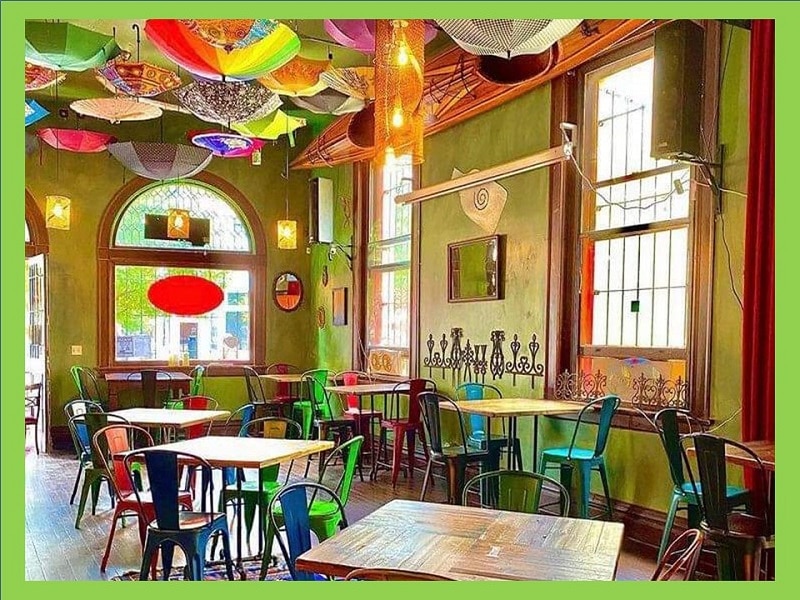
Sharon Palmer has owned and managed Swirl Wine Bar in Manitou Springs with her husband, Andrew, since 2012. The artfully decorated interior space first began as a wine store before being converted into a restaurant and wine bar. The wine bar is popular for its brews, ales, and locally sourced wines. A family business, Andrew occasionally posts pictures on his Instagram account of his young kids helping out at the restaurant.
The governor’s obsessive-like focus on restaurants and bars has stumped Sharon Palmer. “I can’t wrap my brain around why restaurants are targeted when the data doesn’t point to them as main spreaders,” she wrote in an email interview. “My sister lives in Florida and her town, the restaurants choose their capacity. So far, it has worked out very well.”
For Palmer, this makes the most sense. She feels customers can determine their own risk by deciding which restaurants to frequent. Palmer outlines her approach to managing Swirl during the pandemic, “I do think that restaurants should not take free range to be irresponsible but to do their best to provide a clean environment.”
Cautious Optimism
The governor’s announcement of increased capacity limits has Palmer expressing cautious optimism. “You have to scramble to get staff back on, see if anybody is available to work, order more food, update your menu,” she said before adding a caveat, “then all of a sudden they (capacity limits) go back down and then you have to reverse everything. It’s not also frustrating but it’s making restaurants just bleed money.”
The guidelines for compliance or mitigation also cost restaurants and bars money. Swirl has added outdoor heaters to its patio; while this increased capacity, it also created extra expenses for the restaurant. Palmer is grateful she has a patio to work with. Not all other restaurants have patios or can provide outdoor dining without incurring excessive expenses.
Ordering two weeks of food on Monday only for the governor to suddenly shut down or reduce the capacity for the industry on Friday can mean an enormous waste of money for restaurants and bars already operating on paper-thin margins. Palmer also said her husband Andrew spends considerable time in search of cleaning supplies and other items to help keep costs down.
“It becomes this awful cycle of not being able to run your business effectively because the government is telling you what to do,” wrote Palmer in an email. “We chose to be responsible on our part and have been providing a clean environment for our customers.”
Back to Basics
The day after the governor announced the state was moving from Orange to Yellow on his COVID-dial, I emailed Palmer and asked her about El Paso County’s Five Star program and whether or not she’d apply for it. The state’s Five Star Certification Program, created to allow businesses to open and show compliance to state COVID19 guidelines, has been called expensive and problematic for many restaurants, especially larger venues. Initially, El Paso County rejected the state’s Five Star Program, and after an application from the county to the state was rejected by the governor, El Paso County decided the only way for restaurants to open was to utilize the state’s Five Star Certification Program.
Palmer won’t participate and apply. “It creates an unfair advantage in competition. Some restaurants have way bigger pockets and can implement this process and pass on the cost to their customer easily. Many small businesses can’t. Many do not even have the actual space for the requirement.”
Palmer says layers of bureaucracy don’t help and make things worse for businesses. Between the governor’s COVID-dial and the county’s Five Star program, wouldn’t it be easier to adopt Palmer’s approach? Be responsible and keep a clean restaurant. Let customers determine their own risk. Restaurants can determine how many patrons they can safely accommodate.
The way forward is for the governor and state public health department to go back to the basics and end its capacity-focused orientation on managing bars and restaurants. There’s no science behind scapegoating an entire industry. Bars and restaurants should adopt Palmer’s blueprint to safety and success.
After all, there were more coronavirus outbreaks at the governor’s household than there were at Swirl. The Palmers know more about how to keep their household free from the virus than the governor.
I’d take their advice over the governor’s any day.







I don’t recall hearing this kind of whining from the business community after 9-11 when we shut down venues and made everyone empty their pockets and take off their shoes for the next 20 years (and counting). I guess when the enemy is foreign and kills 3,000 Americans sacrifice is patriotic, but when the enemy is microscopic and kills 500,000 Americans, it’s inconvenient. I’m sorry about businesses closed and jobs lost, I really am, but I’m also sorry for hundreds of thousands of American families who lost loved ones too soon because too many of us didn’t like “government telling us what to do.”
[…] Springs business owners roll with the punches in the face of an unprecedented […]
[…] Editor’s Note: In light of the coronavirus precautions of social distancing and stay at home order, the state of restaurants in our city changes rapidly as businesses decide their future. Please continue to support your local restaurants until we can all dine together again. […]