



Horseback to Railroad
When Colorado was first settled in the 1800s, the main source of transportation was by horseback. Then when mining came in the later part of the 19th century railroads started coming in mainly to bring supplies into the mining areas. Historian John Caulfield with the Pikes Peak Trolley Museum explained the history and future of the street railways and trolley system in Colorado Springs during a tour at the museum.
By the 1880s, the street railway systems helped Colorado Springs grow and the city’s mills, railroads, coal mines and other industries began requiring more labor. As the town expanded in all directions it became harder for workers to walk from their homes to their jobs each day.

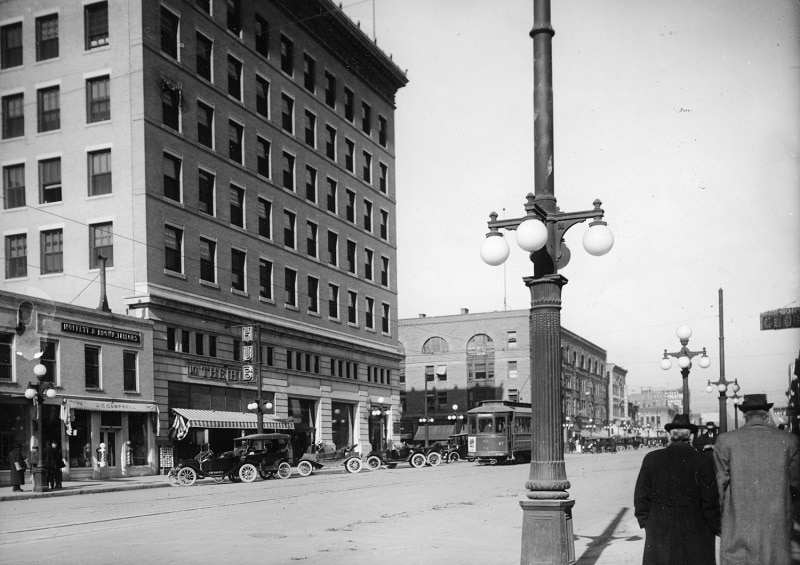
By 1887, the growing need for some type of public transportation system was met when the owners of the Colorado Midland Railroad started the Colorado Springs & Manitou Street Railway. The first street railway ran from the Santa Fe Depot on Pikes Peak Avenue west to 28th street in Colorado City and another line ran down Tejon Street.
The first trolleys were each pulled along the tracks by four horses, but soon it became apparent that there had to be a better way to power the trolleys. “With all of the manure they produced and all of the feed they required, it was not really a great way to move people around,” Caulfield said. “So in the 1880s and ‘90s they tried to figure out a way to motorize the cars. They tried steam powered, they tried (oddly enough) battery powered, and they tried gasoline and diesel. Electricity seemed to be one of the best options, but they couldn’t put everything together correctly.”
After engineers spent several years perfecting the electric motors, the railway company turned electric and incorporated as the El Paso Rapid Transit Company in 1889. The trolley system then expanded to Manitou Springs to the west, Broadmoor to the south, Roswell to the north, and Knob Hill to the east.
In the 1890s, the street railway basically was tourist-driven and the cars stopped running in the winter. The early rail cars were not heated so the engineers had to stand outside and dress in their own warm clothes during cold weather. By 1900, the trolley lines had suffered neglect and were due for an upgrade.
Stratton Purchases the Colorado Springs and Manitou Railway Systems
Winfield Scott Stratton became a millionaire when he sold his Independence Mine in the late 1800s. He began to give back much of his wealth to the city of Colorado Springs, highlighted in the article, “Winfield Scott Stratton’s Dream Still Exists as the Myron Stratton Home.” In 1901, Stratton purchased the street railway systems and spent approximately $2 million upgrading them.
“He insisted that all of the cars had enclosed vestibules and heaters for the drivers,” Caulfield said. “He got uniforms for the drivers. Unfortunately, two years after he purchased the trolley system he died. The foundation that inherited the system and all of his earnings afterward did things like if you want to buy a house and work for us we will co-sign the loan. They bought a life insurance policy for their employees. You are talking about 1910. When were things like that ever done?”
However, as technology advanced, trolleys were unable to compete in the world of public transportation. By 1926, buses began operating in the city and they quickly proved that they were more flexible with routes and cheaper to operate. In April 1932, all trolleys in Manitou and Colorado Springs ceased operations.

Multiple Attempts to Bring Trolleys Back to the City
These days, most of the old rail systems have been taken up by highways, Interstate 25 and major city streets. Bringing back the old trolley system would be nearly impossible without taking drastic measures to change the city’s major streets.
However, recently the Pikes Peak Trolley Museum and Restoration Shop has taken on several projects to bring trolleys back to the city, where roads could accommodate the trolleys on the side of the road.
“We have had several attempts to bring trolleys back to town,” Caulfield said. “In fact there was a city-wide vote about 25 years ago that said, ‘We want to put trolleys back here.’ And that was where we got our initial funding. And it was to go from downtown out to Manitou Springs. The bridges on I-25 are actually built for trolleys. We did all of the engineering work. Then there was a sewer main break in Old Colorado City. And they found that the trolley was going to run right over top of an 1880’s clay sewer pipe. They said that if the main were to break they would have to tear out the track all the way down and all the way back up. So the city said, ‘No, we can’t do that’.”
Caulfield said that since the city is working toward replacing the sewer line, the plans for the trolley from downtown Colorado Springs to Manitou could still become a reality. He also said that the museum has held talks with other entities to partner with to put some type of trolley system in place within the city.








[…] Pioneer Museum, Ghost Town Museum, and The Denver Public Library Digital Collection. Or read up on street railways in Colorado Springs’ […]