

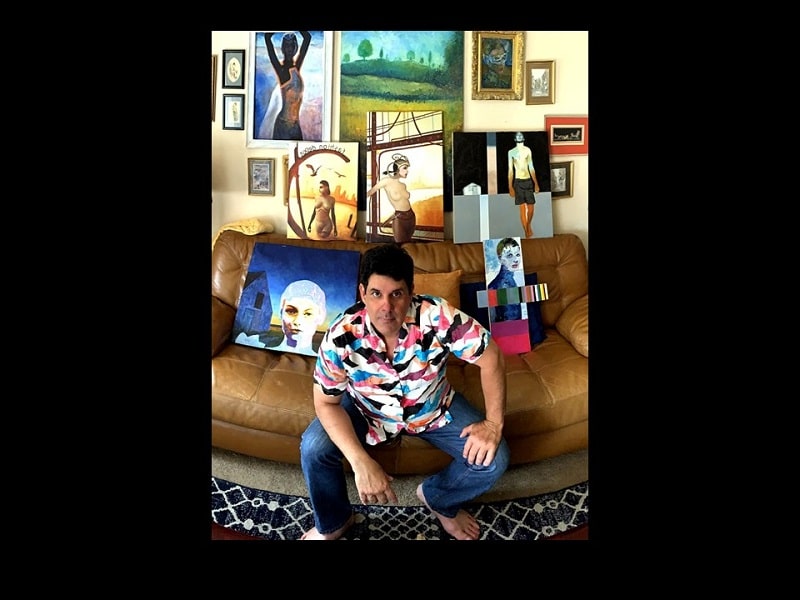
Art is a matter of perspective but also environment. The allure of big city life versus the open space of nature plays a part. Louis Rodriguez, who recently had a show at Modbo, understands the balance but also uses color and landscapes to paint a feeling. Now with inspiration around him in Colorado Springs, he travels his next path.
Rodriguez was born in Cuba before his parents decided to leave after the Cuban Revolution in 1958. After years of paperwork (mainly due to the diligence of his mother), they were able to legally emigrate to the United States.
Futuristic Influence
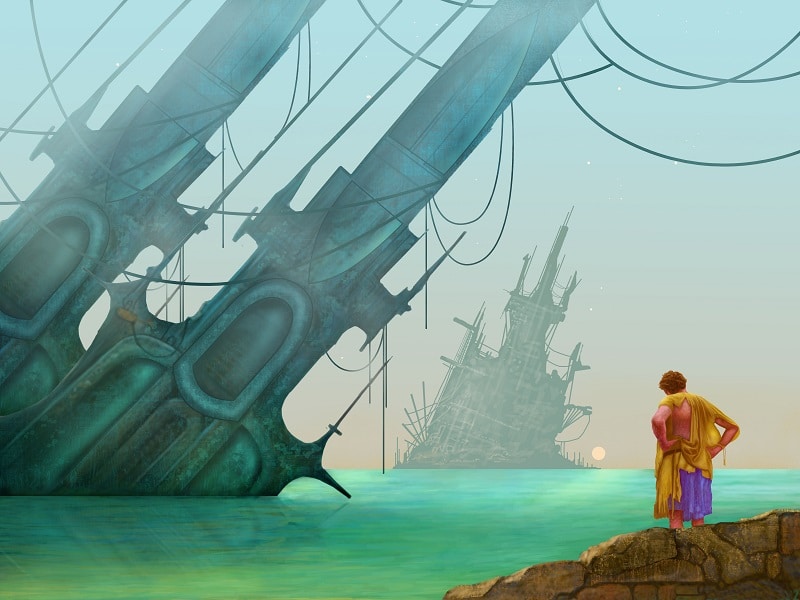
“It took a crazy long time. My father was chopping sugar cane in the sugar cane fields for the United Fruit Company. And then in 1969, we finally were ready to leave. I got on my first airplane … like a 747. And that was the beginning of my perspective in the ways that I saw things futuristically in a sense. That was a staple experience for me. And then all of a sudden, that is my mentality: futurism, science fiction and all that.”
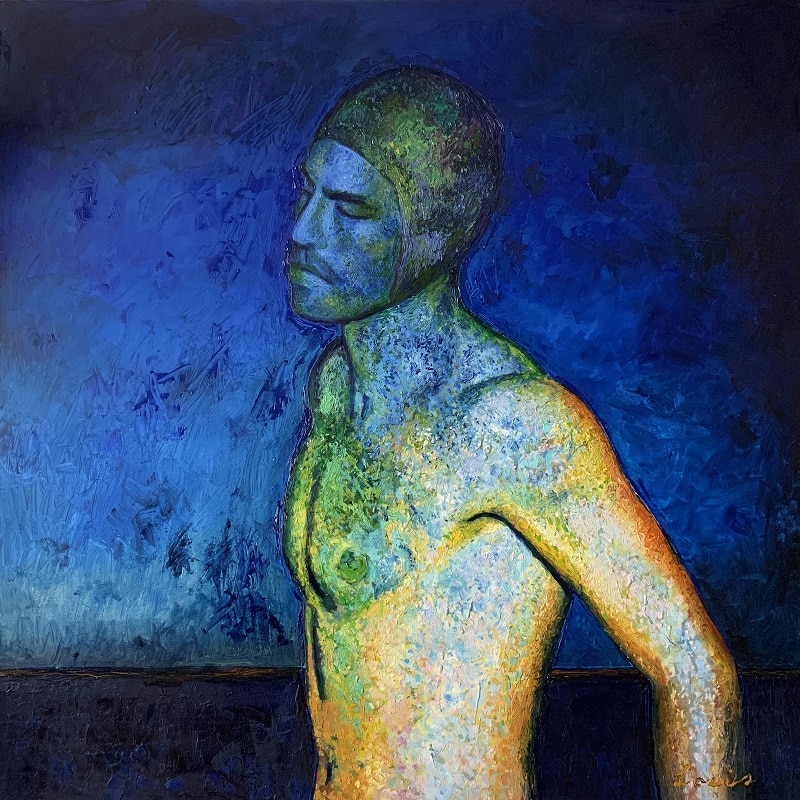
Rodriguez’s most recent collection (partially shown at Modbo) is titled “Experiments Through Color Geometries & The Human Element,” which brings together these types of influences. He says this ongoing series is “experimental and in its infancy.”
Rodriguez, with these paintings, saw something deep within himself and within these colors and textures illuminating “the subtle tension of a story line, or a single figure, within such an environment.” He says he welcomes and challenges the viewer to see things in their own personal fashion and perspectives, but includes that within the live subjects, there is always a sense of hopefulness.
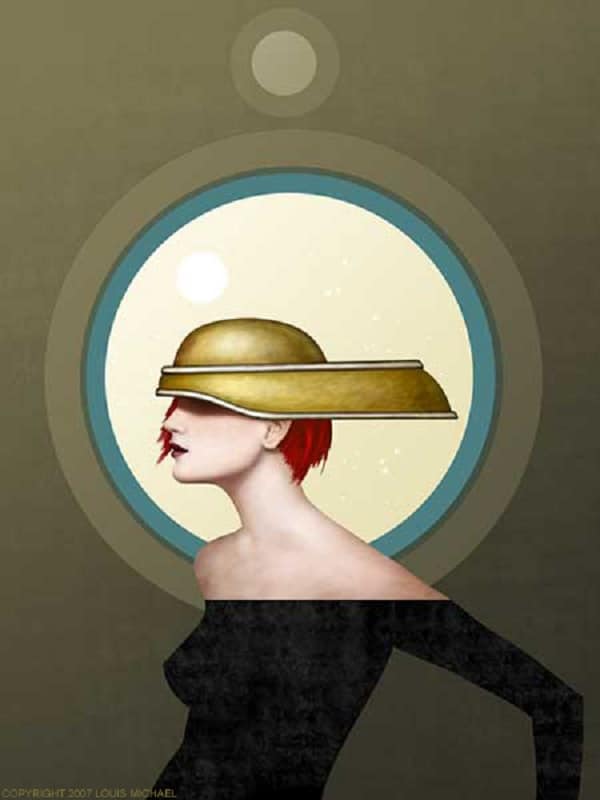
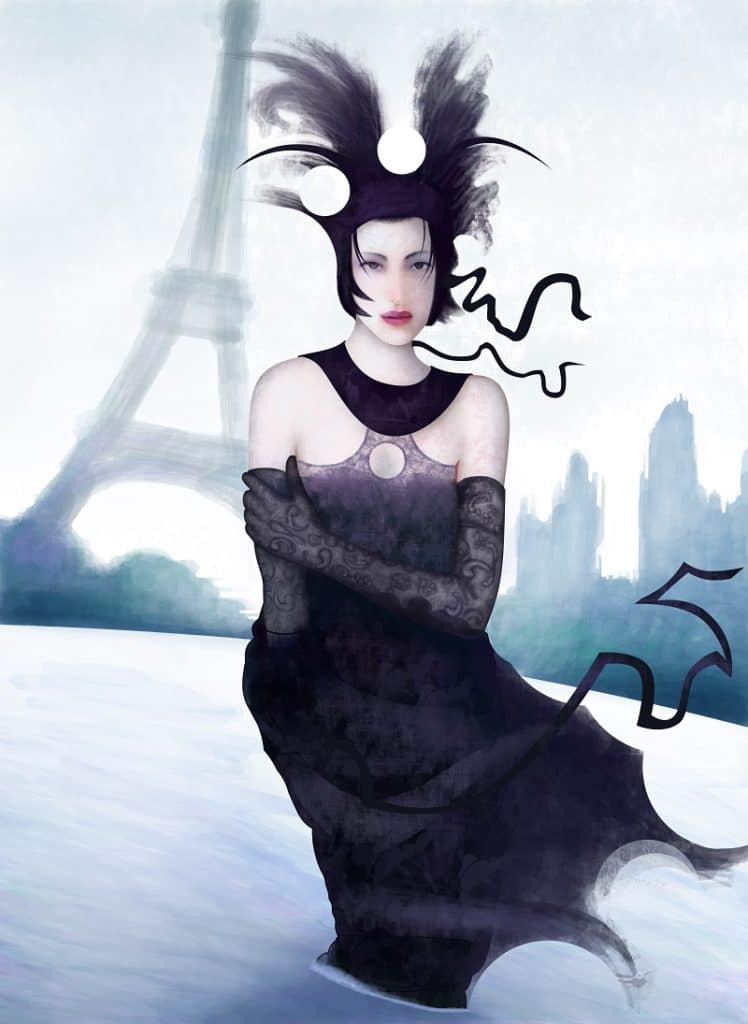
Finding the Horizon
After working for many years as an illustrator, painting book covers for bigger publishers and living in New Jersey, Rodriguez relocated to Colorado Springs. “I came out here in 1999, and I’ve always had a fascination with the desert. It [harkens] to minimalism because if you look at a lot of desert shots with photographers, they really use that horizon line as a minimal separation from the sky and the desert. I dig that, and I enjoy that.”
Rodriguez incorporates these elements into his paintings. “So, living out here in Colorado, I feel like I’m home. And it does have a little bit of an effect on the way that I approach backdrops, not the geometric shapes, but the backdrops themselves.”
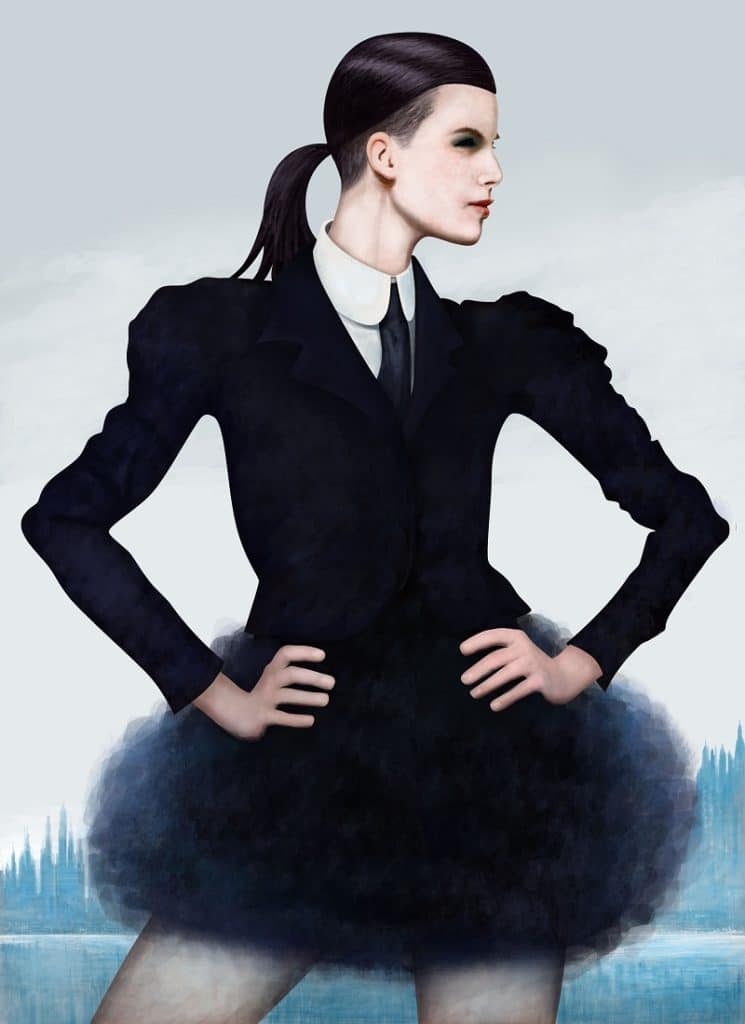
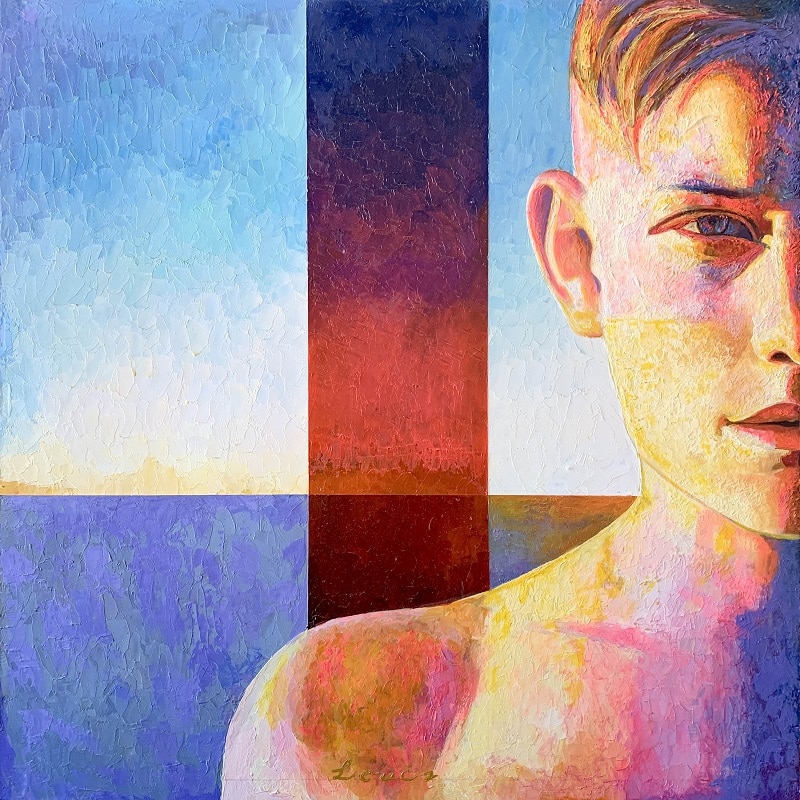
Rodriguez says when he looks at a lot of the abstract artists of the ‘70s, they were doing hard edge with minimal yet beautiful colors and shapes. This inspired and made him really want to place a human factor within that construct. “Hard Edge” is defined as art where abrupt transitions are found between color areas. The color areas are often of one unvarying color and use geometric abstractions.

A Unique Colorado Perspective
Within this style, Rodriguez did not want necessarily the figure to overtake or dominate the painting. “I want the background and the forefront figure to be part of each other. And again, it goes back to minimalism. It goes back to the passion and interest I have for the desert [per se].”
The experience of Rodriguez creating art also impacts how he hopes people see his art. “The psychology of art … that is interesting, because I think about this a lot, right?” Rodriguez says he spends between 12 and 15 hours on one painting but works on several paintings at the same time since he works with oils. When he is doing paintings “hard edge,” he waits until a section dries until he starts putting more tape boundaries for the next pass. Then he will work on another painting – back and forth with maybe five others.

The Psychology of Art
“But I stare at these paintings a lot, and I have my own feeling of whatever is going on inside of me when I paint. But I don’t want to describe my paintings for the most part. When somebody looks at my painting, I want them to have their own experience, their own perception of what they see, what they see in the character, and what they feel is going on because it’s so open to interpretation.”
And beyond this series, there is more evolution in Rodriguez’s style on the horizon. “I have ideas where – because I know how to work with wood – I want to start incorporating maybe some 3D factors within the art. Maybe take the geometric shapes and use eight-inch pieces of wood so they’ll pop out a little bit more.”
He would consider these more “hanging sculptures that are painterly”, a style quite different in form than what he has done before.
While Rodriguez does do commissions in terms of art, he really has not marketed doing those in the style of this series (“Experiments Through Color Geometries & The Human Element”), which is very intrinsic to the subject. “[With this style], I can’t just accept anybody’s commission because I’m very particular about the subject matter.”
That said, he is quite content with his recent showing at the Modbo. “Certain people just said, ‘This is something that you don’t see here in Colorado Springs.,’ meaning the style … what I’m doing with figures, the geometric shapes. I felt good about that. I got a really good reaction from a lot of people and some pieces were sold. So I’m really happy about that and I’m happy about the direction that I’m going.”