



Voter ID laws have been in the news recently – why?
Do you know America is a Constitutional Republic, not a true Democracy? In a democracy, people vote directly on issues, and the majority wins. In a Constitutional Republic, the government must operate within the framework of the Constitution (which limits the government’s power), and We the People elect representatives who serve the interests of us, the constituents.
More importantly, a Constitutional Republic is based on majority rule and can only function through fair and free elections where each person gets one vote.
But what constitutes a “fair and free” election? Do voting identification laws hinder elections, or do they preserve election integrity, and thereby, the right to vote? Let’s find out by examining Colorado’s laws.
Colorado’s Voter ID Laws
In Colorado, voting is done primarily through mail-in ballots, but you can also opt to vote in person. Further, you can register to vote up through Election Day. You can do this either online or in-person at any Colorado Department of Motor Vehicle office, military recruitment offices, a variety of government offices, or at a voter or polling center.
If you want to register online, you’ll need a valid Colorado driver’s license or identification card issued by the Department of Revenue or a Social Security Number (SSN). If you want to register in person, you’ll need to provide one of 16 acceptable forms of identification.
Importantly, all these forms of ID require photo identification or are forms that would’ve required you to prove your identity when registering for them. Keep this point in mind as you continue reading.
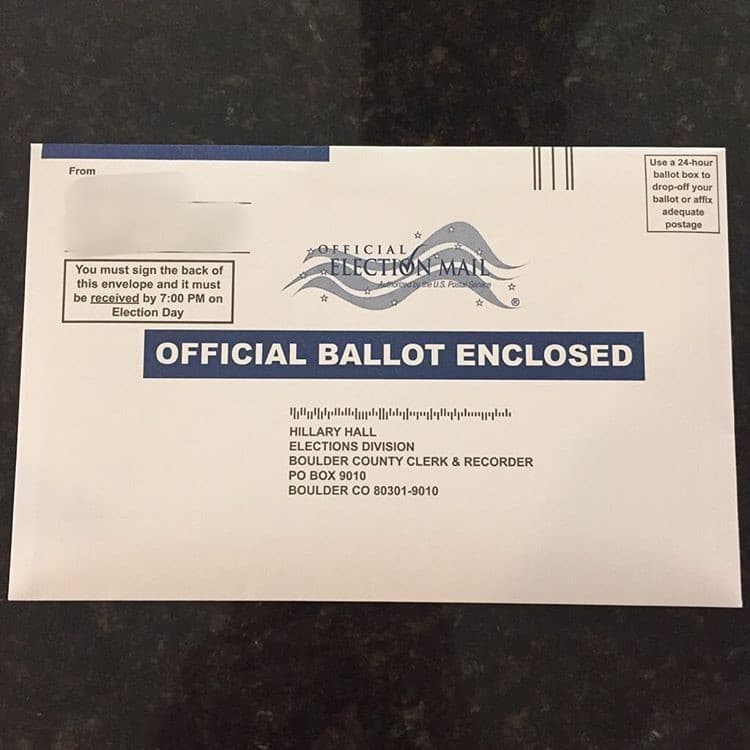
Once you’ve registered to vote, you don’t have to provide ID when you mail in your ballot. Instead, voting officials match the signature on your ballet to an online database. If you vote in person, you’ll be required to provide identification.
For example, a utility bill with your current address and name is an acceptable form of ID when registering to vote or voting in person. But to register for utilities in Colorado, you must provide your SSN. A certified copy of your birth certificate is also an acceptable form of ID. To get a certified copy, you’ll need to provide proof of ID.
In other words, when registering to vote or voting in person, there are acceptable forms of ID that don’t require a photo but to obtain these forms of ID, you still must prove your identity with a photo ID or SSN.
Why Identification is Important
As mentioned above, a Constitutional Republic only works when people participate in fair and free elections — one vote for one person. Representatives are there to “represent” the interests of their constituents, not the interests of the elite. When a representative fails in this duty, they can be voted out in the next election.
If someone, or something, cheats the system (more than one vote per person), the representative isn’t representing the majority’s will and is instead representing the minority. This invalidates a Constitutional Republic because a Constitutional Republic necessitates majority rule.
Thus, to avoid this scenario and ensure each person only gets one vote, states require people to prove their identity when registering to vote or voting in person.
The Race-Baiters
Lately, Democrats have called ID laws racist. They allege that requiring proof of identity disenfranchises low-income and minority (Black, brown, Asian, etc.) voters and prevents them from having their voices heard. Let’s examine this argument.
In 2017, The University of Chicago’s Journal of Politics published a study by a trio of researchers from UC San Diego, Bucknell University and Michigan State, which examined 2006–2014 data from the Cooperative Congressional Election Studies (CCES). The study found that strict ID laws have a “differentially negative impact on the turnout of racial and ethnic minorities in primaries and general elections.” Further, the study found that voter ID laws suppress Hispanic, African American, Asian-American, and multiracial American turnout but don’t impact white turnout.
Obviously, the above study is pretty damning for voter ID laws. And it’s this study that Democrats point to when arguing that voter ID laws are racist.
However, a 2017 follow-up study by researchers at Yale, Stanford and the University of Pennsylvania closely examined the original study, and what they found is shocking.
Specifically, the researchers at Yale, Stanford and Pennsylvania found that:
- The CCES data used is “notoriously unreliable for a voter ID study.”
- In particular, the 2006 and 2008 years had documented errors, but the researchers used the data in their analysis anyway.
- The study didn’t control for variables — if the researchers controlled for variables, they would’ve found that states without voter ID laws have almost the same turnout as states with strict voter ID laws.
- When the study found lower minority voter turnout, it looked at turnout before a state passed voter ID laws.
- The original study was full of misinterpretations of the data and miscalculations.
Consequently, the researchers found that the original study was “deeply flawed.” When corrected, voter ID laws have no significant impact on minority voting.
The finding that voter ID laws have no significant impact on minority voting was further confirmed in 2020 when the CATO Institute examined voter ID laws and their effect on minority voting.
Specifically, CATO examined administrative data from voters in Michigan (lax ID laws) and Florida (strict ID laws) and found, “a change from a non-strict voter ID law to a strict law — the margin over which the most‐serious legal challenges have been raised — is unlikely to have a meaningful effect on voter turnout or election outcomes.”
No, Voter ID Laws Are Not Racist
ID laws don’t suppress minority voting, and when someone argues that requiring an ID to vote is racist, that person is making a faulty assumption at best and is race-baiting at worst.
Further, voter ID laws are there to protect election integrity and thereby safeguard our Constitutional Republic. As such, we should vehemently defend them. Unfortunately, many Democrats are attacking the Constitution and the rights it enshrines. Since the Constitution limits the government, these attacks are concerning and should prompt one to ask why are Democrats attacking it?







[…] recent municipal elections in Colorado Springs, a fluctuating pattern of voter turnout can be seen. In 2019, the turnout was 37.11% with 265,084 […]