


Cryptocurrency has invaded our financial lives, but what is it?
“Blockchain is the tech. Bitcoin is merely the first mainstream manifestation of its potential.” ~ Marc Kenigsberg, bitcoin chaser
When I was 12 years old, I had a paper route delivering Albuquerque Journal newspapers in a neighborhood not far from my family’s house. Before sunrise each morning, I rode my Schwinn 10-speed bicycle to an empty Walgreen’s parking lot where a stack of newspapers was left for me. I quickly rolled them into tight bundles with rubber bands and then stuffed them in a vest containing deep pockets in front and back that I wore as I rode my bike.
In running my paper route, I built a computer database tracking subscriptions and payments. It was an efficient way to track newspaper subscriptions: Some people paid to receive daily newspapers while some paid to only receive the Sunday editions of the Journal. Some people paid for their subscriptions each month while others paid in three or six-months, or one year in advance.
For a 12-year-old kid, ledger books and pencils were intimidating, so I used the computer database to do all the work for me. Today, that information would be far from secure, easily manipulated, and likely hidden from the world. Today, I’m amazed at blockchain technology as it looks to be the newest, greatest technological feat thus far in the Age of Information.
All Blockchains are Databases but Not All Databases are Blockchains
Most traditional computer databases contain tables of information designed and regulated by a hierarchal, centralized feature, such as a database administrator. Often, other database users were granted different roles specific to managing the database. In my paper route days, I was the only database administrator and could make changes to any recorded transaction as often as I needed and wanted.
Blockchain, which began as a theory in computer science in 1982, is essentially a decentralized ledger of all transactions recorded. There is no central administrator to record the information. There are volunteers, or rather, their computers, often called “nodes,” in which information or data is recorded, verified, and stored in a distributed format.
Today, blockchain is increasingly being utilized by the financial sector and healthcare industry because blockchain information is more transparent, secure, and costs businesses less money to maintain. In short, blockchain is the database and information management of the future, and it’s here now.
- Did you know?
- Only 21 million bitcoins will ever exist
- Small amounts of bitcoin are called satoshis
- 1,000 bitcoins in 2011 would be worth millions of dollars today
- FBI bitcoin seizures in 2021 surpassed $1.2 billion
- Majority of Americans know about cryptocurrency but only 16% buy, sell, trade crypto
- Video games and cryptocurrency are slowly merging
- The so-called Metaverse may be facilitated by cryptocurrency
- Cryptocurrency investors donate to philanthropy more than traditional investors
Bitcoin & Rise of Cryptocurrency
The popularity of bitcoin and other digital coins can be attributed to the rising popularity of blockchain-based applications. In 2008, a mysterious person or group named Satoshi Nakamoto created the first blockchain by creating bitcoin. (Recently, a lawsuit may have settled the issue of who first created bitcoin.) Bitcoin was an experiment to use blockchain to facilitate online financial transactions while addressing issues related to transparency, legitimacy, and decentralization away from traditional banking.
Imagine I had a smartphone back in 1983, and asked each of my “clients” to sign up and pay for their newspapersubscriptions through a blockchain service. Imagine many of my 12-year-old peers had smartphones capable of being nodes in my blockchain.
Their smartphones would hold the same data in the blockchain; when a transaction is recorded, that information would be verified, updated and become publicly available and cryptographically secure – and the mining nodes would be rewarded with small blocks of bitcoin.
This is the short version of how bitcoin mining works. (Concerns about bitcoin mining harming the environment continue though there are efforts to reduce and even eliminate the energy demands required of mining.)
The value generated by investing in bitcoin and other coins has fueled the cryptocurrency industry to new heights: a single bitcoin in 2011 was roughly $14; today, a single bitcoin is hovering near $60,000. Tales of instant fortunes made from investing in cryptocurrencies inspire countless people to invest their money in bitcoin and alt-coins, which includes Ethereum, Dogecoin, and Litecoin, among others.
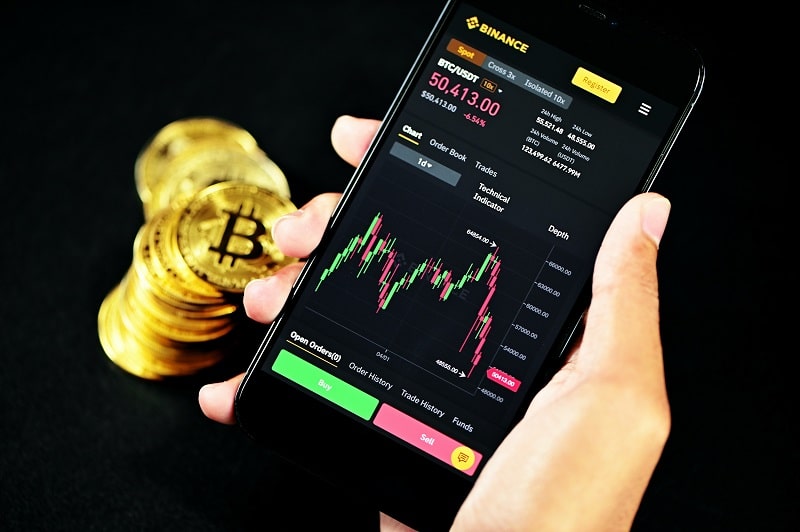
Buying and Trading Coins
Today, there are over 13,500 cryptocurrencies in existence! To begin buying and trading bitcoins and other cryptocurrencies, you will need to sign up with an exchange such as CoinBase or Crypto.com. Both are an exchange and wallet. With a digital wallet, you can more securely buy and sell cryptocurrencies within different exchanges.
Now that you have an exchange and a wallet to begin your cryptocurrency journey, the next question is: What should I buy? Use the information provided by exchanges and wallets to determine future value increases or decreases. Buying the dip is a thing.
Some people adopt a routine of simply purchasing a set amount of bitcoin or other coins each paycheck regardless of the price. Others attempt to engage in cryptocurrency daytrading, which probably should be reserved for those most familiar with investment strategies and so forth.
NFTs Explained
Non-fungible tokens, or NFTs, are part of the blockchain ecosystem. Unlike blockchain-based digital coins, NFTs are not fungible, meaning they aren’t traded like-for-like. A $1 dollar bill and four quarters are traded fungible assets.
When you buy an NFT, you are buying a digital signature of a copy created from the original owner. For example, you can buy an NFT of a personally signed autograph of American gymnast Simone Biles and you’ll receive exclusive VIP access to more of Biles’ select autographs.
Artists of all genres are discovering NFTs are an alternative to traditional forms of selling art. Digital artists, musicians, graphic designers, and more are all joining NFT marketplaces.
Some controversy regarding NFTs harming the environment has remained. Ethereum, the blockchain used by most NFTs, requires energy, or “gas,” as it’s called, when special equipment operates and uses energy to maintain the legitimacy of the blockchain. Ethereum has plans to eliminate the “gas” that results in fees and massive energy consumption. This is a fairly sophisticated issue which you can read more about here.
I recently created an NFT for one of my pictures, and while I didn’t get any offers or sales, it was quite an interesting experience. Some people commented about the Ethereum “gas” and the environment while others saw no benefit to owning an NFT. A few others praised my efforts.
In the end, NFTs may be more akin to art collecting than buying and selling blockchain-based application products. Experts within the NFT and blockchain industries are predicting 2022 will be a banner year for NFTs as interest and popularity in blockchains rises.
Good luck on your cryptocurrency journey.