



Competing Philosophies Approach a Crossroads in Surging Car Thefts
Car theft is spiking in Colorado. Statistics and information from law enforcement, government, researchers, and all levels of media confirm this as shown below. The surge in stolen vehicles is more than simple property crime. The hassle for victims of car theft is more than just major inconvenience and possible financial loss.
Governance, law enforcement, criminal justice, car owners, car sellers, criminal justice reform activists, and others have a stake in solving the problem. At issue are two main topics: 1) How to stop the rampant burgling of vehicles and 2) Disagreement about what the actual problem is.
More specifically, can reformative, gentler sentencing and holistic, personal rehabilitation coincide with fewer stolen cars? In this limited consideration of vehicle theft in the state of Colorado over the past several years, there is correlative evidence saying it hasn’t.
The Statistics are Unmistakable
- 2021: 36,900
- 2020: 28,100
- 2019: 20,700
The rate of stolen vehicles jumped almost 50% for two consecutive years.
While car thefts in other states have also spiked, the problem is particularly bad for Colorado when stacked against others per capita. For 2020, Colorado was at the top (see graph). Only the territory of Washington D.C. was higher. Trailing the Centennial state was California, followed by Missouri, then New Mexico.
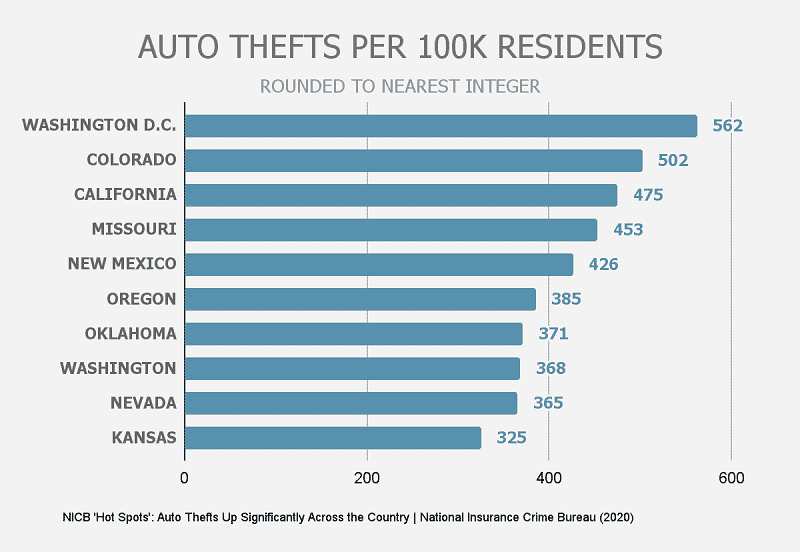
The Colorado State Patrol’s Department of Public Safety knows there is a problem. In a press release on their website they stated “[o]ver this past year, more Coloradans than ever have experienced auto theft in one way, shape, or form personally.”
Secondary Effects of Car Thefts
If a simple insurance claim were the only concern, the problem would be more isolated. However, a stolen car doesn’t just disappear once it’s stolen. Sometimes this is good: around one-half to two-thirds of Colorado’s stolen vehicles from 2019 to 2021 were found. In roughly the first half of this year, 66.9% of Colorado’s stolen vehicles have been recovered.
An accompanying hassle for victims of car theft is the returned condition of their car. A recent story in The Denver Post highlighted this. A Denver psychologist’s Audi A4 was stolen. Though eventually recovered and, technically repairable, it wasn’t. “They had smoked so much meth in it that it was totaled.”
This type of use by car thieves indicates the additional problems with Colorado car thefts: homeless drug addicts or users will steal cars, use them as a temporary or partial residence, and replace them as needed. That is according to Robert Force, director of Colorado’s Auto Theft Prevention Authority.
Lt. James Sokolik with the Colorado Springs Police Department confirmed another compounding criminal effect behind car thefts to KKTV CBS 11. He said that many cars are, indeed, used in other crimes once they’re stolen. Statistics get muddy as there is apparently a legal and statistical detail differentiating what constitutes a directly related crime. The more conservative figure is that 17.5% of motor vehicle thefts are, according to the language in the tables, “with associated offenses.” Therefore, about one in six attempted car thefts has an accompanying crime.
That is, however, an accompanying crime that is charged and registered. The number may be higher behind the scenes. “Roughly 85 percent of auto thefts are involved in other crimes. And I believe about 15 are violent, linking those is the hardest part,” said Colorado State Patrol Sergeant Troy Kessler. “The numbers are just crazy,” he said to Denver 9 News.
How to Solve an Undefined Problem
COVID-19 was economically devastating both nationwide and in Colorado. Much of the car theft is chalked up–by academics, criminal justice reform advocates, and progressive politicians–to systemic injustice. But more immediately, they chalk it up to the economic desperation of the pandemic. “If you’re looking for the cause of why auto theft is up 107% (since 2019), the most likely culprit is economic insecurity, lack of economic opportunity and housing instability. . . . Crime has surged as people are stressed and have lost their jobs,” says Taylor Pendergrass, Director of Advocacy for ACLU of Colorado
Colorado Rep. Leslie Herod (D), a leader in novel criminal justice legislation, noted that crime is up everywhere. Like Pendergrass, she spoke to The Denver Post and shared similar beliefs. She is also committed to risky reforms rather than harsher sentences. “We know these penalties don’t act as deterrents,” leaving little room for ambiguity.
While some politicians and activists want to continue the ambitious, humanistic effort of criminal reform to stop car theft, others want to set examples. “I want to send the message that Aurora is the most punitive city in the state to steal a car so don’t come to steal cars here because you’re going to go to jail,” said Aurora Councilman Dustin Zvonek in The Gazette out of Colorado Springs. His plan, proposed in June would enact a mandatory 60-day sentence for car theft in the city.
Correlation, Causation and Colorado Car Crimes
Policies ostensibly put in place to reduce COVID numbers in tight jail quarters meant the release of certain inmates (or people being held for trial) who would otherwise be kept behind bars. This can account for some of the non-legislative policies that allowed for the higher incidence of crime in Colorado. However, numerous crime bills were signed into law last July by Gov. Polis that likely had an effect.
Colorado July 2021 Summary Points: Crime Bills Signed Into Law:
- Lessened bail/bond requirements for the accused
- Enhanced measures and opportunities to edit, seal or expunge criminal records
- Expanded certain parole options
- Ironically, prevents the department of revenue from suspending drivers’ licenses due to non-payment of court or some offense fines
Another major change in recent years was bail/bonds. $1 or Personal Recognizance bonds for felonies, in the city of Denver, have jumped from 2017 to 2021. In 2017 and 2018, there were zero $1 bonds issued for all felonies. In 2019, they issued two. In 2020 and 2021, there were 249 and 258 respectively.
Even if the results of these Progressive-minded legal changes aren’t crystal clear, they had the practical effect of granting greater access to the open public by criminal offenders. There has been a noticeable increase in the overall crime rate in Colorado, going back before COVID. Car thefts are one part of the trend.
Greater Access and More Crime are Two Dots
Deputy City Manager of Glendale, Chuck Line, is willing to connect those two dots. Surprisingly, as blue districts often favor looser criminal reform policies, Glendale voted to join the Colorado Metropolitan Authority Task Force. Budgeting and manpower constraints, however, threaten it’s continued membership. Line thinks penalties do work. “It’s not a lack of police coverage — it’s a lack of prosecution,” he told The Denver Post; indicating the task force membership might help a bit but is not the broader accountability sought to curb vehicle theft.
More than property crimes, vehicle theft is a safety issue, a quality of life issue, and an economic issue. It’s an issue not just for those who are desperate and destitute, but for every citizen.







[…] Earlier in the year, The Maverick Observer explored and gave some context regarding these and other reasons for the severe motor vehicle theft problem in the […]