

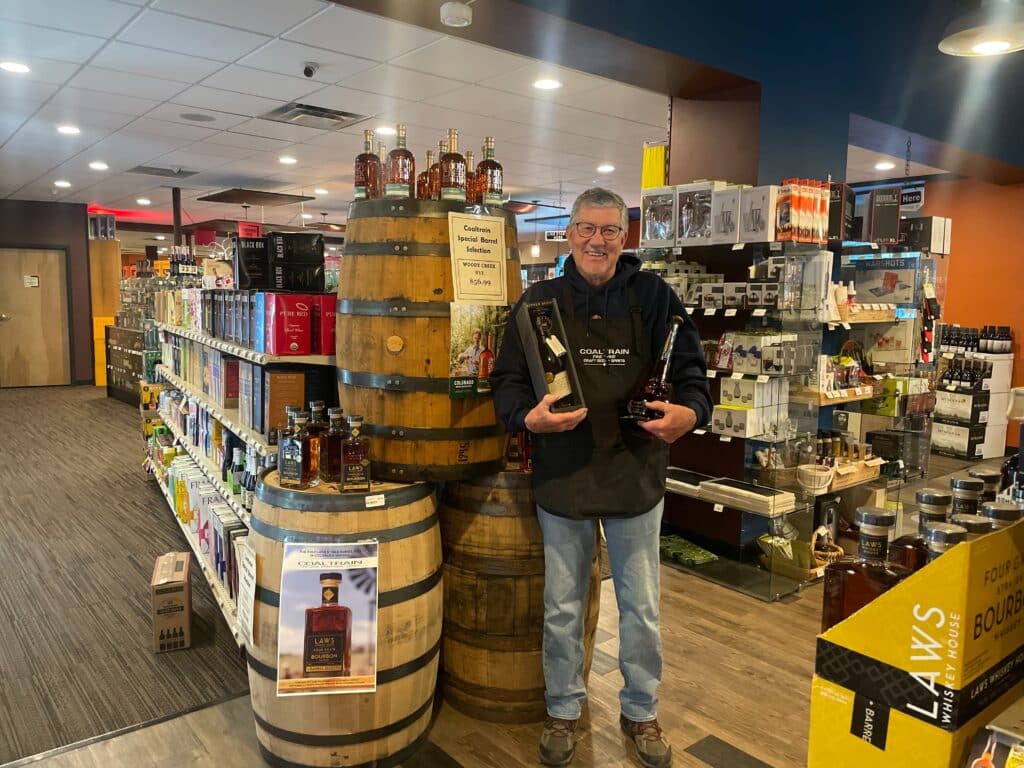
Jim Little understands that the spirits business is changing and that the consumer is changing with it.
With Coaltrain Fine Wine, Craft Beer & Spirits in Colorado Springs, which has been around since 1981, owner Little strives to keep an array of spirits on the shelves. Time and the continual evolution of the Colorado craft beer and brewing industry have allowed him to stay competitive while remaining inherently knowledgeable to help his customers.
Little came to Colorado for college at the University of Denver majoring in hotel and restaurant management. In the mid-‘70s, he opened a smaller store up in Denver near DU. When his partner, Peggy, moved to Colorado Springs in the late ‘70s, she said, “Would you be interested in opening another store?” Little said, “Yeah if you can find a location, it wouldn’t be a bad idea.”
They found a location fairly quickly that was being built near Colorado College and 1-25 which is where they are located today. After six months or so of getting licenses and petitioning the neighborhood, they opened Coaltrain on July 3, 1981. “And when we opened it, it was about a quarter the size it is right now.”
Business is Booming at Coaltrain
From Little’s perspective, craft beer, craft spirits, high-end scotches…“you name it, it’s booming.” He also says the wine business is very, very good because people are up-scaling. “Certainly, the younger generation likes drinking better than the older generation does. We’ve seen a big switch there.”
Little says one of the advantages of Coaltrain’s location is how many hundreds of thousands of cars go by on the interstate a day and how many thousands of cars go by on Uintah. “We picked a good location many years ago, and I think it’s proven to be a great location because despite the growth being a lot more out east, an awful lot of people still come downtown through those two main arteries.”
Little says his store specializes in higher-end products. From the day they opened the store, he says it was with the idea of specializing in wine. “There really wasn’t a very good wine shop when we [initially] opened up down here. So, we always kind of had the idea of being a specialized store.”
And as the products and the demographics of Colorado Springs evolved, Little says people seem to have found Coaltrain as a destination, and not just a local store.
“We have a ton of people that come to see us from Pueblo and Walsenburg and Woodland Park. I think what you’re seeing now is people understanding better products whether it’s food or alcohol.” He says that people are concerned about what kind of food they’re eating and are starting to realize that this is true of alcohol as well. “Some of these really low-end wines and cheap alcohols have as many bad products in them as some of the foods people are eating.” That is why Little is increasing the specialty items he carries like meats and cheese with hopes to expand that even further.

Food and Spirits Culture Evolving in the Springs
“Certainly, I’d like to see the food culture evolve more in Colorado Springs. I do believe that is the case [currently]. I mean, you see so many young people in our store not afraid to step up and buy really good products whether it’s high-end bourbon or scotch or some great wines.”
Little says many people are also looking for organic and bio-dynamic items and asking if the products are sustainably farmed. “It’s pretty impressive. I mean, people are much more aware now than they were back when we first opened our store as to what the products are that are in the bottle.”
Little says as far as local, companies are doing a great job on bourbon and whiskeys. “Obviously, we don’t make scotches here in Colorado. You can’t. You have to make it in Scotland.”
He says that there are also some great gin producers in Colorado, specifically mentioning Lee as an example. He also mentions whiskey distillers Axe and the Oak [Colorado Springs], Laws, and Leopold Bros. [Denver]. He says those specific producers got in several years ago when the distillery business was really tiny coming out of Colorado.
“And the whole industry has just blown up. I mean, now you have to be a lot more selective about what you put [on your shelves]. Initially, there were just so few coming in, it was ‘Oh, I have a local product.’ Now, you’ve got to be a lot more specific and fussy about what’s coming in.”
As far as Little’s palate, he says it is not his job to tell a customer what they’re going to like or not going to like. He says his job is to say how it’s made. “And I certainly give opinions on wines and liquor, but I make it very specific that ‘This is the taste that I like.’ I mean, I love old-world wines but it doesn’t mean California wines or even Colorado wines aren’t good. It’s all very subjective.”
When Little sells a product, people ask him all the time: “What’s your favorite?” “You have to be very careful with that.”

Changing Palates with a Sense of Knowing
As far as palates changing across the board, Little says it is just a sign of the times. They remodeled the store about five or six years ago. “It was always a nice store. My partner Peggy went out and hired an interior decorator and we made the store as high-end as we possibly could.”
He believes that women love shopping at Coaltrain. “They are just as educated about the spirits by far or better in a lot of ways than their male counterparts. If you’re looking at the six or seven barrels that we have in the store right now, many women will tell us what kind of toastiness they like or what kind of vanilla flavors they want.” He says he does think it used to be that men were more associated with going to liquor stores. “But I’ll tell you what, if you spend a weekend at Coaltrain, you’ll see more than 50% [of our customers] are probably female shoppers.”
The pandemic also changed the game because during that time people were experimenting with cocktail-making on their own at home since they couldn’t go out to bars or restaurants. “I mean, seeing the shift in people from just making gin and tonics to people making very sophisticated drinks, it’s impressive. I was talking to some guy the other day about old-fashioneds, and he was saying he’s been in four different bars in the last month or two, and each person makes their old-fashioneds a little bit differently. And we have these different products to match some of these so it’s pretty fun.”
Google has also helped the process. Little explains, “Google is our friend because there are so many regions and so many products. I mean, to know them all would be ridiculous. But yeah, I mean, it has totally changed the game, and the bartenders have become true mixologists. I mean, what was considered an acceptable bartender back when I was growing up doesn’t work now. And I worked in bars. I mean [then], you could make simple drinks and be a bartender. Nowadays, you have to be a legitimate mixologist and know one drop of something can change the flavor of a drink.”
Is There a Point of Saturation?
Little realizes that there might be a certain point of market saturation where it becomes a tipping point. The key for him is making sure he carries a diversity of brands his customers enjoy while remaining selective. “Oh, I think there’s a saturation point. And I think you’re seeing it with some of the breweries. You’ll probably start seeing it with some of the distilleries too. I mean, there’s only so much clientele out there, so I think you’ve got to be pretty careful.”
“I remember, maybe 20 years ago, Michael Myers, who owns 291, the distillery here in Colorado Springs, walking into our store and saying, ‘Hi. I’m Michael Myers. I was a fashion photographer in New York. I lost my job. The economy is terrible back there. I’m coming out here to make whiskey.’”
Little says he looked at Myers and said, “Good luck, Michael.” “And he proved me totally wrong. We probably have 10 different products from 291 in the store. He gets rave reviews from around the world. So, I guess the question is, is there a saturation point? Certainly, there is. And I think you’ve got to be very, very, very good at what you do to enter the market. Whether it’s as a brewer or a distiller. I think you need to be really good at your craft and maybe have something a little bit unique or something different.”