




Publisher’s Note: School districts across the country are taking a closer look at Critical Race Theory (CRT) and determining whether CRT belongs in K-12 curriculum. Locally, on Aug. 12 District 49 voted 3-2 to band the teaching of CRT in its schools. But what is Critical Race Theory? Writer Katie Spence unpacks the theory to help inform your discussions about the controversy.
What do you think of when someone mentions CRT? Perhaps you follow Fox and think CRT is left-wing ideology designed to brainwash kids. Or perhaps you follow CNN and think CRT is necessary to break down a system that’s inherently racist.
But what is CRT? What are its tenets, in other words, and are these tenets problematic?
The Five Tenets of CRT
If you haven’t read the book “Critical Race Theory; An Introduction” by Richard Delgado and Jean Stefancic, I’d strongly recommend it. Delgado is one of the founders and leading figures of CRT, and as such, his book will give you an accurate view of the origins of CRT, the arguments surrounding it, and what CRT hopes to accomplish. For those who prefer the cliff notes version, read on.
There are many components of CRT, and not everyone agrees with every element. However, according to Delgado, there are five basic tenets that most CRT followers agree with. They are:
- Normal Science — Also called The Permanence of Racism, or The Critique of Liberalism is the belief that racism is ordinary and exists everywhere in American life. Also, the idea that “color blindness,” the neutrality of the law, merit, and equal opportunity, allows people to ignore racist policies.
- Interest Convergence — The belief that “whites” will allow and support the interests of minorities only when it benefits “whites.”
- Social Construction — The belief that race is a social construct and does not correspond to biological or genetic reality. Also, the belief that those in power, or “whites,” can manipulate race to benefit themselves.
- Intersectionality and Anti-essentialism — The belief that no person has only one, unitary identity, and as such people have overlapping identities that possibly conflict with their other allegiances and loyalties.
- The Voice of Color — Also called Counter-storytelling, this is the belief that because of their personal experiences with oppression, people of color have a “presumed competence” when it comes to speaking about race and racism and should do so to educate their white neighbors.
It’s important to note that “white privilege” is a theme throughout all of CRT’s tenets. This is sometimes referred to as Whiteness as Property and is the idea that due to embedded racism in American society, being white, or “whiteness,” is an asset that unfairly advances white individuals over people of color.
Pointedly, the above tenets form the foundation for CRT’s argument that America’s policies, practices and laws gave rise, and continue to contribute to, the social inequalities between “whites” and people of color. Let’s examine this argument.
Whites vs. People of Color
One of the most glaring issues with CRT’s argument is that it erases the individual and assigns everyone to groups. One group comprises the oppressed people of color, and includes Black, Indian, Asian and Latinos. The other group is the “white” group. This group isn’t clearly defined but is the group that doesn’t include the above and benefits from the oppression of people of color. To put it simply, CRT sets up a system of “us versus them.”
Consider the following two quotes:
On page 79 of “Critical Race Theory: An Introduction,” Richard Delgado states, “[O]ur system of race is like a two-headed hydra. One head consists of outright racism—the oppression of people on grounds of who they are. The other consists of white privilege, a system by which whites help one another. If one lops off a single head, say, outright racism, but leaves the other intact, our system of white over black/brown will remain virtually unchanged.”
He further defines on page 80, “[R]acism is pervasive, systemic, and deeply ingrained. If we take this perspective, then no white member of society seems quite so innocent.”
According to the Oxford Dictionary, racism is “prejudice, discrimination, or antagonism directed against a person or people based on their membership in a particular racial or ethnic group, typically one that is a minority or marginalized.”
Can racism be defeated with racism? Most would argue no, but the above two quotes are racist by definition. They discriminate and are antagonistic toward white people based on their membership in a particular group.
Are all white people innocent? Certainly not.
Are all white people guilty? Also, no.
As soon as you discount individuals and negatively generalize based on race, you’ve committed an act of racism. More importantly, ignoring the individual removes personal responsibility and autonomy. But that’s not the only problem with CRT.
Outdated Data
CRT originated in the mid-1970s, and it’s essential to understand the context from which it arose. Before the Civil Rights Movement of the 1950s and 1960s, there was widespread discrimination, segregation and racial violence, and America’s laws and policies indeed worked to disenfranchise and suppress people of color.
Thankfully, this started to change following the Supreme Court’s ruling in Brown v. Board of Education in 1954. Then in 1957, Congress created the Commission on Civil Rights, which prohibited interference with voting. However, it wasn’t until 1964 that the first major anti-discrimination law, the Civil Rights Act of 1964, was signed into law. The Voting Rights Act followed this in 1965, and it eliminated qualifying tests for voter registration.
Throughout the 1970s, things continued to improve legally for people of color. But these changes were new and sweeping change didn’t occur overnight. Thus, when CRT critiqued American institutions and laws as being systemically racist, it was correct. But is it still true today?
Ibram X. Kendi, whom some call the “father of Critical Race Theory,” states in “How to Be an Antiracist” that racial equity is “when two or more racial groups are standing on a relatively equal footing.” Furthermore, he clarifies in The Atlantic that perfect equity isn’t the goal; the goal is relative equity. So, let’s look at where things stand.
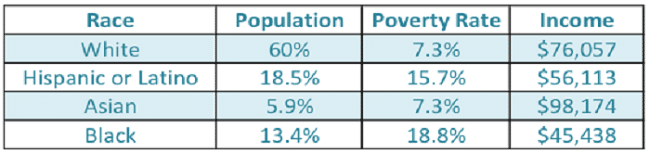
According to the latest data from the United States Census Bureau:
- 60 percent of the population is white, 7.3 percent of white people live in poverty and the median household income is $76,057 for white people
- 18.5 percent of the population is Hispanic or Latino, 15.7 percent of Hispanic or Latino people live in poverty and the median household income is $56,113 for Hispanics or Latinos
- 5.9 percent of the population is Asian, 7.3 percent of Asians live in poverty and the median household income is $98,174 for Asians
- 13.4 percent of the population is Black or African American, 18.8 percent of Black or African American people live in poverty, and the median household income is $45,438 for Black or African Americans.
There are several things you can learn from the above information. The most important being that when it comes to who is doing the best statistically, Asians — who are considered people of color — outperform everyone. Further, when it comes to poverty, blacks have the highest percentage of people living in poverty.
If CRT is currently correct, statistically, Hispanic or Latinos should have a higher rate of people living in poverty, as should Asians. So, what’s going on? Let’s look at some other statistics.
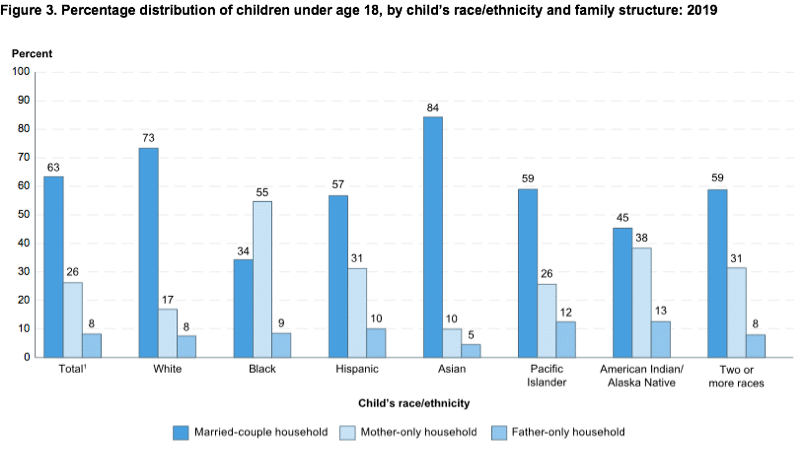
According to the National Center for Education Statistics, when it comes to marriage and children, 73 percent of white households with children are married, 57 percent of Hispanic households with children are married, 84 percent of Asian households with children are married, and only 34 percent of Black households with children are married.
More pointedly, according to the latest data from the Center for Disease Control and Prevention, in 2019, non-marital births for white women was 28.2 percent, for Hispanics it was 52.1 percent, for Asians it was 11.7 percent, and for Blacks, it was 70 percent. But what does this mean, and how does it correlate to the above poverty and income levels?
According to American Enterprise Institute’s (AEI) Poverty Studies, the secret to success is graduating from high school, working full-time, marrying, and then having kids. AEI states:
Young adults who put marriage first are more likely to find themselves in the middle or upper third of the income distribution, compared to their peers who have not formed a family and especially compared to their peers who have children before marrying. … This pattern holds true for racial and ethnic minorities, as well as young adults from lower-income families. For instance, 76% of African American and 81% of Hispanic young adults who married first are in the middle or upper third of the income distribution, as are 87% of whites. Likewise, 71% of Millennials who grew up in the bottom third of the income distribution and married before having a baby have moved up to the middle or upper third of the distribution as young adults.
In other words, Asians have the lowest poverty and highest income rate because they are more likely to wait until they’re married to have children. When Blacks and Hispanics wait until they’re married to have children, they have relative income equality compared to their white counterparts.
What’s Really Going on With Social Inequality and CRT?
“When we are tackling a structure as deeply embedded as race, radical measures are required. ‘Everything must change at once,’ otherwise the system merely swallows up the small improvement one has made, and everything remains the same,” states Delgado.
Delgado further clarifies, “Unlike some academic disciplines, critical race theory contains an activist dimension. It not only tries to understand our social situation, but to change it.”
CRT is more than just learning about America’s racist past. The goal of CRT is to dismantle America’s social structures and institute radical change. It doesn’t believe in progression, and it ignores the changes that have already taken place.
When first introduced, CRT had valid critiques of a system that had suppressed people of color. But like many things from the 1970s, CRT’s arguments are now outdated and haven’t kept up with modern policies and procedures or the realities today. Further, a core component of CRT is dividing people into groups. Marginalizing or demonizing one group for the sake of another is racist and should never be tolerated.
America doesn’t have a perfect past, nor is it perfect today. But we are learning and growing as a society. Moreover, as part of this growth, America has changed the laws to promote equality and equal opportunity for its citizens. But it’s our responsibility as individuals to pursue these opportunities and make smart choices. Unfortunately, CRT doesn’t value equal opportunity and merit and instead sees them as ideas that protect racist systems. This is problematic as it takes away personal autonomy and creates a victim mentality.
Looking at the above statistics gives you a good idea of what’s giving rise to the current poverty and income levels for different racial groups — and it’s not because white people are oppressing people of color, or America is currently systemically racist. It’s because people are making personal choices when it comes to how they want to live their lives, and those choices have consequences.
For more information to aid your own research, consider reading ‘CRT + K-12 = B.S.‘ and watching the video below.







More appropriately called Hypocritical Racist Theory.
Thank you for your comment. We agree that CRT is hypocritical.
[…] isn’t the only person who believes that discrimination against whites is acceptable. As I recently wrote, a preeminent view in Critical Race Theory (CRT) is the idea that no white member of society is […]