



“Government has gotten so big and invasive that it’s really good for us to take a step back and say, is this the proper role of government or is it really better and more effectively done by individuals outside of government?” ~ Laura Carno, author of Government Nearly Ruins Everything
Recently, news of the state’s Front Range Passenger Rail moving forward has grasped the imaginations of politicians and government bureaucrats as well as much of the public.
Politicians and government bureaucrats are clamoring and claiming the public desperately wants a passenger train between Ft. Collins and Pueblo. Reducing “traffic congestion” and the “economic” benefits raised by the proposed passenger train spanning more than 180 miles are the two most cited benefits of this proposed permanent boondoggle.

Conflicting Government Goals, Claims, and Traffic Congestion
Manitou Springs, that lovely little city to the west of Colorado Springs, suffers through summer traffic congestion to the point it is an annual political issue without a solution. Each year, the political class spends increasingly more time and public resources dealing with problems created by traffic congestion.
Most notably is the parking enforcement program in Manitou Springs. It was originally designed to mitigate traffic and parking congestion. The popular mountain town has spent millions of taxpayers’ money buying properties to be converted into glorified public parking lots in vain attempt at controlling traffic congestion. City leaders will tell you traffic congestion harms the city’s economy, and this makes sense in one important context: when there is too much traffic congestion, diminishing point of returns become a major issue and that is where we are now.
What many people in the Pikes Peak region seem to be unaware is that there was a reconstruction project completed on the west side of Colorado Springs and the eastern edge of Manitou Springs in 2014. That project promoted traffic congestion as an economic boon to the edges of the two cities by reducing Colorado Avenue from two lanes to one lane in each direction.
In fact, one may say traffic congestion is a feature and not a bug of the West Side Avenue Action Plan. To wit: Traffic congestion in Manitou Springs is caused by a government reconstruction project featuring increased traffic congestion in both Colorado Springs and Manitou Springs.
Lane Dieting and Bike Lanes
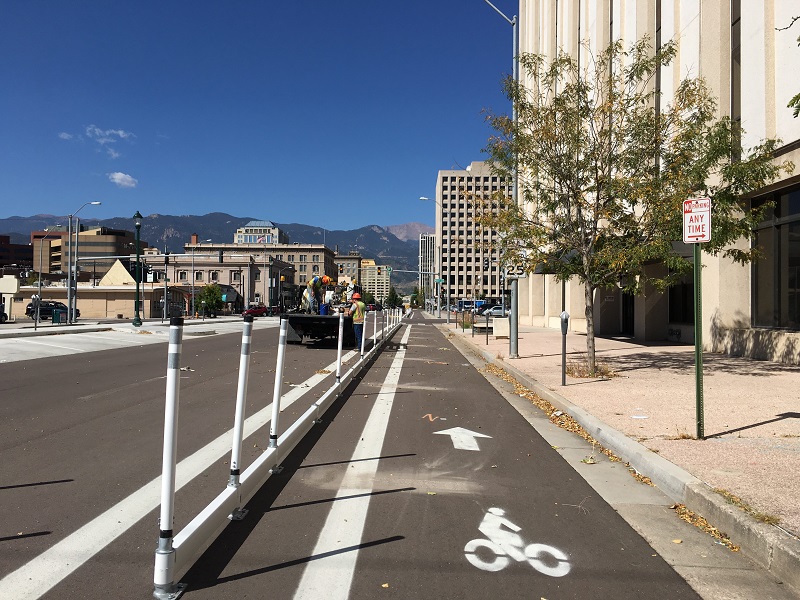
While this was all happening, there was something else related to traffic congestion in downtown Colorado Springs: Lane dieting has put bicyclists directly next to rapidly moving two-ton metal machines. Former Colorado Springs traffic engineer who supported bicycle lanes is quoted as saying, “Traffic congestion is good.”
Former Colorado Springs City Councilor Jill Gaebler is a supporter of those same traffic congestion enhancing policies. She has claimed lane dieting reduces traffic congestion, which is in direct contrast with the former city Traffic Engineer’s opinion.
Gaebler is also a voting member of the state’s Front Range Passenger Rail Commission and has launched herself into the political limelight with continued support of the proposed Front Range Passenger Rail. She claims “traffic congestion” as a reason for supporting the passenger rail project.
Front Range Passenger Rail
This pie-in-the-sky proposed passenger train boggles the mind: it will cost anywhere from $2 billion to more than $14 billion and may take up to 10 years before the first passenger purchases a ticket from Colorado Springs to Ft. Collins.
There are problems with the idea of the FRPR reducing traffic congestion. First, the issue of traffic congestion continues to be a problem government bureaucrats and politicians seem to enjoy tinkering around with as if humans are pegs on a game board. Second, traffic congestion can be mitigated in a variety of other non-rail means, such as encouraging carpooling, ride-sharing services, and even drone delivery services. Third, since the FRPR would not likely be completed for more than a decade, who knows what technologies will come along to move people without creating traffic congestion.
Fourth, and this is an important one: Governments often create problems to solve, ensuring job security for those involved and we’ll see this with latent demand, in which traffic congestion mitigation will be quickly replaced with more traffic congestion. Let us not forget Denver has not completed RTD lines in that city and a healthy dose of skepticism is required when discussing the FRPR and Denver. In some ways, the FRPR is being pitched as a solution to previously failed government interventions into the passenger rail market.
Finally, there is the pandemic and how it has changed the workforce in Colorado: more people are working from home meaning fewer people commuting to Denver or Colorado Springs. And there’s always the possibility the economy will crash and communities along the Front Range will not be able to afford to pay for a boondoggle nobody rides.
Taxpayers Beware
The conflicting purposes and goals of various government projects should illuminate why the Front Range Passenger Rail project should end today. As we see in the west side of Colorado Springs and especially Manitou Springs, the problems related to traffic congestion are directly caused by the policies of both cities. Is traffic congestion on I-25 really something the FRPR would reduce? Not likely.
Traffic congestion mitigation is not truly a goal of the FRPR. It will create more jobs and job security for government bureaucrats and politicians while forcing the costs onto taxpayers in the state.
A Solution to Traffic Congestion
In New Mexico, the infamous Rail Runner Express, now called RioMetro, a government funded passenger train between Albuquerque and Santa Fe was a much preached about solution to traffic congestion long before it was built. It failed; revenue from ridership is a fraction of the overall expenses: $2 million in revenue vs $28 million in operating expenses.
When first built in 2006, the RioMetro cost taxpayers north of $834 million and is now expected to cost upwards of $110 million a year in the near future. It has suffered terrible delays and other problems. It was touted to reduce traffic between the state capital and the state’s largest city. Once it was built, the RioMetro fell on difficult times and a recent scathing report showed the passenger rail continues to suffer from declining ridership. Why has it failed so badly?
Ugly Details of the Train Systems
I’ll spare you all the ugly details, but the simple answer is that most passenger train systems focus less on service and more on funding. Freight train services are highly competitive, unlike passenger trains, mainly because passenger train services are highly regulated. The RioMetro is a lesson in that government planners are quite often wrong on their predictions and the public is left to pay for these expensive mistakes. Curiously, among the passenger rail train systems mentioned in the FRPR website, the RioMetro is not included.
Of course, the final suggestion to reduce traffic congestion along I-25 and the rest of the Front Range is to advocate for more bicycle lanes. I’m kidding. But the fact remains that government is not and should not be considered the first solution to problems it causes.
As Laura Carno states in the quote at the top of this article, government nearly ruins everything because government ain’t suited to build efficiency and productivity. It has become the domain of politicians and government bureaucrats who want government to create problems for government to solve to create more problems and that’s what the FRPR fundamentally is: a permanent boondoggle for the political class.
Take it from the El Paso County Commission: Just say no, Colorado.
[democracy id=”29″]
[democracy id=”30″]
[democracy id=”31″]







[…] the idea of public transportation, in the form of the Front Range Passenger Rail tickles your funny bone, check out Kirk’s […]