


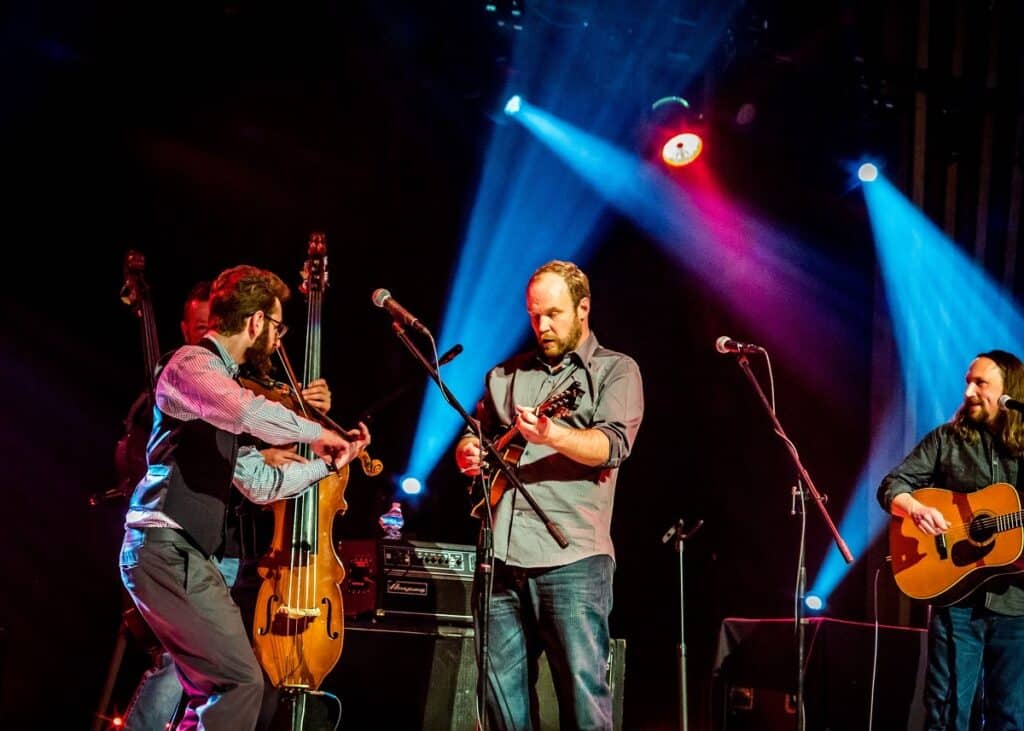
Grass It Up is an American Bluegrass band established in Colorado Springs in 2004. Started by David Jeffrey and Jon Bross, they came to prominence playing at Front Range BBQ on West Colorado Avenue. Fiddle player David Siegel, a Manitou Springs native, joined in 2014 with the band continuing to play throughout El Paso County and numerous festivals.
Siegel was trained as a classical violinist, but he says he always had a hankering for bluegrass. When he moved back to Colorado Springs in 2012 from New York, he met and spoke with Jim Marsh, the band’s banjo player at the MeadowGrass Festival. “With bluegrass, it’s really an oral tradition. It passed down from person to person by hearing it … and teaching it to the next generation.”
Siegel says, in that way, it is very different from classical, which is a written tradition. Marsh invited Siegel to his house, which they affectionately called “The Pirate Ship” to “pick along” at a Grass It Up rehearsal. “I don’t think the rest of the band honestly even knew that I was coming to rehearsal. You show up and you just start making music together, and either it works, or it doesn’t.”
At the time, Siegel had just completed a classical violin performance degree at the Manhattan School of Music. “So, my chops were in good shape. And I knew how to improvise because I had played jazz for years. But I didn’t know the language of bluegrass. I just sort of hung out in enough rehearsals that they started inviting me to gig.”
The Language of Bluegrass by Grass It Up
Siegel says bluegrass has a certain language to it that can be hard to describe. He says that bluegrass has an incredible drive. “And when there’s a banjo in the band – the rolling banjo pushes everything forward. There is a chop of the mandolin on the second and fourth beats – and the bass is playing on the first beat and the third beat.”
While he says that description overly simplifies it, Siegel explains that this interplay really pushes everything forward. “You can change a tune based on when exactly the bass plays a note and when exactly the mandolin chops or the guitar chops or the fiddle chops … whenever you do that, you get that percussive element. I think that’s a huge piece of the bluegrass language.”
Siegel says each member of Grass It Up is both a soloist and rhythm player, which creates a step forward, step back dynamic to a live show. “It forces you, without a drummer, without someone solely tasked with keeping the beat, to the fact that everybody is in charge of laying that foundation down. It forces you to listen and to respond in the moment.”
While they didn’t perform a lot during the pandemic (plus wintertime is usually an off-season for them), Grass It Up is planning to return to festivals this summer. It is that exchange of energy that the band revels in, Siegel says. “Performing is always a two-way street. When we’re on stage, we’re all the time gauging what an audience is reacting to and adapting the setlist along the way so it’s a total conversation.” He also points out that two of their six albums were done live.
Grass It Up rehearsed in somebody’s backyard for the most part during the pandemic but weren’t playing gigs. “Grass It Up went from playing 40 live shows a year to zero,” Siegel explains. The first live show they played during that time was in late summer 2020 at a concert put on by Rocky Mountain Highway at what is now Security Service Field. “And people were seated out across the outfield in 10-foot boxes.”
Siegel says though that the feeling, in that weird setting, was still magical, “Even without people dancing, without people up front, right up front on the edge of the stage, (it was great) just to feel that energy again.”
He says the pandemic gave the band an appreciation for what it’s like to perform live and how important it is to do what they do. On the flip side, Siegel said it also gave them the opportunity to write some new songs and pursue new ideas that weren’t driven by how it would show up in a live performance.
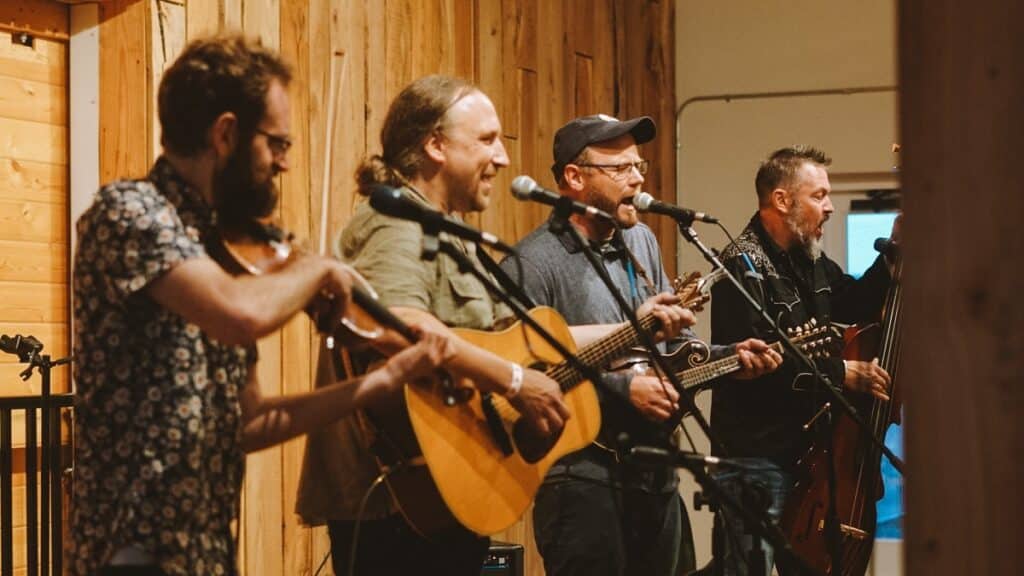
Mixing up Live Performances with Fast Tunes and Ballads
“We’ve actually added some more ballads to the set, which actually, in retrospect, work really well in a live setting,” Siegel continues. If you’re just playing fast ripper after fast tune, an audience can kind of become desensitized to it. So, you need that contrast.”
He explains that when a band is playing live all time, it’s easy to fall into the trap of just high energy. “And I think having the space during COVID away from performing gave us that space and inspiration.”
To bring it back to basics the inspiration that ultimately brought the band together in the long term was the beauty of Colorado. “So, the band formed in Anniston, Alabama.” David Jeffrey, the mandolin player, and Shannon Carr, the guitar player, grew up together in Anniston and were friends. Jim Marsh, their now-former banjo player (who brought Siegel in) was in Anniston as well. Marsh taught Carr the oral tradition of bluegrass when Carr was in high school, and then Carr taught Jeffrey.
Jeffrey was the first one to move out to Colorado, and then Carr followed. Jon Bross was already in the Springs and played rhythm guitar. They formed a trio in 2004, which Siegel says really had an authentic, vibes-style language.
And then a few years later in 2010, Marsh came out to Colorado initially just for the summer and liked it so much that he stuck around and joined the band as well. “The end result is you have this band that’s the whole Jim Marsh family tree style of bluegrass training because Jim had passed on his initial knowledge of bluegrass to Shannon and to Dave.”
Siegel says bluegrass and being part of the band have made him a better player overall. “Like all things, the more familiar you become with a language or a genre, you notice more nuance in that language, in that genre.”
Many of the members play inside projects but always return. “Having a taste of or having these outside inspirations I think is actually really important to the band.” Siegel reaffirms that they are not a traditional Bluegrass band. “We don’t sound like Del McCoury. We’re not trying to be a museum piece for what Bluegrass is or was. It’s more about how we can use the basic structure pillars of Bluegrass to tell a story.”