


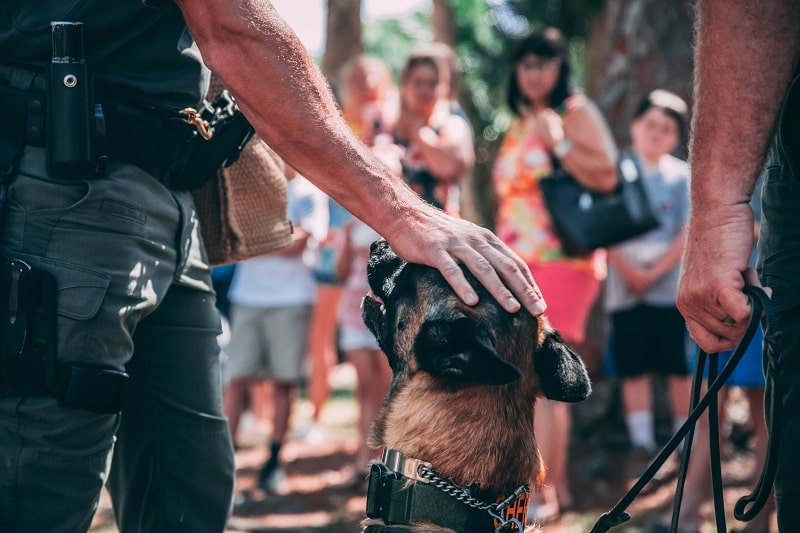
Man’s best friend has been by our side for thousands of years and has helped us in a multitude of ways throughout the ages. From guarding homes and livestock to hunting game and fighting alongside us in wars (and, of course, simple companionship), dogs have proven adaptable and useful in a variety of roles. In more modern times that role has expanded into assisting law enforcement, as law enforcement K9s.
Local Law Enforcement K9s
Locally, several K9 officers serve our community. The Colorado Springs Police Department Specialized Enforcement Division employs several K9s who assist in all areas of their jurisdiction. They typically support the patrol division but can assist any section that requires their help.
The Fountain Police Department also has its own pair of K9s, both working as detection dogs. The El Paso County Sheriff’s Office has a K9 unit that includes a mix of patrol and detection dogs, who remain on-call 365 days a year, often assisting outside agencies, including the FBI and ATF.
Tragedy struck in April of this year when 3-year-old EPSO K9 Jinx was shot and killed in the line of duty while assisting officers and deputies in dealing with a gunman in Manitou Springs. The outpouring of grief and support for the fallen officer shows what an impact these dogs can have in their communities, as well as the very real risks they face. In these tragic situations, these dogs typically receive full memorial services and the penalties for intentionally injuring or killing a police K9 can be severe. K9 Jinx will be remembered for his courage and heroism and will continue to be missed.
A Brief History of the K9
It is impossible to determine when exactly canines were first employed alongside law enforcement. Some believe it began during the middle ages, while others cite evidence more specifically to the 1880s.
What is known, however, is that the first official uses of modern police dogs can be traced to Belgium and Germany around the end of the 19th century. Specifically, a training facility in Ghent, Belgium is credited as the earliest K9 facility, as it focused on breeding and training dogs solely for law enforcement purposes.
In 1907, a New York police commissioner sent an inspector to study the program in Belgium, and several dogs were brought back to start a breeding and training program in America. This was the beginning of the modern police dog era, though the program disbanded by 1918. It was not until witnessing the usefulness of dogs in World War II that widespread interest in the use of K9s returned in America.
By 1956, the Baltimore City Police Department had a successful K9 program that became the model for many others, and more and more departments gradually began bringing K9s on. However, it took until the 1970s for their use to become more common across the country.
K9s have proven to be beneficial in a variety of ways, from getting narcotics off the street and taking down violent criminals, to finding missing persons and improving public relations. It can be expensive for departments and agencies to begin a K9 program, but the investment in training and care can pay off for the agency and community alike.
The Many Roles of the K9
The modern K9 can appear in several roles, with several breeds being suited for these functions.
Most recognizable may be the dogs used for apprehension (also known as “patrol”). According to the American Kennel Club (AKC), these will typically be large and athletic breeds – most commonly, the German Shepherd, Belgian Malinois, Dutch Shepherds, and similar types. These dogs need to be substantial enough to bite and hold violent suspects, but also agile enough to clear buildings and jump or climb over obstacles. They also need to be aggressive enough to protect an officer, but trainable enough to stand down on command.
The AKC goes on to explain that other dogs are used for detection, whether for narcotics or explosives. Many breeds can qualify as detection dogs, though bloodhounds and Labrador retrievers are perhaps the most seen breeds thanks to their exceedingly strong sense of smell. These dogs must be able to detect and differentiate different types of drugs, chemical compounds, or other indicators of an explosive.
Detection dogs are typically trained for narcotics or explosives, not both. Detection dogs can be found in jails and prisons, at airports, at large events, at scenes where arson is suspected, or working alongside patrol units on traffic stops or during other encounters. These dogs must be obedient, communicative, and patient.
Still, other dogs may be used alongside law enforcement for manhunt and search and rescue operations. These dogs may be employed to search for a missing person, a suspect who fled a crime scene, or for people trapped by a disaster. Breeds mentioned above may be used due to their heightened sense of smell, but other breeds may also work in this role. These dogs must be obedient, courageous, agile, and sturdy enough to work across rough terrain or rubble.
In more modern times, a movement has also begun to get more comfort or therapy dogs working alongside police departments as well. Not technically K9 officers, these dogs are still valuable to the victims and witnesses of crimes and violent acts, especially children. Any breed of dog can be suitable for this role, as temperament and personality are what are vital.
Some departments, such as the Greenfield PD as mentioned in the same article, do prefer larger dogs that people can physically lean on without causing harm. Comfort dogs and their handlers also receive extensive training and preparation, so they can assist those in need.
Some K9s may be cross-trained, otherwise known as “dual-purpose.” They are usually trained in patrol or apprehension work, as well as detection – typically for narcotics. Others are single purpose – just focusing on apprehension or detection.
Whatever their specific role, K9s are required to be successful with basic obedience before moving on to more advanced instruction. They will typically engage in training throughout their entire careers, as will their handlers. The relationship between the K9 and their handler is of utmost importance, as the role requires a true partnership, trust, and lots of training and practice. Many have to meet certain training hour quotas and must put in the effort to bond with their dog, keep it in good physical condition, and attend to its needs before their own.
K9s provide a valuable service to their community, built upon the relationship between dogs and humans that have evolved over thousands of years. As their roles expand and change, they continue to surprise and impress us with their versatility, courage, and heart.