

Improving trails and creating new ones, both for conservation, community connection, and outdoor enjoyment, is what drives Medicine Wheel Trail Advocates. For over 30 years, this non-profit organization has focused on creating and maintaining trails for mountain bikers through building relationships with local land management agencies including the City of Colorado Springs Parks Department, El Paso County Parks, the US Forest Service, the BLM, and Colorado State Parks. Executive Director Cory Sutela understands the value of such projects, many of which take years to complete but teach people about stewardship but also enhance access to our outdoor spaces.
When Sutela moved to the Springs in 2004 to take an engineering job, he was already interested in the outdoors and mountain biking having spent time in Vancouver for work. When he arrived, “I learned that there was some interest in building a free ride park, which we now call the skills park in Red Rock Canyon.”
The free-ride movement had been strong in Vancouver with some great trails Sutela often rode. “So, I was interested in that kind of riding and that’s how I first got involved with Medicine Wheel with the Red Canyon [project].”
Sutela says, at that time, he didn’t know anything about trail building. “I was really learning from the others in the organization.” He says that’s probably the most important aspect he would emphasize about joining Medicine Wheel as an advocate and builder of trails. “[Medicine Wheel] has this amazing history and wealth of knowledge of really skilled trail builders. And what fascinated me was the fact that there was permission to do this. And how did we get permission to do this?”
Sutela wanted to learn how decisions were made about public lands. “I didn’t really have any background on who owned what land and how decisions were made about public spaces. As I got more involved with Medicine Wheel, I was curious about the people that make the decisions and how to influence those decisions?” That led Sutela to the Trails and Open Space Coalition.
Sutela joined the Trails and Open Space Coalition as a board member and served with that organization for six years taking on various responsibilities including secretary and VP of advocacy. Through these positions, he learned a lot about nonprofits. He kept working with Medicine Wheel throughout his time there.
The forming member of Medicine Wheel Trail Advocates – Brian Gravestock, was no longer consistently involved but Sutela said the people that taught him the most were Jim Schwerin and Harry Hamill. Hamill, he says, continues to work with the organization closely. “And he’s really one of the most skilled trail builders that I’ve ever known.”
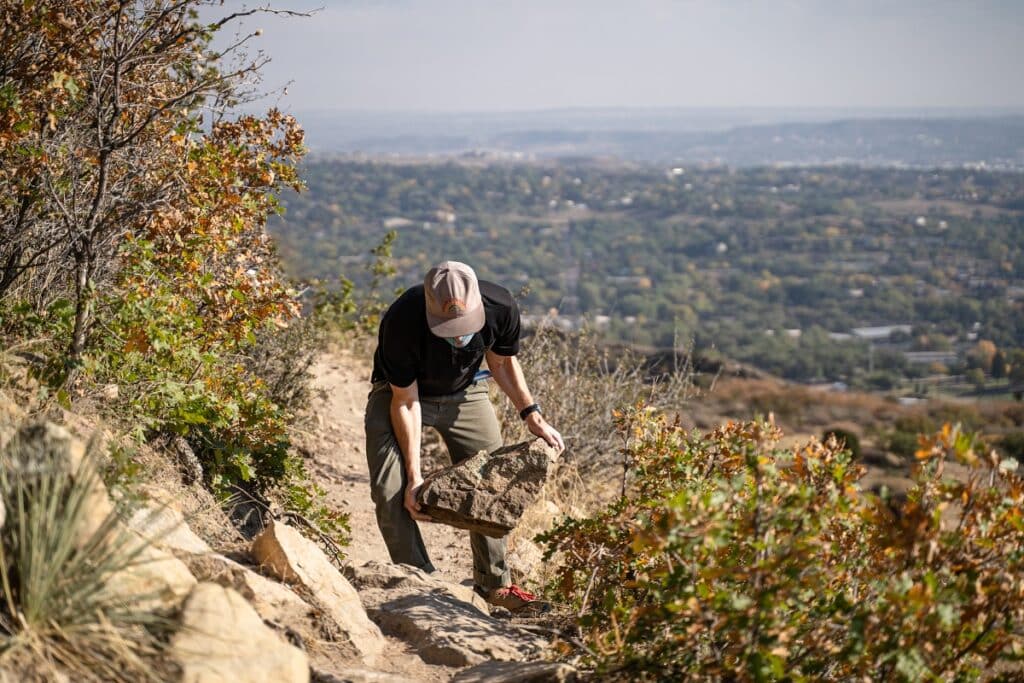
Learning Technical Trail Layout from Mentors
Sutela learned the technical parts of trail layout from these two men: how to use a clinometer, how to look at the landscape, and really see the future potential of what could be there. Building trails, Sutela says, requires artistry. “In a way, it’s like road building or civil engineering. There are basic principles that you can follow. But to be able to look at the landscape as a whole and find the really unique experiences and see through all the vegetation to see what’s possible [is key].”
Hamill taught Sutela that to build a trail you’ve got to go spend some time on the land and go back many times, make a potential trail layout, and then go home and think about some more and come back. “I can’t tell you how many times a walk-through was done on the Lake Moraine Trail. Probably hundreds of on-the-ground visits to go and really look at what was possible.”
Normally, Sutela explains, in the process of trail building, the assessment of the natural resources is generally done by the time a trail layout is complete, so the builders are aware of the constraints.
“And typically, for a public land manager, they’ll hire biologists and paleontologists and archeologists. So, we always say, ‘Yeah. we get involved after the -ologists have gone through.’ And so, we’re walking into public land, with permission and approval, to start construction or at least start the design and layout.”
Sutela says, though, as a lover of the outdoors, and especially when someone’s new to trail building and corridor clearing, it can be kind of heartbreaking. “There is a natural human tendency to say, ‘Oh, OK, there’s sort of a social trail here. I’m going to go around this bush.’ Or ‘the scrub oak is really thick there so I’m going to go around this way because it’s too hard to get through.’”
He explains that when they lay out a trail, they must see through that. “And we often will take out a lot of vegetation. There are some trees that are really important that we really work hard to try to keep. But there’s a lot of vegetation that we’ve just got to take out. And that can be a little bit heartbreaking.”
Sutela says they try to do it in a thoughtful way, but he says after the trail is in place and has been broken in a little bit, it looks like it fits in the environment. “But right at the beginning, it really looks like devastation. You have to clear a really quite wide corridor in order to create a good trail bench that eventually will narrow down so that it’s a compelling piece of single track.” This can usually require 6, 8, or sometimes 10 feet of width.
“It happens every time. We had a corridor-clearing event last night where we were building a new trail to connect Bristol School to Mesa Open Space. And it was all about corridor clearing.” Sutela and the crew, all volunteers, spent hours taking out a lot of vegetation including scrub oak and mahogany. “It’s not endangered or rare, but you always get a [sinking] feeling when you take out vegetation. It really is just part of it.”

‘Experience as a trail builder is connected to vegetation.’
Sutela continues that an experience as a trail builder is always directly connected with vegetation. He also outlines a case they had with the greenback cutthroat trout for the Lake Moraine trail, where it had to be adjusted based on a specific location where wildlife habitation was extremely important.
“[For that trail] you cross the cog, cross under Lake Moraine, and then drop into Jones Park and Bear Creek where the trail finishes. But it goes down through the Bear Creek drainage. Bear Creek is the place where there are greenback cutthroat trout, which is Colorado’s state fish – and it’s the only place where there is a living population in the wild of our state fish.”
So partway through the planning, which was a 20-year process for the Lake Moraine Trail, Medicine Wheel became aware of how special those fish in that specific drainage were. They entered a federal process related to that because these specific trout were listed as threatened under the Endangered Species Act. “I mean, you don’t really see a lot of them, especially if you’re riding through there. But the trail used to go right down in the drainage.” The planning was able to be adjusted to conserve and protect a valuable resource that might have been unseen.
Being aware of vegetation and life along the trails had widened Sutela’s approach and wisdom. He says bighorn sheep are a major concern that he is now more attuned to. There’s also the Preble’s Meadow Jumping Mouse, which is a listed endangered species, that’s around a lot of the streams. “I would say, over time, I’ve started to become more aware and looking for those things now. But every time I build a new trail and I’m cutting out vegetation, you feel it directly because you’re directly taking out some of the natural resources there.”

Attracting New Generations Through Connection to the Land
Ultimately building these trails with Medicine Wheel’s group of volunteers, it comes back to the connection to the land. “I think it’s a natural thing for humans or at least for people that live in this kind of area. We connect with the land when we’re out there on trails. And the more we can connect with the land, the more we will become stewards and want to care for the land. So, it’s an inevitable consequence.”
This element is key in attracting new generations whether it is building trails in conjunction with a school as Medicine Wheel doing in Fountain Valley or creating a skills park.
“Every time we make trails, we are building not just trails, but we’re building stewards. Not everybody is going to really connect and resonate like that. But it is very rewarding when you see the smile on someone’s face, and you can really tell how much they’re connecting with their experience on the trail.”
Sutela says he hears from people all the time: “I feel like the trails give me so much. I really want to give back to the trails and that’s why I want to volunteer.” He says it feels wonderful, for him personally, to be able to provide those experiences and allow people to connect directly by not just using trails but doing trail construction.
Sutela says that this is always the case when a person goes and does trail construction or trail maintenance. It fosters that memory. “Every time you use that trail for the rest of your life, you’ll remember that rock that you touched. You really can zoom into a section of trail, and it becomes part of you when you build it, or do substantial maintenance work, so both the use of the trails and the trail work that we do, that’s why we call it trail love. People really connect and really want to show their love and give back to the trails.”