


On January 19, Senator Bob Rankin (R-District 8) and Representative Hugh McKean (R-District 51) introduced Senate Bill 22-073, “Alternative Energy Sources,” in the Colorado General Assembly. And after its introduction, SB22-073 moved to the senate’s State, Veterans and Military Affairs committee.
If it’d passed, SB22-073 would’ve required the Office of Economic Development to look at the possibility of establishing small modular nuclear reactors as a carbon-free energy source for Colorado. But apparently, nuclear energy isn’t the right kind of green energy for Colorado Democrats, and the bill failed on a party-line committee vote. Here’s why this is bad for Colorado.
Green Energy and Nuclear Power
Over the past year, The Maverick Observer has taken an in-depth look at Governor Polis’ plan to move Colorado to 100 percent renewable energy by 2040 and how, for Polis, this involves modernizing the Public Utilities Commission (PUC) to include more wind and solar.
However, what we’ve discovered is that neither wind nor solar are reliable sources of energy. Consequently, the energy produced from wind and solar must be stored in batteries and supplemented with natural gas and coal.
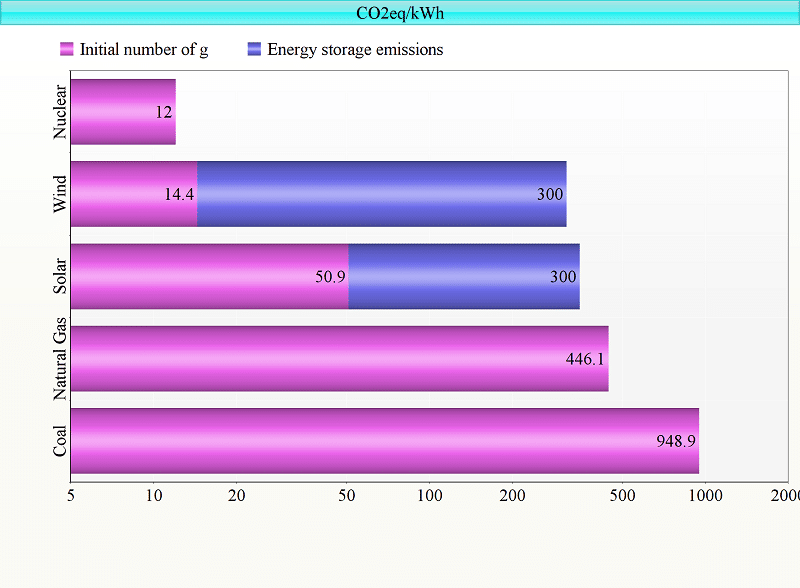
The problem is that coal produces a mean carbon dioxide equivalent (CO2eq) per kilowatt-hour (kWh) of 948.9 g CO2eq/kWh, and natural gas produces 446.1 g CO2eq/kWh. This is significant in terms of greenhouse gas (GHG) emissions.
And while initially onshore wind power only generates 14.4 g CO2eq/kWh, and photovoltaic power (solar panels) generates 50.9 g CO2eq/kWh, once you add storing energy in utility-scale lithium-ion batteries, emissions increase between 70 g CO2-eq/kWh and 300 g CO2-eq/kWh GHG. In other words, once you store wind or solar energy, it becomes significantly less “green.”
On the other hand, nuclear energy produces no GHG emissions during operation and throughout its life cycle, produces approximately 12 g CO2eq/kWh, according to the World Nuclear Association. Simply put, nuclear is as “green” as wind. More importantly, nuclear energy is reliable and deployable on a large scale.
Consider France, for example. Seventy percent of France’s energy comes from nuclear, which has resulted in very low levels of carbon dioxide emissions per capita from electricity generation. Further, France’s energy costs are below average, and France is energy independent.
Conversely, consider Germany. Germany has tried moving away from nuclear energy (closed all but three of its nuclear plants) and to wind and solar. However, unfavorable weather conditions and stagnating capacity mean Germany doesn’t have enough power for its country. As a result, Germany now relies on Russian natural gas and coal. Current world events have proven that relying on Russia for anything is a bad idea.

No to Scientific Studies
Moving to 100 percent renewable energy is a worthy goal, but wind and solar aren’t currently capable of fully supplying Colorado’s energy needs. On the other hand, nuclear power is, and that’s exactly why Rankin and McKean introduced SB22-073.
Indeed, through SB22-073, Rankin and McKean hoped to appropriate $500,000 from the general fund for a study on the feasibility of using small modular nuclear reactors in Colorado. Specifically, this study would’ve looked at current state laws and regulations related to small nuclear reactors, the economic feasibility of replacing carbon-based (coal and natural gas) energy sources with nuclear reactors, and the safety and waste streams that result from small nuclear reactors.
After the study concluded in July 2024, a report would’ve gone to the committees that have jurisdiction over energy matters in the Senate and House of Representatives.
In other words, Rankin and McKean wanted to undertake a scientific and economic study into the positives and negatives of nuclear power in Colorado and then use the results of that study to inform green energy initiatives in the future. If you’re reading this and thinking to yourself, “that sounds reasonable,” you’re not alone in that opinion. But, Democrats Jaquez Lewis, Coleman, and Gonzales didn’t hold the same view and, on a party-line vote on Feb. 17, successfully moved to postpone SB22-073 indefinitely.
The Future of Green Energy in Colorado
Colorado Democrats are quick to assert that they are the party of science and the environment regarding green energy initiatives. However, February’s vote proves otherwise. Instead of allowing a study into the possibility of nuclear power in Colorado, lawmakers killed SB22-073 because it’s not the “right” kind of green energy. Given the limitations of wind and solar, this is shortsighted and bad for the environment.