

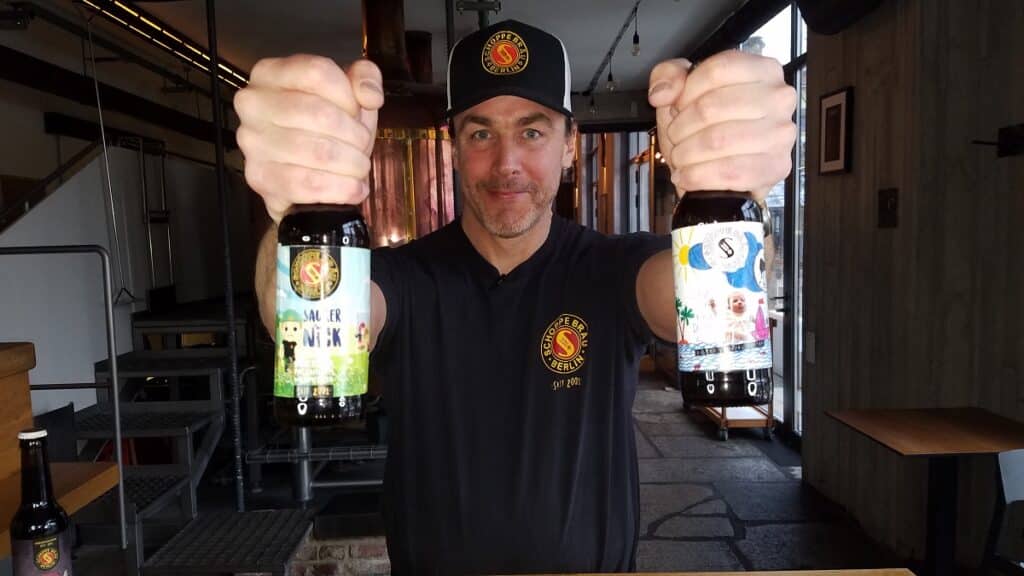
Brewing beer in Berlin has evolved in recent memory because of the influx of craft brewers. Thorsten Schoppe, founder/master brewer of Schoppe Brau in the Kreuzberg section of East Berlin, understands the tastes of his customers. He also can move the needle a little further in an industry that has become so global and yet keeps an essence of artisan nature to his process.
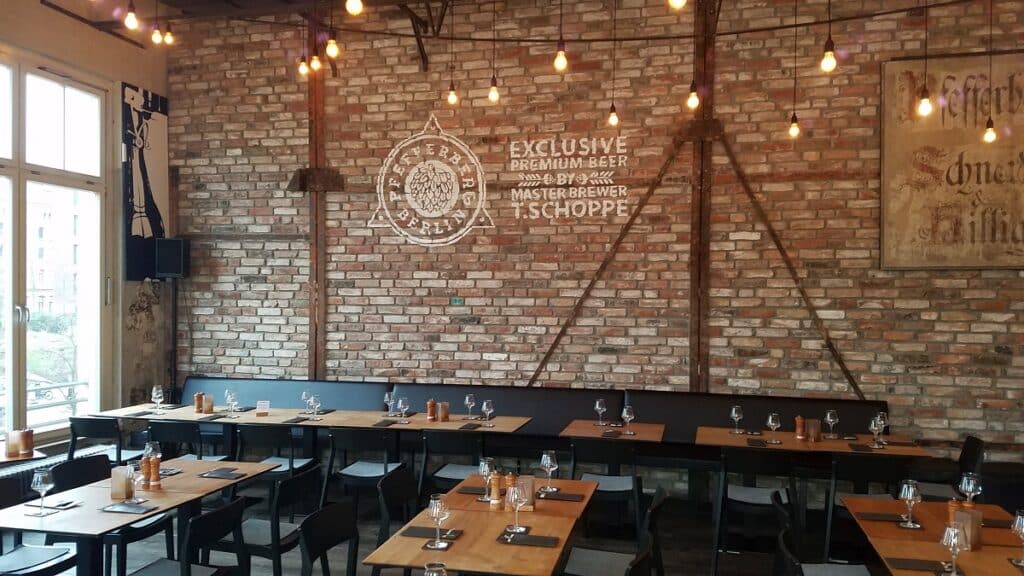
Schoppe loves his location just off the main square in this corner of East Berlin. “This is for sure a very beautiful place, especially for me. It is right next to an old brewery, what more can you ask for?” The former brewery on the site, marked by a smokestack, just beyond the beer garden, was founded by a Bavarian brewer called Mr. Pfeffer in 1840. “It was an interesting time for brewers back then because the lager yeast had just been invented, or they had found it somewhere and were finally able to brew beers” without them going sour.
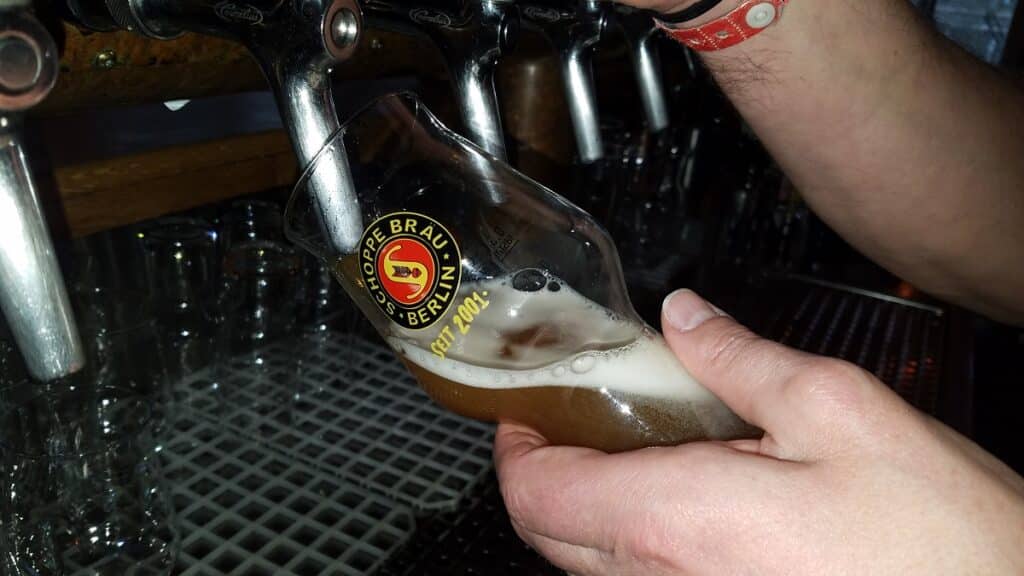
Creating a Variety of Beers for an Evolving Consumer at Schoppe Brau
Schoppe likes a customer who has an idea of what they want in a beer. “There’s so much variety in beers and it always scares me if somebody enters my bar and says, ‘Give me a beer.’ We have so many taps, so many bottles.” Schoppe says they are working to educate locals, but he says normally in Germany, beer equals Pilsner. Schoppe says he always found it interesting to search local varieties, and international varieties, and to experiment with beers. “I like to try out new recipes, new raw materials, new ingredients, But in Germany, you have to get exceptions through German purity law. It’s a little more tricky than abroad, but we can still brew a vanilla stout. If we get an official exception, we can do this. And I like to do this a lot.”
The beer purity law is an interesting quandary…and applies to bottling which Schoppe does a lot of locally. “There’s a real law, which says, ‘Brew your beer with only those four ingredients: hops, malts, water, yeast.’ No exceptions. But there’s one exception possible in this law, which was mostly made for historic beer styles. Because even in Germany, back in older times, we had beers with other ingredients.” He uses the example of gose from Goslar, a beer that finds its origins in a river in the 16th century in southeast Germany that was heavy in saline. They discovered how to brew specifically using salt and coriander and it became a regional specialty, making it exempt from said law. “So, this law didn’t want to destroy those historical beer styles. So, they put in this kind of exception.” Schoppe says nowadays the exceptions are easier to get depending on the ingredients. “It is going to cost you a couple of hundred euros, but then you may get it. The problem is it being completely local.” He explains that the exceptions must be approved by the local sanitation department, the veterinarians, etc., and they decide whether to go ahead with it.
On the draft side of the tap, it is different. “If I serve it here, then I’m in the end completely free. I mean I shouldn’t poison the customers,” he jokes. “But otherwise, I’m pretty free.” But if he wants to get certain brews into supermarkets outside via his bottling process, he needs to go through the exception process.
The Path to Becoming a German Brewer
Schoppe’s path to master brewer, he explains, was the classic German way of becoming a brewer. He did an apprenticeship at the big industrial brewery, then came to Berlin, which is one of two cities in Germany where you can do your studies in brewing. “So here I became a brewing engineer, which is like five years of studying at university with a lot of chemistry and microbiology, but also the engineering [aspect].”
Back at that time, in the mid-90s, Schoppe stumbled onto one of the first craft breweries in Germany (which was ironically called The Beer Company) and fell in love with it. Back then, he says the brewers coming up were very much influenced by the USA brewing scene. “So, everybody was wearing the hat of the American Homebrewers Association.”
The irony is that most Americans talk about the greatness of German beer and yet the reverse was true as well. “Exactly. I found people who have said, ‘Why don’t you sell your beer to the US?’ and I laugh and tell them, ‘What shall I sell them?’ I’m buying US hops, brewing it here, and selling it back to the US. Does that really make sense? I don’t think so.”
With his own brewery line, he started with two beers in 2001. “I was always doing seasonals and some of them were really good. People were asking for them more often, so they became regular.” Their line of beers got bigger and bigger. “We need to stop it. It’s getting to be a horrible lot of work to do all these labels.” That said, there is a great degree of creative control. “Yeah, and we also have the craft beer geeks who are really supporting us.”
Schoppe says that generally, he brews beers that he likes himself. “If somebody asked me, ‘What’s your brand? What’s special about your beers?’ I think a while about it, and then say “I’m brewing the beers I like because I think they are good. Luckily enough, I find customers who agree with me.”
Experiments and Collaborations in Beer
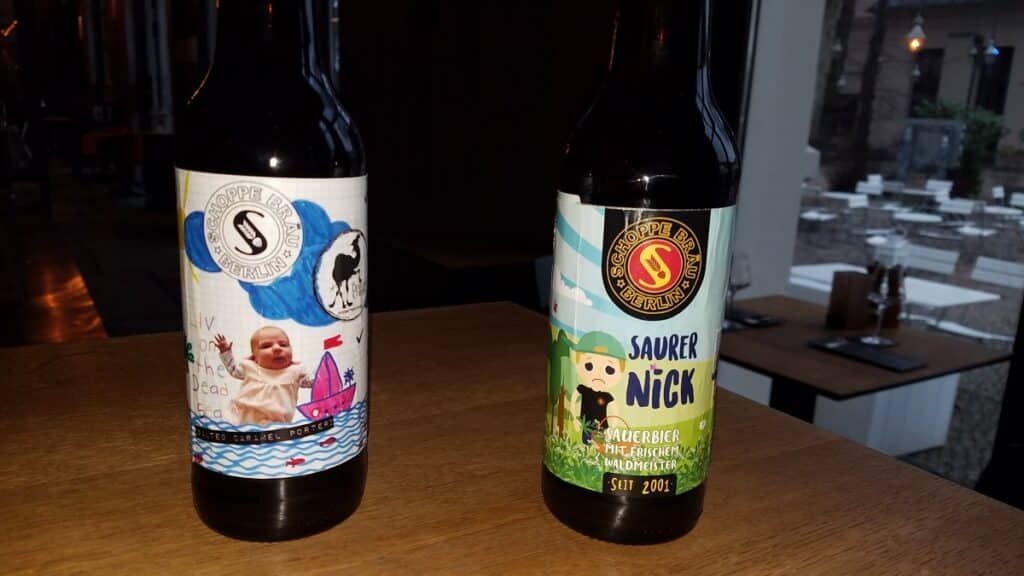
Schoppe also does some interesting experiments. “We did a collaboration with an Israeli brewer, and he flew to Berlin and brought a kilo of salt from the Dead Sea,” Schoppe explains the brewer (who ran a brewery called Dancing Camel Tel Aviv) was looking for distribution in Germany. “So, we stumbled over one another and agreed to do a collaboration” which was a salted caramel vanilla porter. Schoppe said he made it for the birth of his daughter. At that time, his oldest son was 7, and the boy got really sour about Schoppe only brewing a beer for the daughter, so Schoppe later brewed a sour beer in his son’s honor.
His kids totally understand what he does. “My daughter always says, ‘You are the big brewer and I want to be the small brewer.’ So, at the moment, at the age of 6, she wants to step into my footsteps. I was more expecting my son to be at that point, but he wants to become a fireman.” Schoppe says back when he started his studies, he was only surrounded by male brewers. “We didn’t have any women (brewers) but that is changing.”
Schoppe wants to refine his brewery to be more and more efficient. In their current location, they are at capacity, but they are still about making good beer. Berlin, he hopes, as a beer destination is also growing. Munich has international attention, but he agrees that Berlin is growing in this regard. “It surely is, but I’m not sure if people really recognize it. They would rather go to Munich, I guess, from an international point of view. But we really can offer a lot…, especially in talking about small-scale breweries, and craft breweries; Berlin is like the center of it. We are the town with the most craft breweries in Germany. It’s kind of doubled in the last 10 years. And this is surely worth a visit, and I’d love people to know that.”