

Stacy J. Platt, the Senior Instructor of Visual Art & Art History at the University of Colorado, Colorado Springs, knows that the essence of all photography is about perspective and having a focus on what wants to be said.
The advance of digital photography and how images are captured and manipulated and begun to change a sense of what the art form means. As a teacher instructing the next generation of image-takers while also pursuing her own artistic endeavors, the balance of technique and instinct becomes even more important.
“I would say, and I think this is true of a lot of our educators in higher-ed, is that when we’re strapped into and have our teaching hats on, which is like nine months out of the year, it’s pretty all-consuming.” Platt says the summer is when she says educators like her have a bigger mental space to think about things other than teaching “That’s when we can kind of make creative work and think about projects in a much deeper way. [Thus] a lot of us work on multiyear projects.”
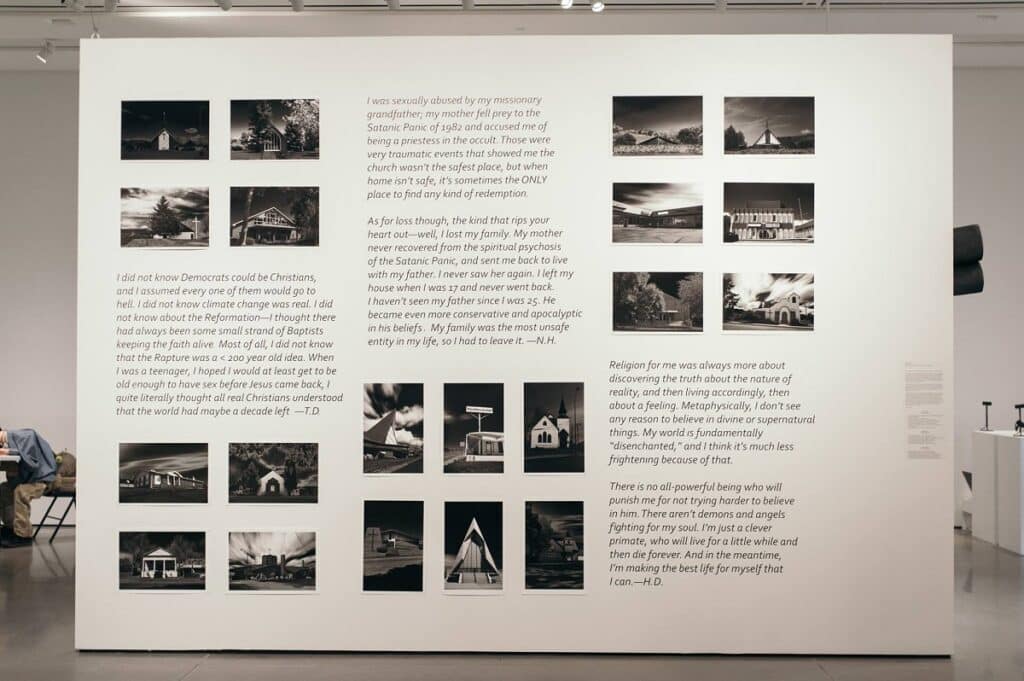
The multi-year project that Platt has been working on is called hashtag (#) ex-evangelicalism. When she was a child in the late 1970s, she lived in Colorado Spring where, for her first couple years, she was raised in “a pretty conservative evangelical religious mecca” around an organization called Focus on the Family. Her father was military, so they moved around a lot. But that time period of about six years, Platt says, had a huge effect on her life “and not what I would say in a good way.”
Finding Creative Focus on a Specific Subject Through Photography
After returning to Colorado Springs after going to school and living on the East Coast to get her BFA and MFA, she found herself drawn to approach the subject as a photography project. “I began photographing all the churches that hold Christian services in the Springs. There’s no formal database, but there are over 400 of them. I’ve been photographing them using long exposures with this filter on my camera that basically looks like there’s black glass [on the lens].”
This way she can shoot in super bright daylight and catch all these shadows and darkness with long exposures. She has also been interviewing people who identify as ex-evangelical and using their stories to counterpoint the images. “So, in this way, I’m kind of interested in big, broad human themes about belief and also what happens when a belief system or an ideal fails, as well as in the way it affects human ecology [through] experience.”
When Platt talks to her students about photography (and art broadly speaking) she addresses it as being a problem-solving practice. “I have come to really love teaching as a calling. Sometimes in academia or even as an artist, you’re not supposed to love teaching as much as your own creative work. But I also think of teaching as a problem to solve.”
She loves the student base at UCCS because it has an air of familiarity. Platt went to the University of Tennessee at Chattanooga for her undergraduate work. When she attended there in the late ‘90s, UTC didn’t have a photography program, so she just took the same class taught by a different adjunct professor multiple times. “They have so much more than that at UCCS than what I had at UTC at the time.”
The student body at UCCS, Platt says, are people who feel real to her. “Like me, they worked 30 hours or more a week while they were at school. And they have some real-life lived experiences that they can draw from. I hope to try to teach them and prompt them and guide them to draw from those experiences and see them as valuable.” This, she says, can only enhance and deepen their creative work.
Platt is seeing a change in the generational shift of the students themselves. “The kind of work that I’m seeing now is really different from the work I was seeing six or seven years ago, mostly in the kinds of things the students are concerned with or that they’re preoccupied and wrestling with.”
Before, she used to see a lot more students doing active military tours but less now since there are no active conflicts. The concerns are more internal and home-based, likely exacerbated by the pandemic.
The Culmination of Work in Certain Perspectives
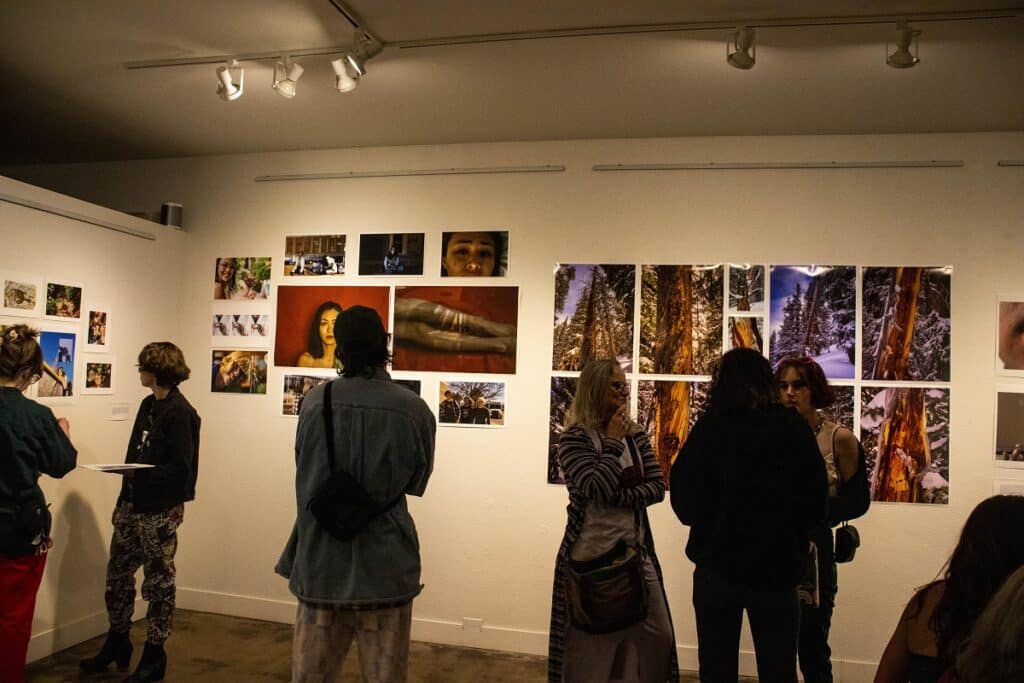
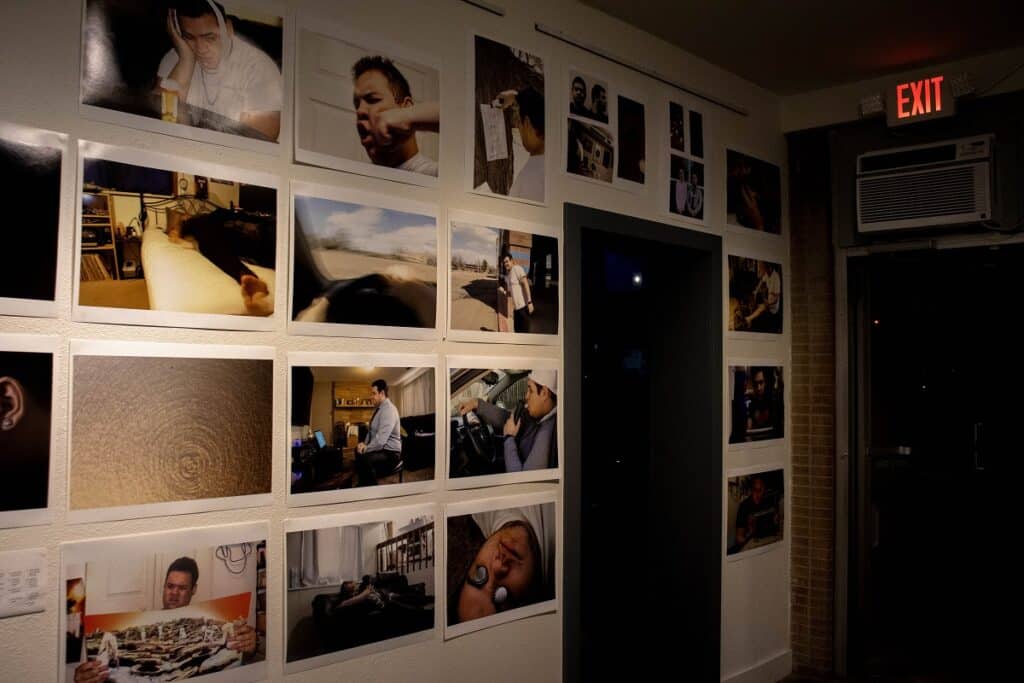
A couple of months ago, her students were given the opportunity to do a one-night, pop-up show at the Kreuser Gallery downtown. She says it becomes a different approach when people show their work publicly. The show was also a culmination of a semester of work in an advanced class where students had to stick with a subject, though there was flexibility in approach.
“[For that show] I actually had students directly addressing religious trauma in their work. I had one student who is a female-identifying queer student. Her mother had taken her to a conversion camp when she was 10, and she’s super traumatized by it. That was the first time she tried to make work about it.”
Platt says that everybody’s been affected by the last three years. “And so whether or not they think that they’re directly addressing it, it finds its way into what you’re making and thinking about regardless.”
On a technical and thematic end, the current zeitgeist and range of references for college-age individuals are exceptionally different than even 10 years ago in terms of information dissemination and pop culture. With the media influence constantly flashing on their phone, she adds, “It’s quick, here and gone. And so they don’t have that exact frame of reference for the images [they are seeing]. Yes, they live in a beautiful place [in the Springs]. And there is kind of a visual image bank that comes with that. But [in a way] they’re not also totally familiar with that either.”
The shift in this era of new photographers and artists is about trying to connect to a sense of place. “And by that, I don’t mean just the landscape, but where they are in their lives and trying to connect to at this moment in time.”
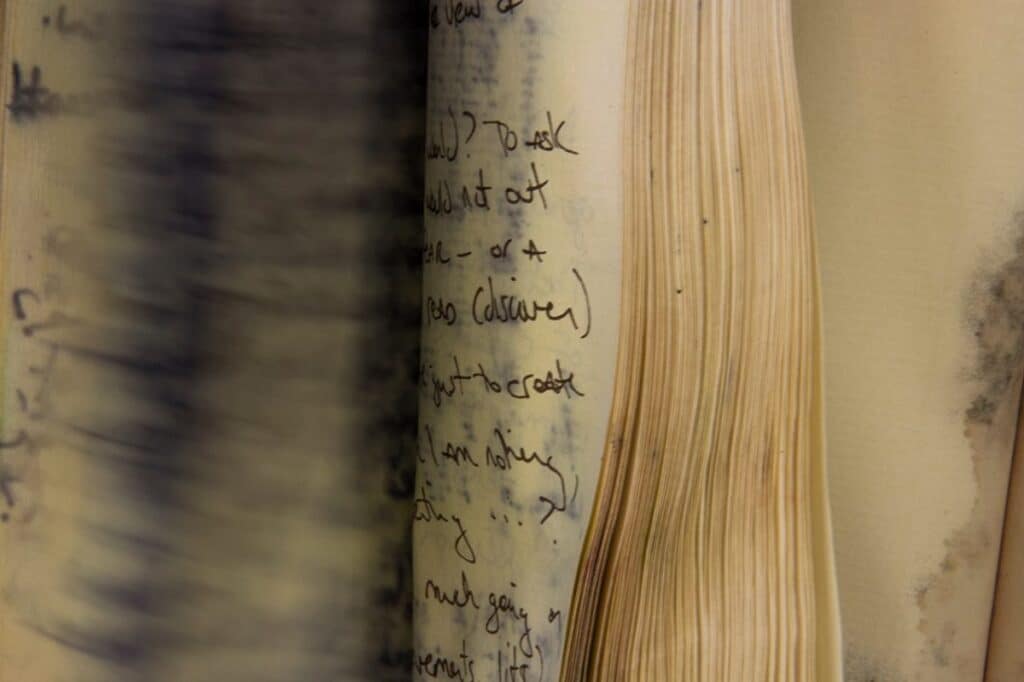
One of Platt’s favorite artists is a woman named Alison Rossiter, who was buying expired, very old photographic paper on eBay, and then using, basically, developer chemistry and rolling it across little pieces of the paper to make it look like mountains or lakes ringed by trees.
“And all it was literally – the paper never went in a camera. It was a camera-less process. And it’s just a very interesting way of saying, ‘We’re not seeing what we think we’re seeing, or we are looking at something and we expect it to be this, and then it isn’t that.’”
Platt says that the thought process is not just about photography but about something in this moment in our time as a culture in terms of how perspective shifts.

The Question of Seeing Something Different Than What It Is
“We’re not seeing what we think we’re seeing or we can make you think you’re seeing something but it’s not really that.” Platt thinks that those are interesting questions that photography can pose right now in a filter-filled culture where elements can be added on or stripped away indefinitely.
“I also think students love this possibility too, as I do. I admit I’m like, I’m not a good draftsman. I’m a photographer because I can’t draw.” She laughs at this admission. “Photography is instant gratification for people in that sense.”
She quotes the painter Chuck Close, who said, “Photography is the easiest medium in which to have competency but it’s the hardest medium in which to really have a personal vision.”
Platt says photography is the hardest one for somebody to be able to see your photograph and say, “Ah, that is a Valley Man photograph because he owns that vision, or that is a photograph by Ansel Adams.” Ansel Adams, she points out, is never ever mistaken for anybody else. But the challenge becomes in our increasingly complex world, is that our approach to art or the captured image gets more complicated the more contemporary you get.