


Form and function of tuberculosis huts provided by the flow of fresh, dry air.
Colorado’s first population boom occurred in the mid- to late-1800s when gold and other precious minerals were found in the state. But then, when the gold rush slowed, a second population surge hit the state due to thousands across the country suffering from tuberculosis.
Back in that era, doctors all over the world thought that tuberculosis could be treated with fresh, dry air and sunlight. Colorado Springs was among areas that were sought after due to the arid climate and the fact that the region sees about 300 days of sunshine per year.
In fact, the Colorado Springs Chamber of Commerce at one point used it as a selling point and welcomed tuberculosis patients. According to an article on the Only in Colorado website, in the late 1800s and early 1900s about one third of Colorado Springs’ population consisted of tuberculosis patients, family members, and doctors and nurses treating the disease.
During that time, over a dozen sanatoriums popped up across Colorado Springs that featured several tuberculosis huts for patients. However, by the 1940s when antibiotics were invented, the sanatoriums were no longer needed.
The Penrose Hospital, St. Francis Hospital and the University of Colorado Springs are all located on the properties where sanatoriums used to be. Most of the tuberculosis huts got repurposed and they are now used as storage sheds, art studios, bus stops, and one is a café.
Even though most of the structures were sold and repurposed, there are a few in town that still stand. Located on the corner of Cascade and Jackson (on the Penrose Hospital property) sits a hut that is set up how they would have been in the 1800s. The St. Francis Hospital and the Colorado Springs Pioneers Museum also have huts set up on display.
The Unique Architecture of the Huts
According to an article on the Mental Floss website, the huts were either made out of canvas or wood and they were open at the top and bottom to provide for fresh air. Every hut was equipped with a steam heater and had a bed, closet, washstand, electric lights and chairs.
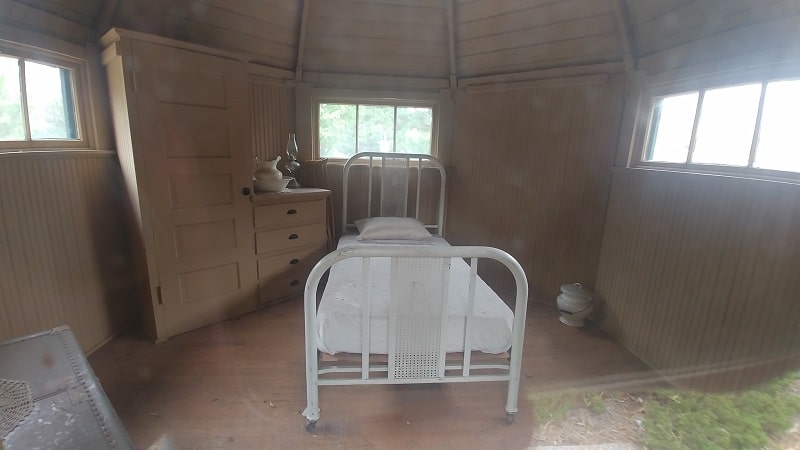
According to an ad published in the Garden of the Gods Magazine in 1902, the tents were designed to help treat people with tuberculosis and encourage breathing in fresh air. “The tent is circular or octagonal in shape with a wall five feet, roof 2-3 pitch of diameter—namely a tent 12 feet in diameter, has eight-foot pitch, five foot-wall, and an extreme height of 13 feet,” the ad described. “The top terminates in a ring, 15 inches in diameter, to which the rafters are fastened. The edge of same all around has an air space of two inches covered with wire netting, thus securing a gradual in flow, without draft, of pure air. The 15-inch opening on top forms an exit for heated and impure air. This opening can be covered by a metal cap, which can be raised or lowered by means of ropes.”
The presence of the huts might have also been one of the earliest forms of social distancing. “Tuberculosis huts were what we might think of today as tiny houses,” Director of the Colorado Springs Pioneer Museum Matt Mayberry told Mental Floss. “They each hosted one patient. The purpose of the hut was to keep patients isolated and help them learn how to keep from spreading the disease.”
The Inventor of the Original “Sanitary Tents”
According to a post on the US Represented website, Charles Fox Gardiner was the first one to produce and market the tuberculosis tents/huts. Gardiner grew up to a wealthy family in Europe and he developed an interest in medicine at a young age.
When he got older, he stayed interested in medicine and moved to the U.S. where he volunteered to be the surgeon at a local jail. While there, he learned dentistry and veterinary care, which would help support him later in life.
In 1882, Gardiner moved to Crested Butte, where he was known as the “doctor on skis” as he would use skis to travel to different patients in the high mountains. After being there for two years, he returned to New York and picked up his sweetheart Daisy Monteith, married her and brought her back to Colorado.
But then, in 1893, Daisy contracted tuberculosis from her sister and died from the disease. Gardiner then devoted his life to treating tuberculosis patients.
According to an essay written by Gardiner and published in the Transactions of the American Clinical and Climatological Association in 1902, the doctor got the idea of the huts from the Native Americans of the Ute tribe. “The invention of the sanatory tent was a slow process of evolution from a primitive and simple form which I copied from the Utes,” Gardiner wrote. “I noticed that in their ‘tepees’ of skin the ventilation was nearly ideal. The reason for this was, they used a conical tent with a hole in the point of the top for the escape of smoke and plenty of space around the lower edge, where the tent rests upon uneven ground, for air to enter it. In this way the ’tepee’ acts like an inhabitable chimney or fireplace.”