



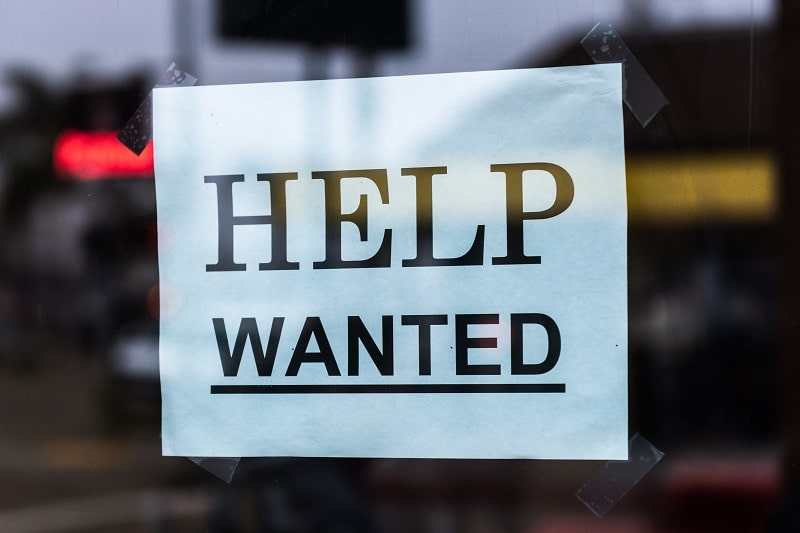
Ever since jobs started coming back this year, employers across the country have found it tough to fill their positions. The first industry to see a shortage of employees was the restaurant industry (as discussed in the TMO article Lack of Culinary Staffing: You May Have to Bus Your Own Table).
Labor shortage across the board
However, according to staffing agency employees, the labor shortage can be seen across the board. Evidence of this can be found by looking at job sites and social media pages. Many industries that did not have to advertise for new help are now forced to advertise to attract workers.

For example, in Cripple Creek the pandemic made it even harder than before to attract casino workers. In the local newspapers, almost all of the city’s casinos are advertising several positions. As employers are now required to post salaries, a wage war was ignited among casinos. Some of the casinos in Cripple Creek are even offering sign-on bonuses for employees, which they have never done before.
Some employers, especially those with seasonal businesses that need temporary or part-time help, have had to get creative to attract employees. The Rocky Mountain Vibes recently posted pictures of several high school graduations that were hosted at UCHealth Park and then added to the post that they were in need of several positions.
Santa’s Workshop posted on their social media pages in mid-May that they would not be able to open all their rides during their opening weekend due to staff shortages. The amusement park instead opened select rides for a discounted rate until they can get more workers.

Staffing agencies notice employee shortages in all fields
“It seemed to happen overnight a few months ago when companies started opening back up,” Suzanne Acevedo, Franchise Manager at Express Employment Professionals of Colorado Springs North, said. “The mandates were lifted and companies were able to hire again and starting to grow. But obviously the supply and demand is a little out of whack right now. It is a struggle and most of the areas we are having trouble with are the entry-level, general labor jobs. But, also the skilled trade areas.”
Acevedo also said that Express has been seeing employee shortages across the country. “It’s definitely a different market we are in today,” Acevedo explained. “I have been doing this for 20 years and it is definitely a little bit of a different market. It is a roller coaster in our industry either there are too many companies hiring or there are too many people looking for work. And we are here to average that out and help both sides.”
Becca Tonn, the Communications Manager for the Pikes Peak Workforce Center that serves both El Paso and Teller Counties, also said that they have seen an employee shortage in most industries. “It has definitely been across the board in all industries,” Tonn said. “But the retail, hospitality, restaurant and tourism industries have been the hardest hit.”

Why is the unemployment rate so high?
According to statistics provided by the U.S. Bureau of Labor Statistics, in February 2021 there were over 17,000 people unemployed in Colorado Springs and over 25,000 in El Paso County. The unemployment rates in both Colorado Springs and El Paso County were nearly 7 percent. Before the pandemic struck, the city and county’s unemployment rates were both under 4 percent. At the height of the pandemic the rates jumped to over 12 percent.
Both Acevedo and Tonn agreed about the several factors that are causing the unemployment rate to remain high.
“I think there are three things going on and, yes, one of them is that people are getting an extra $300 a week from the federal government on unemployment, which makes it hard to incentivize people to go back to work,” Tonn said. “But that ends on Sept. 6, and there are two other things coming into play. There are still some people that live in the same household with people who are immune compromised. They can be very concerned about getting an in-person job. And then another thing I think that gets overlooked a lot is childcare. The childcare industry has also been hit hard so they are not fully staffed. The other piece is that some of the schools stayed online this entire time. So if someone has a small child they may literally not be able to return to work because they are helping their child with online classes.”

However, Acevedo and Tonn both thought that the employee shortage will soon come to an end once schools open back up, childcare is available and the federal unemployment stipend ends.
“I think that additional resources being provided to people such as childcare opening up will help,” Acevedo said. “There are a lot of individuals that can’t necessarily go to work full time because the day-care facilities they used haven’t opened up yet or they just reopened. I think that once these additional resources open back up that more individuals will be able to go back to work.”
What can a business do if an employee refuses to return to work?
According to an article written on MWE, LLC.’s website, the U.S. Department of Labor does require that an employee return to work for a “suitable” job, or they can lose their unemployment insurance payments. Under the department of labor’s laws, employers are required to report an employee that refuses to return to work and stay on unemployment as fraud.
However, there are many stipulations as to what “suitable” work can mean and several states have put further restrictions on when employees have to return to work. The Colorado Department of Labor and Employment’s (CDLE) frequently asked questions page mentions the state’s Safer at Home Executive Order D 2020 044 that addresses worker’s rights and protections when returning to work.
According to the executive order, businesses cannot make employees return to work in-person if they are part of the vulnerable population and feel they would be at risk. The order states, “Employers must make accommodations to the greatest extent possible for workers who are experiencing a lack of childcare due to school closures such accommodations include but are not limited to remote work options and or flexible scheduling.”
Federal law also gives up to 12 weeks paid unemployment leave from the government to parents of children whose school closed due to a COVID-19 scare. And two weeks of paid leave are also given under federal law if a person or their child tests positive for the disease.







[…] there are not enough restaurant employees; too many people are happily receiving unemployment benefits. Bonuses are offered to those on […]
[…] 2021, most industries saw an employee shortage that kept businesses from reopening. And for some businesses like those in the restaurant industry, […]