

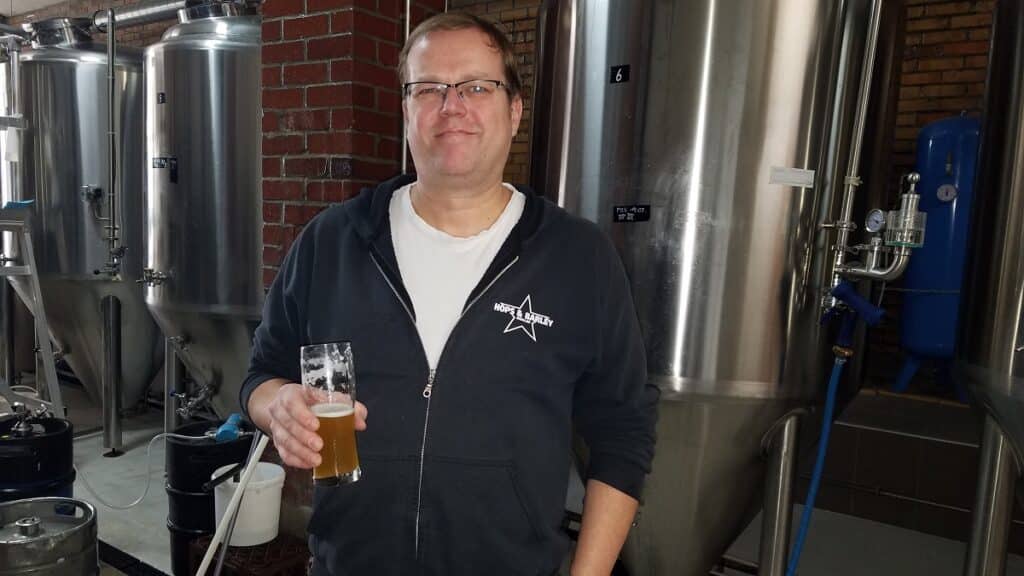
Having been in the brewing business for nearly 25 years in Berlin, Philipp Brokamp has watched the Berlin brewing business transform into a burgeoning craft scene. Comparing the similarities between the beer culture in Germany (specifically Berlin) and the evolving and robust brewing culture in Colorado comes back to consistent taste and forming an intrinsic community of beer lovers that can recognize quality and creativity. With his bar in Central Berlin (within the Friedrichshain-Kruzberg borough) as well as his brewhouse located in a repurposed national army barracks in East Berlin, Brokamp continues to be firmly committed to great beer but also to the community it supports.
“The psychology of beer is always to have a good time,” says Brokamp with a laugh. “It is about meeting each other and enjoying some good beers.” Brokamp’s love of beer began during his schooling days watching football. It is allowed in Germany to drink at 16 but at that age, he jokes, finding cheap beer was important. In his teen years in the early 90s, he recognized that he had a good relationship with beer but not spirits or wine. “I’m not really interested in other alcoholic drinks.”
The Changing Berlin Brewing Community
The current brewing community in Berlin he says is the result of the last 15 to 20 years of business. He says the oldest local brewer, Oli Lemke, has made a lot of different beers. He currently runs four different bars and restaurants in Berlin. “He started around 20 years ago and tries a lot of special beers. But he has had to move back (and forth) to the more traditional styles.” Lemke, he says, is very famous for wooden barrel-aged beers. Brokamp does some similar brews sometimes with barrel-aged beers but not consistently. For example, he has used Woodford Reserve barrels out of Kentucky to age one of his past imperial stouts.
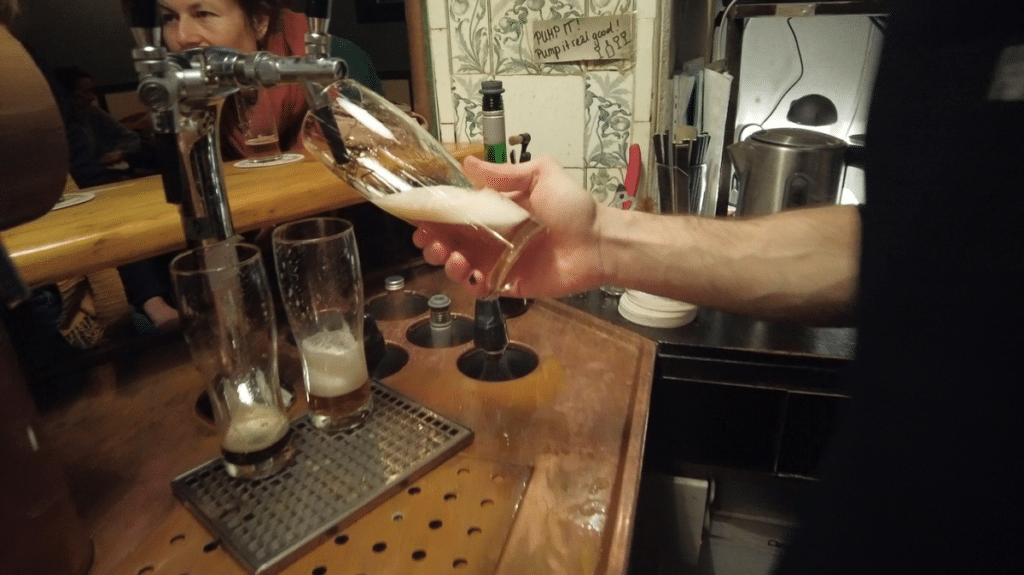
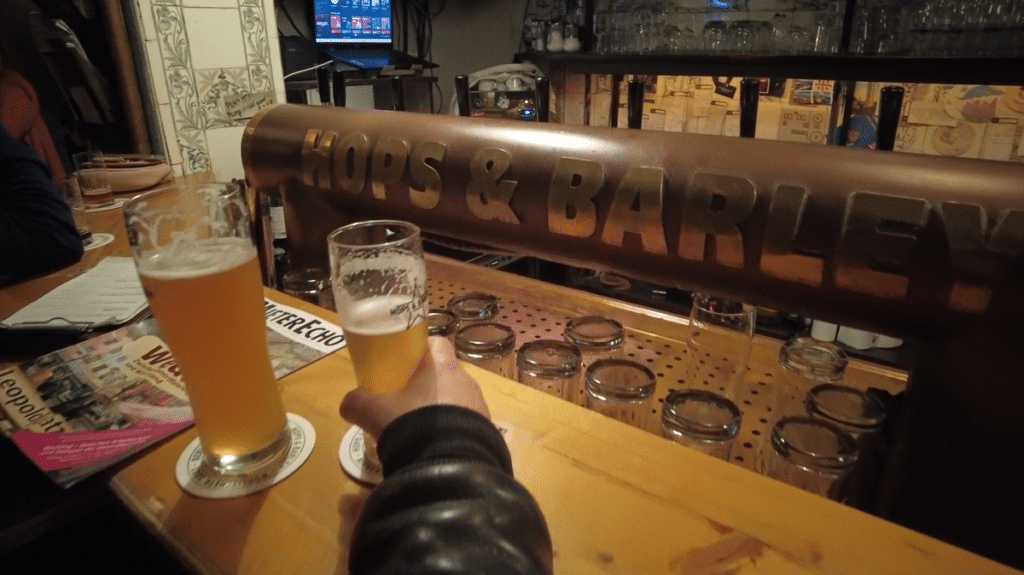
In his cozy bar setting on Wühlischstraße in Berlin, his converted-butcher-shop-turned-bar replete with 130-year-old tiles has that feeling of a comfortable pub with soft lights, good conversation, and smooth beer. Brokamp explains currently they see that people are much more interested in lower alcohol (about 5%), in their typical pilsners, darks, and lagers. “They want to drink more,” he says laughing. “But they want to last longer. They will sit there and drink maybe 5, 6, or 7 beers. Better than 1 or 2.”
But Berlin is changing. “The concept initially with the bar/brewery was really to bring many people together. Everyone was welcome.” But when he started the brewery 15 years ago, it was another time. “It’s a bit hard to compare it to right now. Fifteen years ago – the area was much more alternative. There were some flats and houses but they were occupied by alternatives. I felt it was a nice spot because you can live there cheaply. But as you know, as in the US, this has become a typical area of gentrification. The flats now cost about five, four times more than then.”
Being a Beacon for Beer
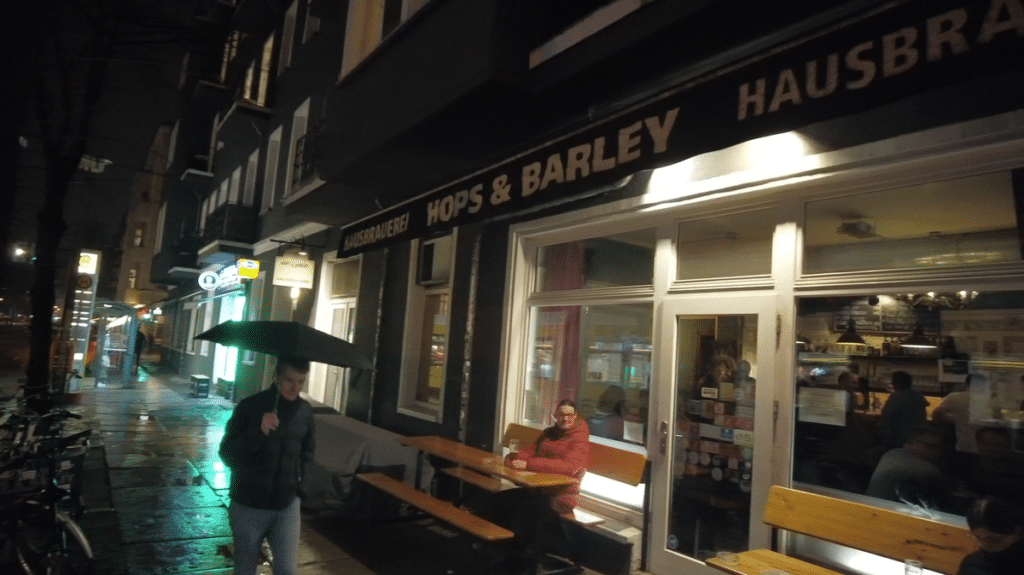
Freidrichshain, the area the bar now occupies, is a beacon for some young people though for many it is a destination that requires them to travel from outside the city on the bahn (train) or by car to visit. This dedication in coming to his specific oasis in town breeds loyalty in customers. “We still get more young people. A bit more alternative.” But the clientele now is a good mix.
Brokamp reflects on the first time he saw the location his bar would be realized in. “It was ruined but it had these old, 130-year-old titles. And it was an old butcher shop. But the first impression I had was a small brewing plant in front of these nice tiles. It would make for a very good atmosphere for a brew pub and a good mixture of people. That was the first idea. Fortunately, now, it works quite well.”
Unlike the US, there is no food truck boom so the food offered has to remain simple. “We have only Flammekueche. It’s a bit like a German pizza with tomato sauce with a bit of sour cream as a base, and you can put different things on it. You don’t need forks and knives because you can eat them with your hands.”
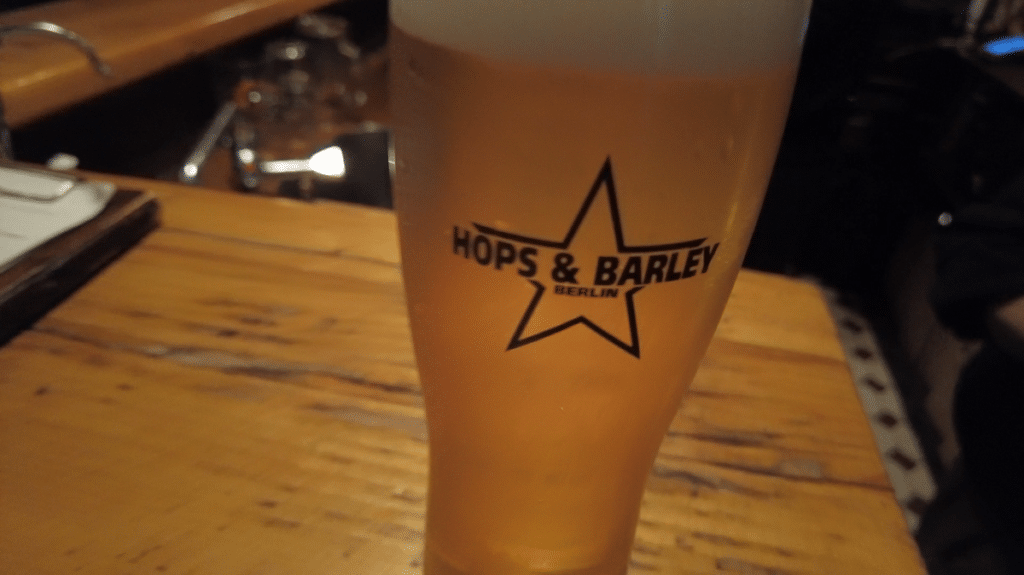
Brokamp explains that the mixture of the brews now for their pub consists of traditional pilsner and lager. But he also points out a special beer he first made 15 years ago, which was a bit more multi-bodied in terms of flavor and color. It is called Bernstein (which means Amber in English) and is one of their most popular brews.
Adjusting Traditional and Experimental Within the Brewhouse
He also works heavily in delivery but directly with specialty groups. Some of those special clients, he says, really like IPAs. “For example, we work with a very big club but they also have a beer garden. They are built on a very nice old brewery called KulturBrauerei in a space called the Frannz Club.” Brokamp says that even though the club has a contract with a huge brewery and they sell a lot of beer, they want special beers.” Hops & Barley provides that service, with Brokamp delivering 10 kegs the following day.
Having a brewhouse also gives him now the ability to stretch out and experiment as compared to the more compressed bar area. That brings a sense of freedom “The separate brewhouse is, for us, really important right now with this amount because we couldn’t realize it in the pub in Friedrichshain, if only for the space, of course.”
At his brewhouse, Brokamp has over 3000 square feet. He can drive the delivery van right to the front of the door. “I couldn’t do that in front of the bar because there is a train stopping right there on the street. You can’t deliver and load the van.” The brewhouse is not far away from the pub…only a 10-minute drive. It is the best of both worlds for Brokamp.
“It was always the idea to have traditional and experimental trials. Our first idea was not an amount like this. Maybe four or five taps. But this is also not much more. We have eight now.” But that allows for that bit of creativity.
“Of course, the main goal is to make– and I think this way always if I’m in a pub – it’s much better to have one really nice beer than 10 not so good,” Brokamp laughs. “Sometimes it’s very often like this, unfortunately. I won’t say what bar it was but they had eight or nine taps and were selling a normal pale ale or something. But everything was really sour and not good. That still happens. That would never happen at our bar, because I try it, of course, every day.”