




In 2019, Governor Polis released his “Roadmap to 100% Renewable Energy by 2040 and Bold Climate Action” report, which included several projects designed to help Colorado become more environmentally friendly. Part of this initiative involves modernizing the Public Utilities Commission (PUC).
But will modernizing the PUC benefit the environment? And how will this transition impact Colorado residents?

Zero emissions?
You’ve probably heard the term “zero emissions,” used to tout things like electric vehicles and renewable energy sources. However, when someone uses this phrase, he or she is talking about the “point of use” emissions, not cradle-to-grave, or lifecycle, emissions.
Lifecycle emissions consider how much Green House Gas (GHG) is produced from all stages of the technology – from the raw material extraction to making the electricity generator (think wind turbines or solar panels), to plant operation and maintenance and, finally, decommissioning.
When you take all of the above into consideration, you get a much better picture of how “green” energy is.
In 2017, half of Colorado’s electricity came from coal-fired power plants, according to the U.S. Energy Information Administration. But, thanks to the modernization of the PUC, in 2020, one-third of Colorado’s energy came from renewable energy, one-third came from coal, and one-third came from natural gas. Further, wind and utility-scale solar power made up the bulk of this renewable energy usage. As such, it’s essential to look at the GHG emissions produced from both wind and solar.
In 2019, RE-INVEST compiled and compared several studies that examined lifecycle emissions for renewable and non-renewable electricity generation technologies. It found that when it comes to lifecycle emissions, the mean carbon dioxide equivalent (CO2eq) per kilowatt-hour (kWh) for different types of energy was as follows: coal 948.9 g CO2eq/kWh, natural gas 446.1 g CO2eq/kWh, onshore wind power 14.4 g CO2eq/kWh, and Photovoltaic power (solar panels) 50.9 g CO2eq/kWh.
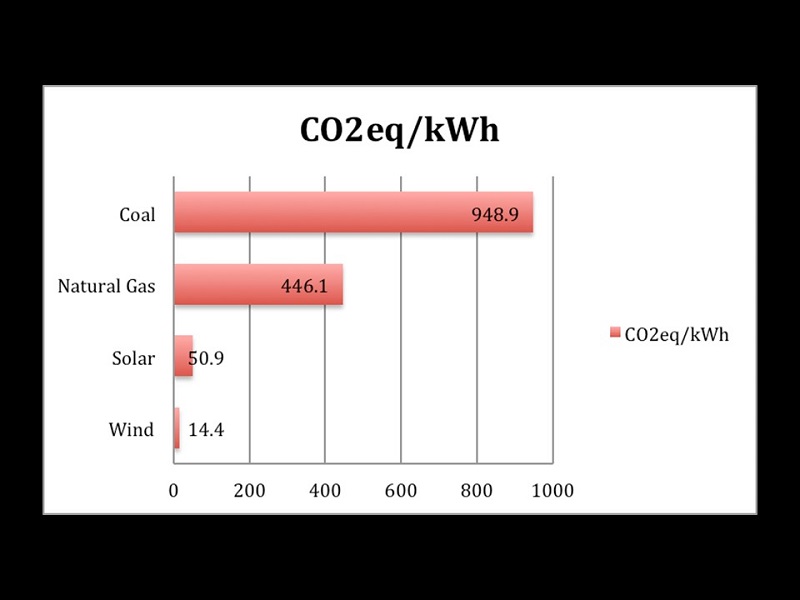
In other words, when it comes to generation, coal produces the most carbon dioxide, followed by natural gas, and then solar, while wind produces the least. When it comes to simple lifecycle GHG emissions, Colorado will benefit from the move to wind and solar.

The cost of renewable energy
The reduction in GHG emissions is excellent for Colorado, but that’s not the only benefit of moving to renewables. According to Lazard’s latest annual Levelized Cost of Energy Analysis, thanks to improved efficiency and system components price declines, the cost of wind and solar is continuing to decrease year-over-year.
When you look at GHG emissions from energy generation and price, moving to wind and solar makes sense. However, these aren’t the only factors to consider.
The downsides of renewables
When you look at the above, you can easily see that wind wins when it comes to GHG emissions and price. So why isn’t Colorado moving solely to wind power?
Simply put, wind isn’t a reliable source, and turbines usually function at about 15-35 percent capacity, according to National Wind Watch. It has to be supplemented with other forms of energy such as solar, which is also not reliable, and natural gas.
The solution to wind and solar’s unreliability is energy storage, but there are several problems with this. First, the average cost for battery storage with four hours’ discharge duration is $150/MWh, according to Energy Storage News. Second, the technology currently being used for short-duration (one to four hours) energy storage is predominately lithium-ion. As of this writing, long-duration energy storage technology still needs to mature before it becomes viable.
As I’ve written before, lithium-ion batteries are not environmentally friendly — mining the components of a lithium battery is devastating to the environment, and the batteries, themselves, are very rarely recycled.
Plus, just like with vehicles, it’s imperative to look at the carbon footprint of manufacturing lithium-ion batteries for utility-scale storage. According to Forbes’ Estimating The Carbon Footprint Of Utility-Scale Battery Storage, using lithium-ion batteries for wind storage will produce “somewhere between 70 g CO2-eq/kWh and 300 g CO2-eq/kWh GHG emissions.” The variation between 70 and 300 is based on how many times a battery can be recharged and discharged.
In other words, when you factor in storage, while it’s still less than coal and natural gas, wind produces far more GHG emissions than previously thought.

Don’t miss the forest for the trees
The move to adopting environmentally friendly energy is a good idea. The price for generating wind and solar has decreased, and they produce less GHG emissions.
However, when you add in energy storage in the form of lithium-ion batteries, wind and solar take a significant environmental hit. As such, while the move to wind and solar generation is beneficial, modernizing the PUC by using lithium-ion batteries is shortsighted and should be avoided.







Totally unconsidered in this analysis are the huge acreage per KWH required for large scale wind and solar, and the resulting enormous maintenance costs and damage to wildlife and the landscape. The NIMBY attitude alone will kill the already futile attempt to replace our ever-increasing energy demands.
Thank you for your comments and joining the Maverick Observer.
Angela
[…] as I previously detailed, there are many obstacles on the road to green energy, and many times “green” energy is […]
[…] On the other hand, Gov. Polis fulfilled many of his campaign promises as itemized above, but not all these successes are good for Coloradoans. For example, Gov. Polis published his Roadmap for renewable energy and reduced GHG emissions, but his plan relies heavily on lithium-ion batteries. This is both shortsighted and bad for the environment, as detailed in my previous articles. […]
[…] plan to move Colorado to 100 percent renewable energy by 2040 and how, for Polis, this involves modernizing the Public Utilities Commission (PUC) to include more wind and […]