


At world-renowned sporting events like the Olympics, feats of human stamina and focus are rallying points of pride all over the world. But to see a collectible backdrop for those who cover and enjoy the games in person in the form of trading pins is a unique perspective. For Mark Reis, who photographed over 20 Olympic Games for the Colorado Springs Gazette, seeing the impact of trading pins throughout his years has been an intriguing development.
The first Olympics Reis covered was Atlanta in 1996. He didn’t even know what a trading pin was. His next Olympics were in Nagano, Japan in 1998. There he met a trading-pin aficionado who found his way onto a media bus. The man asked Reis if he had any pins to trade to which Reis said: “Pins? What do you mean?”
The man explained the pin trading world and what a big deal it was at the Olympic Games. He suggested, as a member of a smaller news organization like the Gazette, Reis would benefit by having something like these small pins to hand out to people. Reis took the advice to heart. “You meet a lot of people at the Olympics. And it’s a great level of introduction to people.”
Not a Trader

Beginning with Sydney in 2001, Reis and his wife designed the pins for The Gazette. He paid for the pins himself, he says modestly, as it was inexpensive ($1.50 a pin). Many big companies like Coca Cola have their sponsor pins circulating. But the pin guy on the bus explained that collectors would want Reis’ pins because there would be fewer of them.
Reis makes the distinction that he, personally, is not a pin trader. It is just something to have to give to people. He says that when you go to the Olympics, usually, outside of every venue, and many times the main press center, “You’ll see pin collectors hanging out with all of their pins spread out in front of them.”
He explains that members of the public just come up and sometimes buy pins, but, more often, somebody would just say, “Hey, I really like that one!” And then the pin trader will say, “Well, what have you got? What would you like to offer?”
People, Reis continues, walk around with these trading pins all over them. “I mean, there’s some people who will be wearing them all over their hat, all over their lanyard, perhaps on their ticket pouches that they’re carrying or maybe just on their clothing.”
Reis says that the unspoken rule is “if you’re wearing a pin, you are up for trading. You wear a pin because you’re sort of advertising to someone else who might also be interested in collecting pins, that they can approach you and say, ‘Hey, I really like that pin you’ve got there. Would you like to trade?’ It just becomes kind of a one-for-one swap.”
The Power of the Pin
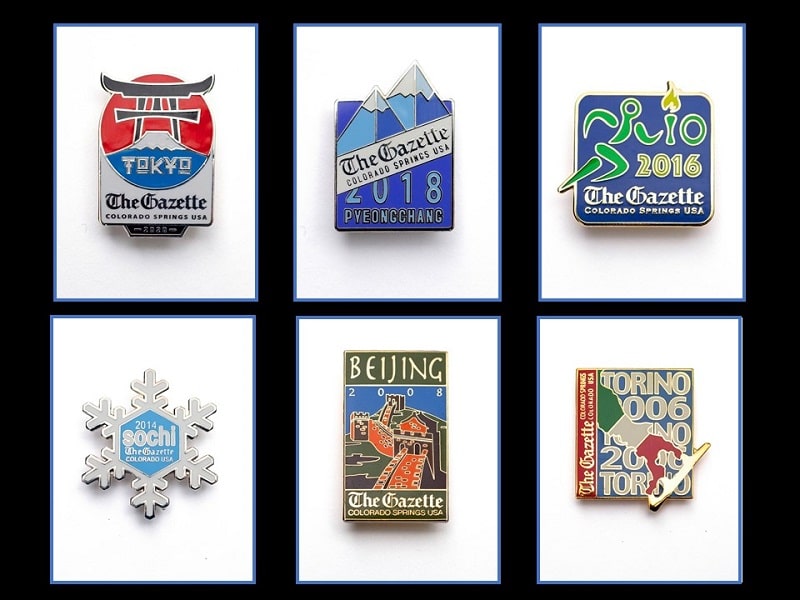
Reis says there is a fervor for the pins at the Olympics, top to bottom. He relays a story that shows the power of the pin but also its benefit. “When I am at the Olympics, I don’t wear pins on me. I just have them to hand out as gifts because, again, I’m not trading.”
Reis recalls the first time he had pins to share was at the Sydney Olympics. The first event he covered there was the women’s triathlon on opening day. The track had the Sydney Harbor, the Opera House, and the Sydney Harbor Bridge as the backdrop. “It was really a great way to open the Olympic Games.”
Reis was at the venue early, probably two or three hours before the triathlon started, and was wandering around looking for a good place to capture the action. “There were certain photo positions that were allotted but I wasn’t crazy about them. They weren’t really getting me the kind of pictures that I thought I wanted from the event.”
While wandering around the venue, looking for a good place, a couple of security guys reprimanded him, saying, “You can’t be here.” They came over and told him that the area was off limits. Reis explained he was a credentialed photographer to which they pointed to the area where he was supposed to be. Reis started talking to them, asking them where they were from.
The men were police officers from a small town outside of Sydney who were brought in to help with security. Reis told them he was from a newspaper in Colorado. Before he left, he gave them each one of the pins he and his wife had created. “And they both just kind of stopped and looked at this pin, looked at each other, and said, ‘That’s really nice [of you]. You know, it’d be all right if you stayed here. We’ll stay with you to make sure nobody gives you any trouble.’”
As a result, Reis was able to photograph the first event of the triathlon (swimming) from this spot. The next day, he came back to the same venue for the men’s triathlon. Again, he was wandering around looking for a photo position. “I hear, ‘Oi. Gazette guy.’ And it’s these two police officers.”
This time, they kind of hustled over and asked, “Hey, do you have any more pins? Some of our mates where we’re staying would like some.” Reis handed them each a handful of pins. “And they said, ‘We have some ideas for you today.’ And they proceeded to take me on a tour of little places that they thought perhaps would be good for me to photograph from, and that they would be my sort of personal escorts into areas where I really wasn’t supposed to be. So that’s probably my most dramatic example.”
Full Circle
Hence the power of the pin, which comes full circle. With the US Olympic & Paralympic Committee [USOPC], Reis had an assignment to photograph medals at their headquarters before they were moved to the new museum. There was a large archive of Olympic memorabilia there before the museum opened – including a lot of pins.
As Mark Reis was talking to the archivist, she said, “Oh yeah, we try to get as many pins as we can for the archives.” The second day when Reis returned to photograph the medals, he brought her a handful of his pins from various Olympics as a gift. She asked if she could make them part of their collection.
He signed a document that he donated these pins to the USOPC Archives, “I thought that that was kind of interesting that even the US Olympic Committee recognizes the importance of trading pins to the Olympic movement.”