


Growing up at a winery changes your perception of life and business. Palisade as your playground – its beauty, its uniqueness, and its personality – profoundly influences you as a person and as a businessman. For Keenan High, operations manager at Colterris Winery in Palisade, and his parents Theresa and Scott High, the founding proprietors, creating great wine but also enriching the experiences and stories is part of their legacy.
High was born in 1999. His parents began the journey to acquire their first property in Palisade in 2001 when he was about 2 years old. His dad, Scott is a Denver native, originally started a wine distributorship there. His mom, Theresa, met her husband through the wine industry.
When they eventually moved to Palisade in 2000, they purchased 11 acres of a Palisade peach orchard. High says his parents said, “These peaches are too good. We can’t take out these trees.” High says the original intent was to take out the trees and put in vines because when his dad had proposed to his mom, he told her, “I will not promise you a rose garden, but I will promise you a vineyard.” At some point in 2000, High’s mom said, “Where’s the vineyard?”
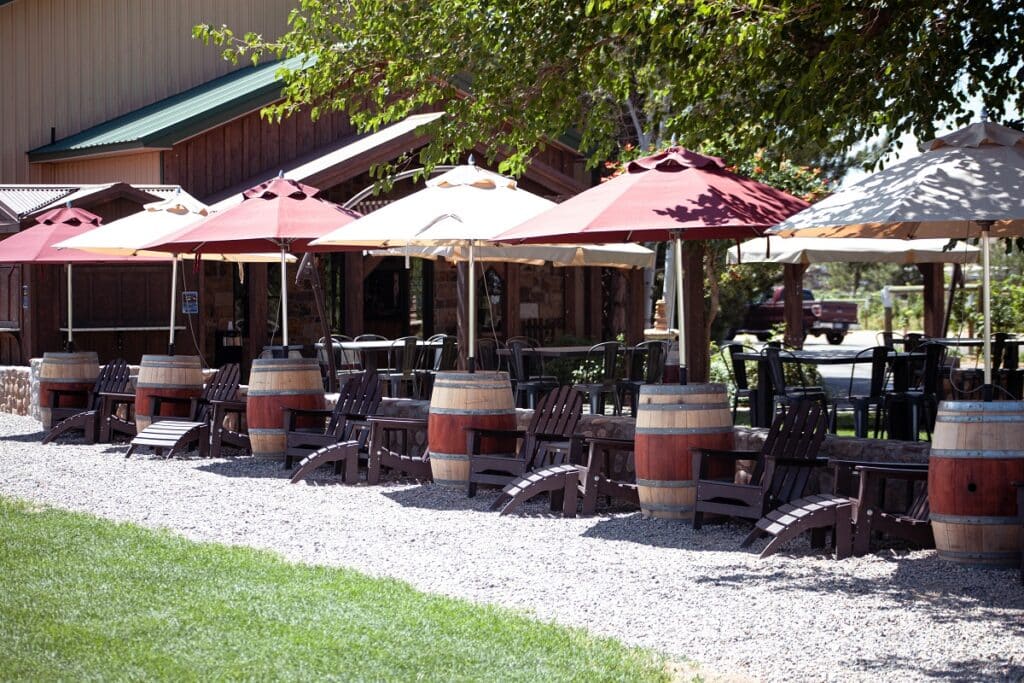
Growing Up on the Colterris Winery in Palisade
High grew up around the winery and went to Palisade High School. The family slowly acquired more and more land until they finally got their vineyard. Around 2008 they made their first vintage Colterris. Their first tasting room opened in 2010. “And from there, we have expanded to become Colorado’s largest estate-grown winery, which means we do absolutely everything ourselves. We’re Colorado proud.” The “COL” in Colterris stands for Colorado and “Terris” is like Tara, Latin for earth or land. “So, our name really means ‘From the Colorado land’ so we’re very Colorado proud in everything we do.”
High says the family really prides itself on being the largest estate-grown wine in the region, and that importance was instilled from the beginning for High and his siblings. He has a brother, Matthew, who’s 7 years older, and a sister, Katie, who’s 16 years older. “Something our parents told us when we were younger is that you can make good wine from good grapes, and you could also make bad wine from good grapes because you can screw it up. But you cannot make good wine from bad grapes. It all starts in the ground. It all starts where you plant. It all starts with what you plant. It all starts at the vine itself.”
High says it is important that it all happens in Palisade. “We do everything ourselves there. We grow the grapes. We produce all the wine at our location, and we bottle all the wine at our location. And that gives a quality level to everything we do from our tasting rooms to front range distribution, to marketing, to our experiences.” It comes from them but also equally from the land.

Great Colorado Land
High says that Palisade has some of the greatest agricultural lands in the Mountain Time zone. “Obviously, there’s an old Roman saying that where peaches grow well, the wine will grow well too. And I think going back in Palisade’s history a little bit, there used to be wine grapes here before Prohibition happened. And when Prohibition hit, they took out, obviously, the vines and put in peach trees because peaches are very delicate crops that can’t really grow in many places, so they’re a luxury fruit.”
High explains that being able to grow peaches in this specific location shows how good the land is in Palisade. The temperatures factor in as well. “I mean, we have the $1 million breeze that comes through here every spring, every summer. We call it the million-dollar breeze because it saves millions of dollars in crops every year.” High says being so close to the Colorado River also provides a fantastic water source.
He also explains that “every night, what we see at sunset, from the place I am right sitting now at Orchard Mesa, which is about 100 feet above the Colorado River, is that the cold air drops down to follow the river and the warm air takes its place.” He says they get to witness a little mini-inversion constantly during those months. “And it’s all of these environmental factors put together that make Palisade a fantastic area for growing peaches, and especially grapes.”
Reflecting on his experience growing up, High says his parents kept a traditional approach to winemaking. “It’s a very traditional industry and it has been around forever using barrels and old-school techniques that consistently work to this day,” High says he fully believes in those processes, but he also says regarding the schooling side of things, the new generation is obviously interested in modern technology as well as all the aspects in marketing and advertising.
When High was on his way to the University of Arizona (his mother’s alma mater), his parents told him that he didn’t need to go for business because, in their words, ”You know business.” High grew up at Colterris learning business. “I ran a little country store for High Country Orchards since I was nine, and I started doing agricultural tours when I was 10. So, I kind of just grew up around that business environment, especially growing with Colterris. I just soaked it in.”
Bringing Education Together with Instinct
High ended up majoring in software engineering with a minor in business before he returned to Colterris where he is now operations director. “My parents are obviously the proprietors. But we all wear about seven hats around here. I always think that is the beauty of a family-run business. Being able to hop in and do things [as needed]. I will jump into the tasting room at any time I can because that’s the most fun. I love connecting with customers and seeing everyone but also getting the take on how the tasting room can obviously be run better. I mean, I do have an engineering background. I really want things to be efficient together.”
High also says his sister, Katie, who runs the marketing side, comes to help every now and then when he has trucks and orders coming in and out. “She helps organize the wine club. And I put the wine in the boxes for that from the execution side. So, we like wearing all the different hats.”
High jokes that when he prepares to give a tour of the vineyard with a group of usually 10 to 15 people, he finds their reaction funny. Many of them say, “Oh, we got a little kid for the tour, huh?’ High laughs at that and says that once he starts talking, and communicating his vast knowledge, they ask, “Wow! How long have you been in the industry?” High replies, “About 25 years…or my entire life.” This story only reflects the encompassing passion of the entire family. Wine is something they talk about all the time, on car rides, dinners, anywhere, “because it is a very fun and interesting thing from all its facets.”
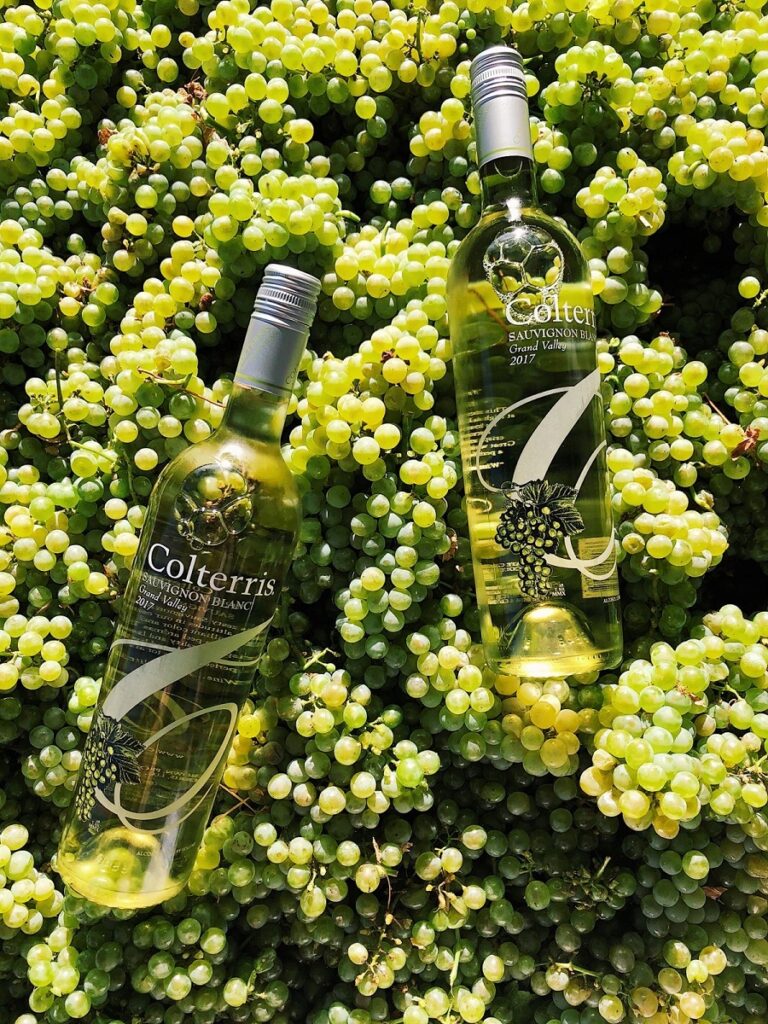
With the different wines they specialize in, especially their extremely popular Coral White Sauvignon Blanc, High says that his taste in wines has expanded considerably in the past few years. “So, with my palate, I’ve been very lucky to be around parents who have given me the opportunity to try some very interesting wines.”
High says when he was a little younger, he wasn’t a big fan of acidity. White wines, like Sauvignon Blanc, for example, possess a very acidic taste. “They’re known for that. It’s usually sometimes a citrus note paired with maybe a grassy note depending on which region you’re drinking it from.” Now, he says, a few years later, he loves Sauvignon Blanc and its acidity. “I want that more. I could see that my palate has just developed as I age. And I definitely feel that people from all over the place do that too. As they age, they start trying different wines and they start going to different things.”
![Colterris Winery The refreshing Colterris Coral White. [Courtesy Of Colterris Winery] Glasses-Tasting: Glasses set out for a reserved tasting at Colterris Estate Winery in Palisade.](https://themaverickobserver.com/wp-content/uploads/2023/06/Coral-Rose-768x1024.jpg)
Lessons that Graduate into Favorites
He says a big lesson he learned from his parents is that “if you kind of get stuck on one variety or one wine that you really like, you can sort of develop a house palate and when you get used to that — you try to not have anything else.” A person who only drinks Malbec, for instance, he says, would eventually probably not enjoy Cabernet Sauvignon, Pinot Noir, or Rose as much. “So, I always try to always change things up. Because it’s a constant learning [process] for the palate, constantly keeping your mouth fresh but also allowing yourself to see interesting techniques from all over the world.”
He says when he thinks of Sauvignon Blanc now, his favorite white wine — besides their own Sauvignon Blanc, is a Bordeaux White, which usually is around 85% Sauvignon Blanc, and around 15% percent Semillon (a specific type of grape). He specifies the Chateau Haut-Brion which is in the Graves region over in Bordeaux. “It is one of my favorites because their Semillon has a bit of a viscous, almost watermelon note to it that will soften up the bright acidity of a Sauvignon Blanc. But [because it is a lower percentage] it’s not overpowering.” High says that this is a little example of his current mindset and approach. He is hoping to see if they can do a Bordeaux-style white here in the future.
High says for the most part Colterris is a Bordeaux-style winery. “A majority of what we do is Bordeaux style which has just taken off here. Obviously, our Chardonnay’s not a Bordeaux. But we do Syrah, which I see has an intensity that people really enjoy”. High adds, after referencing it earlier, that one of their top sellers is their Coral White Cabernet Sauvignon, which is a Rose made from Cabernet Sauvignon grapes.
Many would think such a wine would be difficult to do because Cab Sav is such a bold red. But Colterris made a white out of it by making it rose. “That has been our top seller because it has some acidity, like a white wine, but it also has a tinge of sweet to it but not a ton.” They also have the Bold Red Backbone which is Cab Sauv. “That has been one that has just been flying off the shelves.” So as the winery (and High’s knowledge) continue to grow, the diversity of wines, their history, and the love for different tastes continue to evolve.