



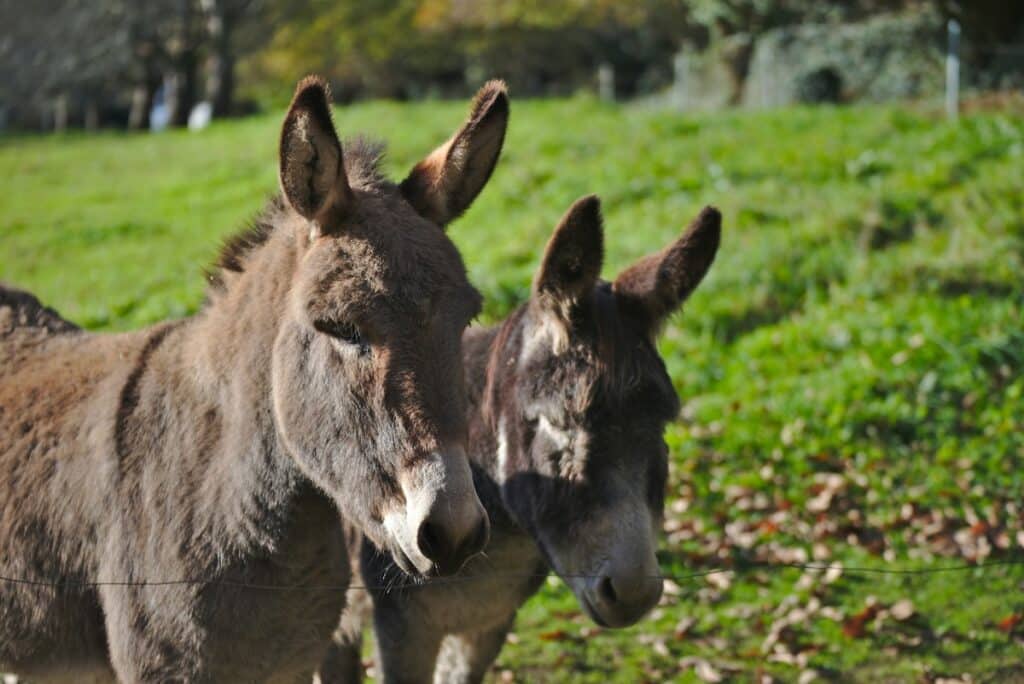
Wildlife Officials Use a Unique Way to Protect Cattle Herds from Wolves with Donkeys
Now that 2023 has arrived, the Colorado government is tasked with formulating a plan to bring wolves back to the state after Proposition 114 was passed by voters in 2020. Wildlife officials and Colorado ranchers must come up with ways to live next to wolves in the future. One possible solution has been to add donkeys to a herd for protection against the canines.
As soon as Colorado voters passed a proposition to reintroduce wolves into the state, ranchers all over spoke out against the decision. Since wolves are known to be apex predators, many ranchers fear for the lives of their cattle, and other livestock, once wolves are brought back to the state.
But according to an article published by the Colorado Sun, before wolves were officially let back into Colorado, a pack surfaced in the northern part of the state close to the Wyoming border. It was believed that a female wolf from Wyoming and a male from another area wandered south into Colorado and mated, giving the state its first pack of wolves in several decades.
Wildlife officials put GPS collars on the animals when they first found out they had crossed the border. The officials used the collars to monitor their behavior and migration patterns. But, it was reported earlier this year that the collars lost power, leaving the officials without a way to track the wolves.
Not too long after the first pack of wolves came to the state, ranchers in northern Colorado started to experience livestock deaths.
According to an article published by the Denver Post last October, Colorado Parks and Wildlife investigated the deaths of 18 calves near Meeker that wolves may have caused. The article also reports that a wolf pack that was located near Walden was responsible for the deaths of at least five cattle and two dogs.
Solving the Problem
According to an article published by CPR, Rancher Don Gittleson who owns a cattle ranch near Walden, Colorado has had three of his cattle killed by wolves since December 2021. The rancher has tried things to keep the wolves away from his livestock like setting up electric fences and conducting night watches to scare off the packs of wolves.
But Gittleson told CPR that all of the precautions he has taken have not been as effective as he had hoped. “All of those things wolves are going to get used to, so it’s going to have a shelf life,” he said. “They’re not going to be afraid of it forever.”
Gittleson then came up with the idea to use other animals to help protect his cattle. He first thought of getting giant guard dogs, but he realized that feeding them is expensive.
He then came up with the idea to get donkeys to protect his herd, a method that other ranchers across the country have used. Gittleson then teamed up with a Colorado Parks and Wildlife (CPW) officer to find a herd of donkeys that could work. The donkeys needed to be wild and they needed to come from a high elevation so that they were already acclimated.
CPW helped Gittleson find a herd of six wild donkeys in Nevada that were up for adoption. The idea is that if feral donkeys are introduced to a herd of cattle in the right way, the donkeys will fight and help protect the cows from predators like wolves.
Wild donkeys are accustomed to having to protect their own herds in the wild and they will do the same to their new family of cattle. If a wolf or another predator goes after a cow, the donkeys will attack the assailant by biting and kicking them.
“What we want to create in the minds of the wolves is a possibility that if you come into the cows, you could be killed or you could be injured,” Gittleson said.
Chuck Becker, a northern Minnesota rancher, told CPR that he has used donkeys to help protect his cattle for two decades. He said he has never personally seen a donkey take on a wolf, but he has seen what they have done when a coyote attempted to get past one of the guard donkeys.
“He beats it about half to death, and then he just stands back about 100 feet and watches it, like waiting for it to try to get away,” Becker said. “It was like a cat with a mouse.”
Since it is illegal to shoot a wolf unless a human or animal is in direct harm, ranchers could choose to incorporate donkeys into their herds to help protect their cattle. And it may become an even more common occurrence once there are more wolves let back into the state this year.
Does Adding a Donkey to the Herd Work?
Multiple sources report that donkeys can often be good protectors of livestock, but it might not be a perfect solution. An article published by Mother Earth News lists the pros and cons of adding a donkey to a livestock herd for protection.
A donkey does carry some traits that make it good for defense. “Donkeys do tend to become territorial although they do not patrol their area,” the article reports. “They are an especially alert grazing animal with very good hearing and a wider field of vision than horses. They also tend to be less spooky or flighty and more likely to stand their ground than horses. If the donkey brays loudly at threats, this may discourage predators as well.”
Most donkeys are naturally aggressive to canines, but this is not always the case. “Not all donkeys will confront canines, choosing to flee instead,” Mother Earth News also reported. “Some donkeys will ignore threats to the other animals in their pasture and only react if they themselves are threatened.”
Despite the case, some Colorado ranchers may have to come up with various ways to protect their livestock from the influx of wolves. Adding donkeys could start to become a popular means to add another layer of security to a ranch.







Quite evident slickers are nil on info. A mule or donkey will help with coyotes or an occasional cat, but vs herds you can dream on… Had a friends donkey killed in the Black Hills by a mountain lion. Once the cat gets on top it is good night Irene. Same with a pack of wolves. Voice of experience with a mule for calf protection from coyotes……soapweed
[…] Another take on wolves and livestock are highlighted in Trevor Phipps’ article “Donkeys Serve as Livestock Guardians“. […]