

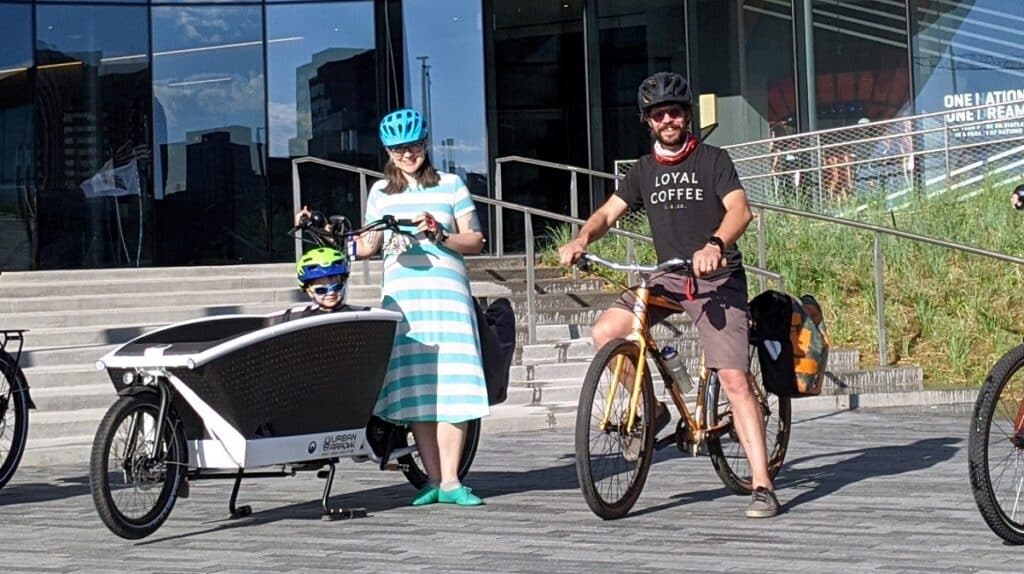
Cully Radvillas, executive director of the Organization Of Westside Neighbors, finds a balance between work, life, and advocacy. He also works with Bike Colorado Springs in communications and as a product data coordinator at SRAM so his experience balances both data-driven information and real-world effects.
Radvillas grew up in the suburbs of Chicago as a rare mountain biker in the Midwest. “As a junior high kid, I fell in love with mountain biking in a place that didn’t have mountains,” he explains. There was a bike shop that he lived near that was run by BMXers and mountain bikers. Radvillas ended up going to Norbert College in De Pere, Wisconsin just north of Green Bay. He says there were more hills up there thereby allowing him to get into cross-country mountain bike racing as well as dirt jump and skate park riding. His degree ended up bringing him into corporate IT specializing in information systems. He says he hated that kind of work with a passion before he ended up finding a position with SHRAM, a bicycle component manufacturer based in Chicago. They also have an office in Colorado Springs. After 4 years in an entry-level position in Chicago where he started in 2008, he was able to transfer to the Springs office in 2012. Ridvallas has been here ever since.
Advocacy at the Grassroots Level
Once he moved to Colorado Springs, he saw a big opportunity to be involved in advocacy at a very grassroots level. In Chicago, as he explains, many of the advocacy organizations are all very set in their bureaucracy, making it hard to get a foot in the door. In 2015, he continues, there was a group of bicycle advocates headed by the Trails and Open Space Coalition. Allen Beauchamp, and some other folks related to trail and bicycle advocacy in Colorado Springs, came together to form Bike Colorado Springs. When that organization was formed, Ridvallas was part of the steering committee and then joined Bike Colorado Springs as the communications chair in 2017, a role he still occupies.
His connection to the westside happened organically because it is where he ended up settling down. When Radvillas and his wife moved to Springs in 2012, they initially rented a house on the west side and then eventually bought a house there in 2014. The location they found is what he describes as a bit like “No Man’s Land” between downtown and Old Colorado City, just west of 1-25 near Cerberus and 503 West.
Coming from Chicago, where he rode his bike for transportation pretty much everywhere, Radvillas always had to share the street with cars. “There were no options. If you were in a bike lane, you were just in the travel lane. But you were in very close proximity to cars at all times, getting wherever you were getting in the city.” He says that luckily, in Colorado Springs, his location makes a difference. “Living in very close proximity to the Midland Trail and the Pikes Peak Greenway, it’s been pretty incredible to be able to use urban trails to get to my place of work and get to many places around town that I want to go to.”
Incredible Access to Mountain Bike Trails
One of the main reasons he cites for moving to the Springs is because residents and visitors alike have incredible access to mountain bike trails. He loves the ability to pedal right out of his front door to Red Rocks, to Cheyenne Canyon, or to Stratton Open Space for great mountain bike trails. The transportation aspect is also extremely important to him. “My interest has shifted in recent years to transportation, community building, and how our cities can be more accommodating to people who want to get around without necessarily using a car.”
Radvillas says walking, biking, taking public transportation, and the effect of getting around by those means are also more conducive to building a stronger neighborhood and community environment. These kinds of routines, in his opinion, allow for chance interactions with people and taking in the direct environment versus being in a car where things go by quickly and a person doesn’t necessarily notice their neighborhood as much.
Destination-Driven versus Simply Traveling Through
As Executive Director of the Organization of Westside Neighbors, Radvillas says that the more a city can identify those places and businesses that are more destination driven versus places people simply travel through is key. “It’s already been pretty interesting to watch that happen downtown over the last few years with the apartments going in. And we’re so close to downtown. I think what happens downtown very much spills over to the west side. And one of the aspects of the west side/Old Colorado City versus downtown is that Old Colorado City doesn’t have the same structural organization as downtown. There’s no downtown partnership for Old Colorado City. Some smaller nonprofit organizations are trying to move in that direction.”
Radvillas believes businesses that cater to locals will also be appealing to tourists. “I mean, when I go to places, I don’t want to go to the tourist spots. I want to go to the local spots. I want to take in what the locals think is good because that’s why I’m in a place.”
The reality, Radvillas explains, is that, as far as bike transportation, the distances between businesses to residential areas are much further. He says that even if the infrastructure were there to get from someone’s house to shopping, a restaurant, or even work, the distances were designed for cars, so it’s much harder to make that shift overall. He does say, however, that is why he advocates for the west side, specifically the older neighborhoods. It is because he wants to make sure that what is built into the future can also support a certain standard of living and a type of lifestyle that allows people to feel comfortable walking or biking to whatever destination they are going.
Reducing the Speed for Safer Travel on the West Side
With certain roads that have high-speed traffic, he says, that can be more difficult. One of the key corridors, he continues, on the west side is Colorado Avenue on which there was a recent transportation study. “One of the things that I’ve been pushing for is to make Colorado Avenue a slower and safer street to cross because Colorado Avenue, in some ways, could be similar to Tejon Street. In some areas Tejon is downtown. Colorado Avenue could be more of a destination corridor versus the drive-through thoroughfare that it is in some places today.”
Radvillas comments that one of the things that the west side has going forward is diversity. “Diversity in kind of political beliefs, in housing stock, in types of businesses.” He further recognizes that the west side had built up very organically over time. “There wasn’t a zoning code when the west side was initially developed…and that shows.” He uses the example where there’s a tiny 800 ft² house next to a large 2500 ft² house on the same block. “I really like how different the population can be from house to house, from block to block, and I think that needs to be embraced. And I think part of what can help us embrace that is making a community that is easier to walk around and easier to get around.”
He says that it’s not just about infrastructure but also how the area is encouraged to develop. “So that means having more businesses that are within walking distance of neighborhoods. I think the west side does some of the best jobs of that anywhere in our city. But I do think the more the city can embrace that and encourage small businesses to develop, especially in the Colorado Avenue corridor.”
Radvillas’ hope is that more local businesses, whether it be community centers, coffee houses, breweries, etc, along with easier biking access and lanes, can help foster interaction with neighbors and build community, “I think that’s what will turn the Springs into an even better place than it is today. I mean, we love Colorado Springs, and I think we’re here for the long haul, but everything can improve, right?”